In 1885, William W. Wallace arranged for the Ridgewood Athletic Association nine to draw crowds
to his newly built Ridgewood Grounds. The grounds were home to many teams over the coming years, including two
major league teams, but various Ridgewood squads would call Wallace's Grounds home, on and off,
for some years. Ambrose Hussey's Ridgewood club arrived at the Grounds in 1902.
Hussey's Ridgewood
nine became a powerful squad at the semipro level. Several times they played the Bronx Athletic Club in
best of three contests for the semipro championship of New York. They would also regularly schedule
the Brooklyn Royal Giants, and other strong Negro League teams such as the Cuban Giants and the Leland club
from Chicago. Major league squads visited, too. In October 1905, led by star pitcher Ernie Lindemann, the
Ridgewoods took on and defeated the World Series champion New York Giants 5-2.
Lindemann was the greatest player to wear the Ridgewood uniform, although he pitched
for many teams at the semipro level in New York and New Jersey, and played in the minors in
Connecticut. He started one game for the Boston Braves in 1907, but turned down a contract offer
in favor of sticking with his career at Equitable Life and playing semipro ball. He eventually
retired with well over 600 wins and several no-hitters to his credit.
In 1907, Hussey moved the Ridgewoods to Meyerrose Park, along with his short lived, outlaw
Atlantic League squad. In 1912, when Meyerrose Park was demolished, the team returned full
time to Wallace's Grounds.
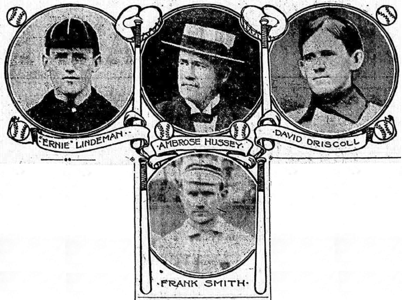
Ambrose Hussey and three stars of the 1911 Ridgewoods
Max Rosner tried to emulate such success, first with the Paramount Club, then with Cypress Hills,
but could not build such a powerful team as Hussey's Ridgewoods. Eventually, with
the financial help of promoter Nat Strong, he bought out the Ridgewoods when Hussey retired from
semipro ball in 1913, and renamed them the Bushwicks in 1914, when, briefly, Ambrose Hussey, Jr.
formed a new Ridgewood club to share the grounds. The Bushwicks remained at Wallace's
Grounds until September 1917, when the grandstand burned down. Starting in 1918, the Bushwicks
moved to Dexter Park, in Woodhaven. When Nat Strong died in 1935, Rosner was left as the sole owner
of the leading semipro franchise in New York.
The Bushwicks would take on all comers- other semipros, Negro League teams, Cuban nines,
and powerful major league squads. The likes of Babe Ruth did not intimidate the Bushwicks.
They also toured other places- traveling to Venezuela
and winning the Serie Interamericana, a forerunner of today's Caribbean World Series, each year from
1946 to 1949. A few players played for both the Bushwicks and Dodgers at some point in their
career- Dazzy Vance, Gene Hermanski, Overton Tremper, and Leon Cadore among them. Of these, former
Penn baseball captain and local high school star Tremper was by far the least
notable Dodger, but the most notable Bushwick. He played from 1931-34 with Rosner's squad as
an excellent outfielder. The club also passed up some remarkable talent- a hard hitting but wild
pitcher from Commerce High School in Manhattan, named Lou Gehrig, was given a tryout in 1920 but
didn't make the squad.
1946 Bushwicks in Venezuela, Overton Tremper
The Bushwicks' attendance was always good because tickets were cheap, and they had no trouble
attracting quality talent to the park. But eventually, with the Negro Leagues disappearing,
many reliable opponents no longer existed. The advent of television and a consistently successful
Dodger team probably hurt, too. The money dried up. The Bushwicks tried a series of gimmicks,
including adding motor racing to Dexter Park, but folded after the 1951 season.
The second best known Brooklyn semipro team of the Bushwicks era was the Bay Parkways, who played
at Erasmus Field, the home park of Erasmus Hall High School. Tremper also spent some time with the
Bay Parkways, after he left the Bushwick club. Future major leaguer Pete Gray starred in a brief
but spectacular stop with the Bay Parkways despite having only one arm.
The most notable Bay Parkway players, though, were recently retired major league icons looking
for fun and a payday. Carl Hubbell played a game against the Bushwicks in 1933, as did Babe Ruth
on October 13, 1935. He faced Bushwicks pitcher Dazzy Vance at Dexter Park, and went 1 for 4
with a home run in a 3-2 loss. Hank Greenberg played a few times for the Parkways in the late
1930s, also.
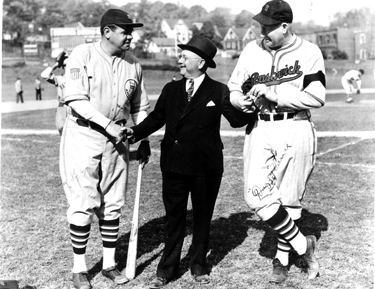
Babe
Ruth of the Bay Parkways with Max Rosner and Dazzy Vance of the Bushwicks
The Bay Parkways were owned by Max Rosner's younger brother, Joe. Both
teams were part of the Inter-City Baseball Association, a group of semipro teams providing a guaranteed minimum
schedule for all, but also a guaranteed income for Nat Strong, who controlled most non-major league ball
in the New York region. In the late 1930s, these teams and opponents such as the Mount Vernons and
Springfield Greys competed for the Metropolitan Baseball Association pennant.
Of course, Brooklyn was home to many more than two semipro teams - others included the Bay Ridge Club, the Sunset Club, the
Arctic Polar Bears, the West Ends, the Suburbans, the Hawthornes, the Martense Athletic Club, the
In-Er-Seals, the Loughlin Lyceums, and the Edisons - but time and sanity prevent us from being complete in this regard.
Standards varied widely, from social teams accepting money simply to cover rent on a field, to hired ringers
on the far more serious forerunners of today's corporate and church softball teams, to the highly
organized profit making enterprises of Hussey, Strong, and Rosner. In fairness to themselves and their
opposition, teams would advertise for opponents of like standard, stating opponents defeated, or
using terms such as "light" and "heavy" semipro. Some of the many clubs are mentioned along with their
home fields on our page of other
parks.
Today, semipro ball is much harder to find. One remaining league is the Pedrin Zorrilla Baseball League,
which plays at the main City Line Park field in East New York. Many of the players are former
minor leaguers, hoping for a return to the professional ranks, mostly in vain. Almost all are of
Hispanic heritage.
Many thanks are due to Jane and Douglas Jacobs for access to their paper, Dexter Park: Brooklyn's Other Ballpark, which
helped us a great deal in putting this and the Dexter Park page together.