Some Other Ballparks in Brooklyn
The major entries at this site are for parks which hosted professional or major semipro baseball
matches, and large amateur, scholastic, and public venues of historical significance. That still
leaves out a huge chunk of local baseball history, of course, as well as places where professional
teams played (or tried to play) just once. Here are as many of those missing parks as we can track
down.
Most of these parks no longer exist - even in the 1860s and 1870s newspapers regularly reported
teams moving to new grounds due to the progress of building works. Much amateur baseball migrated
to the Parade Ground, and professional and semipro ball to the few larger ballparks available.
Today, of course, many public parks in Brooklyn feature softball fields or full sized baseball
diamonds, often in large numbers, taking care of a demand which once saw a ballfield on every
second block. We have tried to include all of these, and continue to search back through the
years for more.
The lists on this site were partially sourced from Long Before the Dodgers by James L. Terry, and from
the collected papers of Bill Cahill - who has been there and done that before us with spectacular
success - at the Queens Borough Public Library, with numerous corrections, additional parks, and other
material gleaned from over 160 years of contemporary newspapers, maps, and just wandering around
Brooklyn to see what's here. There is certainly no way to list everywhere in Brooklyn that has
hosted baseball. The odds are pretty good that on any block in Brooklyn you are within throwing
distance of a former or current ballpark.
A word or two about method: Many 19th and early 20th century ballparks had no proper name. We have
chosen here to grant club names to parks without other clear names, based on the most prominent or
the earliest tenant we could find. For such parks, newspapers would mostly use references such as
"The Gotham Club of New York played the Resolute Club of this city on the grounds of the latter."
In a few cases a park was consistently referred to only by its address, and in those cases we have
named it thusly. If there is a famous club obviously missing, they probably played at the Parade
Ground, or perhaps they are just missing. Information is patchy, to say the least, and researching
many of the less active grounds is difficult at best. We cannot guarantee that we have not
presented two fields as one, or one as two, somewhere in this page.
Any corrections, help in making this list a little more complete, or stories for
the lesser known parks, would be most welcome.
Knights Oval
Greenpoint Avenue and North Henry Street.
The semipro Knights of Saint Antony played here in the 1910s. In a thrilling match on May 26,
1912, the visiting North Woodsides took an 11-10 victory, but only after the Knights had scored
twice and loaded the bases in the bottom of the ninth. An even better match was to take place on
September 2 of the same year. The Knights of St. Antony Cubs fought St. Raphael's Juniors
for 3 hours and 25 minutes in the rain, with both starting pitchers going the distance. The Knights
squad finally won, 3 to 2, when Cole drove in Donohue with two out in the bottom of the nineteenth.
Losing pitcher Meyers struck out 25 in a heroic effort.
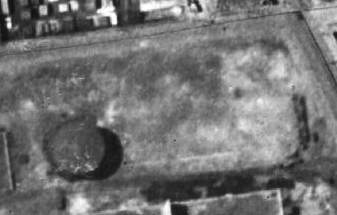
Knights Oval in 1924
Picture
from NYCityMap
Muffin Grounds
Fulton Avenue (now Fulton Street) opposite Ryerson Street.
The Muffin Base Ball Club of Bedford was organized in August, 1860, with W. Teevan appointed captain
of the first nine. Play days were Tuesdays and Fridays.
Fulton and Brooklyn Avenues
As stated - Fulton Avenue is now Fulton Street.
A match between the Athletic Club and the Jerome Park Club of the Bronx was scheduled to take
place at this location on September 20, 1867.
Sumner Athletic Club Grounds
Putnam Avenue and Sumner Avenue (Marcus Garvey Boulevard).
The Sumner Club joined in the amateur competition in 1886 and 1887, which was organized by
the Nassau Athletic Club. This ground also saw matches in the local Insurance League. On
October 8, 1886, Equitable defeated New York Life 22 to 6. Doremus of Equitable hit a
home run grounder with the bases full - perhaps a consequence of the "unevenness of the ground."
Henry Eckford Ground (I)
Terminus of the railroad, Greenpoint.
Not to be confused with the Eckford Club, the Henry Eckford were a similar but lesser team
from the docks. Both senior and second nines played at this ground in the early 1860s. Guy Holt
of the Henry Eckford represented Brooklyn in representative matches against New York, although
the club was at that time considered a New York club, being outside the City of Brooklyn. On
August 27, 1863, the Henry Eckfords defeated the Mystics 26 to 16, despite the Mystic nine
including W. Kelley of the mighty Atlantics.
A later Henry Eckford Ground (II) was at 63rd Street and 3rd Avenue in Manhattan.
Taylor's Oval
Greenpoint Avenue, Morgan Avenue, Nassau Avenue.
Home to the Rambler Club Juniors and Midget squads around 1912. In
1914 the carnival to support St. Cecelia's Church transformed Taylor's Oval into a "miniature
Coney Island" complete with fire divers, German and Irish villages, merry-go-rounds, a dance
pavilion, and 12,000 electric lights to entertain a crowd of 10,000 people.
Penny Bridge Grounds
Meeker Avenue near the Penny Bridge.
This ground saw amateur games in the 1890s. In 1894, a best three of five series was scheduled
between the nines of St. Aloysius and St. Cecilia's Chruches. On September 1, St. Aloysius took
a tense match, 17 to 16, and with it the series and the silver cup donated by Mr. William Reilly
of Monitor Street.
Leary's Oval
Kent and Provost Streets.
Also known as St. Alphonsus Oval. After World War I, the St. Alphonsus squad, formerly of Bay
Ridge, reappeared at Leary's Oval in
Greenpoint. Here they took on such teams as the Brooklyn White Sox, St. Mary's of Staten Island,
and St. Christopher's Colored Stars of New York. On June 29, 1919, 1,200 fans saw the U.S.S. Mexico
nine play a gripping game against the home side, going twelve innings, with the teams managing just
nine hits between them while striking out 29 times. The sailors emerged victorious, at last,
1 to 0.
Greenpoint Little League Fields
Vandervoort Avenue and Division Place.
These three fields stand at the north end of a large block in industrial Greenpoint, owned
by the National Grid company, formerly Keyspan. A sign in center field of field number 1
reads: National Grid & Greenpoint Little League "A Winning Team."
The lot was originally donated by the Brooklyn Union Gas Company in 1953, and the employees of the
Socony Vacuum Oil Company volunteered their time and effort to create the fields. The Greenpoint Little
League has operated here continuously since its opening day on May 23 of that year.
On July 1, 2009, Vasallo Trading defeated Rozza Plumbing 14 to 1 to take the Greenpoint Little League World
Series by a 2 to 0 sweep. Rocco Loguercio hit a grand slam in the first inning, and Lukas Burton gave
up no hits before being removed for hitting the 85 pitch limit.
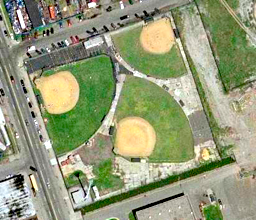
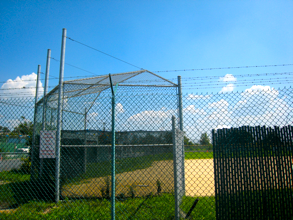
Greenpoint Little League Fields
Overhead photo taken from Google Maps
National Grid Field
Vandervoort and Maspeth Avenues.
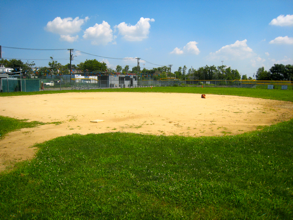
At the far south end of the same block is National Grid Field, formerly Keyspan Field. The stone strewn diamond is
home to the Lady Bears softball team, representing Division III St. Joseph's College in the Hudson
Valley Women's Athletic Conference. The team's history dates to 2002, and 2009 was their most successful
year to date, compiling a 26-10 record en route to championships in both the regular season and
the conference tournament. On April 18, 2009, Alyson Chiaramonte hit one batter but was otherwise
perfect in striking out 13 and no-hitting New Rochelle for a 12 to 0 victory.
When the landmark giant gas tanks on this block were razed in July, 2001, the local community
feared that Keyspan Field and the Greenpoint Little League Fields would be removed, also. But nearly
a decade later, the fields remain, as busy as ever.
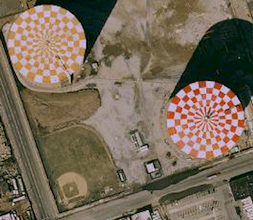
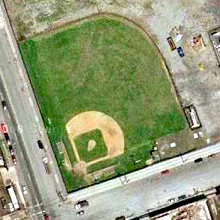
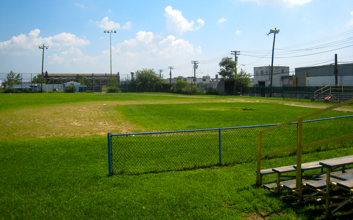
National Grid Field, before and after gas tank demolition
Overhead photos taken from
NYCityMap and Google Maps
Greenpoint Oval
Norman Avenue and Dobbin Street.
Also known as the Greenpoint Athletic Club Grounds. The Greenpoint Athletic Base Ball Club played here in
1895, playing such squads as the Young Men's Union of Brooklyn and the Metropolitan Life Insurance
Athletic Club.
The Greenpoint Field Club played here around 1912, tying a superb game with the Harrison Travelers on
October 8 of that year, 2 to 2 after 11 innings. Greenpoint left fielder Barry saved a run, and the game,
with a great throw to the plate in the ninth inning, and the Harrisons' Brenser "made one of the best one
handed running catches ever seen at the ground."
Greenpoint Oval was also home to the semipro Municipal Field Club - a picked nine of players from clubs
in the Municipal League - in 1913, hosting such visitors as the Gibsons. The Municipals advertised for fast
opponents, offering "reasonable inducements for strong teams."
Loughlin Oval
Kingsland Avenue and Jackson Street.
Also known as the Williamsburgh Athletic Association Grounds. The Williamsburgh A.A. organized in
1889 and competed at these grounds from 1891. The Loughlin Lyceum semipro baseball team played
here from the early 1900s. The Loughlins were a tough squad for
over three decades, matching up well with highly regarded nines such as the Maujers and Knights. Top
negro clubs such as the Cuban Giants were regular visitors, also. The Loughlins were good enough
to be invited to Washington Park to play the Superbas in a pre-season exhibition in 1910.
In 1907, the Loughlins took up a prevalent local ruse for circumventing Sunday baseball laws,
insisting on the presentation of a Loughlin Lyceum membership card to enter the grounds.
At Loughlin Oval in 1910, 6,000 fans saw Henry Batterman & Co. of
Brooklyn defeat O'Neill-Adams of New York, 10 to 4, to win the Department Stores League pennant.
In 1912, "one of the biggest attractions ever booked" at Loughlin Oval saw the New York Bloomer
Girls take on the Boston Bloomer Girls in a championship baseball match.
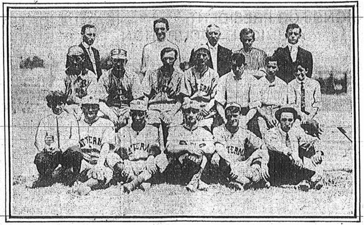
H. Batterman Company's champion squad of 1910
McGolrick Field
Morgan Avenue and Jackson Street.
Also known as McGolrick's Field and McGolrick Stadium.
Opened in 1917, this field was built at a cost of $50,000. Monsignor McGolrick of St. Cecilia's church
was responsible for the field, and was open for the use of all in the Greenpoint area, not just members
of that congregation. The grand stand seated 1,000 people, and the field was surrounded by a ten foot
high stone wall. The field also had its own flag designed, in purple and white, the "colors proper to
a monsignor."
The Loughlin Lyceum team played matches here, starting with an exhibition against the In-Er-Seals
during the field's grand opening on July 15. Other teams to call McGolrick Field home included the
Glenmore Cardinals in 1926 and the Porto Rican Stars in 1938. Track and field, boxing, and soccer were
also common at this field.

McGolrick Field in 1924
Picture
from NYCityMap
Osceola Club Grounds
Fourth and Fifth Avenues, and Dean and Wyckoff Streets.
Also home at various times to the Quickstep, Washington, American Eagle, Exercise, Hiawatha, and Favorita Clubs, and
possibly the Dean Street Croquet Club. In 1858, the earliest match we can find at this site saw the second nine of
the Osceola Club defeat the Hiawatha first nine by a score of 46 to 30 in six innings. Play was reportedly poor
on both sides.
Superior Club Grounds
Henry, Union, Clinton, and Sackett Streets.
On October 10, 1857, the Superior second nine defeated the Montauk first nine 34 to 32, in
a ten inning affair.
Vigilant Club Grounds
West of Fourth Avenue between Sixteenth and Middle Streets.
Also home to the superbly named E. Pluribus Unum Club. A classic seven inning game was played at these grounds in
September, 1858. Trailing 23 to 20 in the middle of the sixth, the Sylvan Club scored nine runs, but the Vigilants
scored nine themselves in the top of the seventh, and shut out the Sylvans in the bottom of the inning to win
32 to 29.
Exercise Club Grounds
Third Avenue and Tenth Street.
Play began here around 1859. At one time, this ground was also home to the Vigilant Club, and possibly the Solomon Club.
In a match between the Vigilant and Exercise teams in 1860, Vigilant catcher Messerole was struck in the face by a foul
ball. Distracted thereafter, the Vigilants played more carelessly than their name indicates, and lost 29 to 14.
Contest Club Grounds (I)
Third and Fourth Avenues, 23rd and 24th Streets.
The Contest Club was a junior nine, the first organized in Brooklyn, dating to 1857.
The club remained undefeated as Junior Champions until a loss to the Mohawk Club in 1861.
Other opponents included the Starlight Club of New Jersey.
Contest Club Grounds (II)
Third Avenue and 12th Street.
The Contest Club was reorganized in 1865, by its old members, and competed with junior
nines that season before graduating to the seniors in 1866. Practices were held at the grounds
every Tuesday, Thursday, and Saturday. Against the more seasoned
nines, success was mixed. But the signal result of the Contests of 1866 was a 57 to 13 win
over Greenwood at the Contest Grounds, on July 7. The club, then said to boast forty members
strong, would survive for several decades to come.
Belmont and Railroad Avenues
This was one of many fields laid out on more or less undeveloped lots in East New York for the
Uptown Church League. The field at Belmont and Railroad Avenues was home to the Glenmore Avenue
Presbytarian Senior team. The Glenmores defeated Wesley Seniors in the last game of the season,
7 to 6, finishing the season with a 12-2 record, taking the title and the William Dappart Cup
by a three game margin.
Bradford Street, Dumont Avenue, and Livonia Avenue
This ground hosted the home games of the Williams Avenue Methodist and Episcopal team during the
Uptown Church League season of 1916. The Williams Avenue squad had a poor season, never contending
for the lead in the league, and finishing with a 4-10 record.
Linwood Street near New Lots Road
This field was home to the St. Barnabas and Wesley teams during the 1916 Uptown Church League
season. Wesley finished in a three way tie for second, while St. Barnabas blanked Goodsell, 5 to 0,
on the last day to climb into a tie for fifth at 5-9.
Essex Street two blocks south of New Lots Road
Now Essex Street and Linden Boulevard.
This field also hosted the St. Barnabas and Wesley squads in 1916.
Crescent Street and Sutter Avenue
This ground was used sparingly in the 1916 Uptown Church League, seeing the Glenmore Avenue
Seniors tangle with St. Barnabas on August 12 in a "batting bee." St. Barnabas scored five
in the top of the eighth inning to take a 16-13 lead, but the Glenmore Avenue nine was up
to the task, scoring four themselves in the bottom of the ninth for a 17 to 16 win.
Bradford Street and New Lots Road
Now Bradford Street and New Lots Avenue.
Another rarely listed Uptown Church League ground, this site saw Euclid Avenue Baptist
scheduled to play Williams Avenue Methodist and Episcopal on July 22, 1916. The Euclids failed
to realize that Williams Avenue had home grounds, however, and waited at their own grounds in
vain. Williams Avenue claimed a 9 to 0 forfeit score. A week later, Arlington did find the grounds,
and defeated Williams Avenue 18 to 2.
Belmont Avenue and Crescent Street
This was home to the Goodsell Junior team for some games of the 1916 Uptown Church League, seeing them
host the champion Glenmore Avenue team on July 22. The Glenmores took a well played game, with
400 spectators present, 4 to 3. The crucial two runs were scored on an error by Goodsell's second
baseman.
Blake Avenue and Crescent Street
This field was home to the Glenmore Avenue Juniors for the Uptown Church League season of 1916.
After the Glenmores beat Wesley Juniors 11 to 10 in ten innings, to force a tie at the end of the season,
a three game playoff was arranged at Blake Avenue and Crescent Street. Despite taking a dramatic second
game 13 to 12, Wesley could not keep Glenmore Avenue at bay, and they completed a sweep of the senior and
junior titles.
Cypress Grounds
East New York.
The Cypress Club of East New York played here from around 1866, not always with great success. On August 21,
1867, the Peconic Club visited and emerged victorious, 58 to 17. The Eagle's reporter was impressed with the
Cypress Club's supporters: Too much praise cannot be given to the partisans found on the ground for the
impartial sentiments expressed. Comment is unnecessary. Peconic's pitcher, J. Potts, not only played his
position well, but scored eight runs for just one hand lost.
The Grounds at Ridgewood and Railroad Avenues
This field was owned by former Players League mastermind John Montgomery Ward.
The Cypress Hills Club of the 26th Ward played at this ground from 1900 to 1902, its members boasting
that it was the "only uniformed team in East New York having its own grounds." A circular to this effect
advertised a game on April 6, 1902 - a Sunday - against the Dewey Base Ball Club. A thousand people braved the rain
to see the game, but after three innings, with the Cypress Hills team leading 5 to 1, the police arrived
to put a stop to proceedings. The players protested that Captain Colligan had allowed the game, and the
police countered that Captain Dunn had not, and had heard complaints. These likely came from the Rev. Althoff
of the Euclid Baptist Church, who had spent much of 1901 threatening to take the matter of base ball at this
ground to the courts. The game was halted peacefully and without any arrests.
Howard Grounds
Atlantic and Alabama Avenues.
The Howard Grounds were so called for being part of the property of Colonel Reid's Howard House, a large
and extremely popular hotel of East New York, perhaps best known as the scene of a riot of disgruntled
Union soldiers from the nearby barracks in August, 1862.
The East New York Cricket Club, its old grounds having been taken over for military purposes, moved here
in 1862. In base ball, the Howard Grounds were suggested as a potential site for the infamous decider between the
Excelsior and Atlantic Clubs in 1860, but the match ended up at the Putnam Grounds instead. In 1866, the Typographical
Club played here against the "hitherto invincible" World team from New York, and won by a 30 to 20 score. The game was
"very prettily played throughout." The Typos' third baseman, DeNyse, scored six runs and was put out just once.
Greenleaf Oval
East New York.
This field saw a number of matches in the Uptown Church League season of 1914.
On August 29, Goodsell Methodist and Episcopal defeated Shaw Avenue, 10 to 7.
Brighton Beach Field
Brighton Beach Avenue and Corbin Place.
Also known as Brighton Beach Oval.
In 1922, a major women's track meet took place here, under the auspices of the Brighton Beach Baths Club.
The meet was attended by two of the best baseball players in the country, pitcher Katherine Davis and slugger
Rose Thiede. A baseball throwing contest was added to the program for their benefit, and they also went
through their paces for photographers when the meet was postponed.
In local amateur action on May 28, 1925, the Flatbush office of the Irving
Bank-Columbia Trust Company overcame an early deficit to crush the People's Trust Company nine,
20 to 4. Van Dyne took the victory over Cannon.
Brighton Beach Field was sold off for development later in the 1920s.
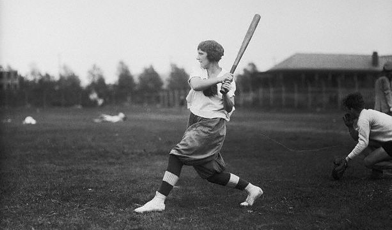

Rose Thiede at Brighton Beach Field, Brighton Beach Field in 1924
Overhead picture
from NYCityMap
Brighton Beach Base Ball Grounds
Behind Brighton Beach Hotel, adjoining the Brighton Beach Race Track.
Also known as Engeman's Grounds. In 1887, on a plot where Buffalo Bill's Wild West Show had performed for a time in 1883,
and Charlie Byrne had unsuccessfully negotiated to build a park in 1885, new base ball grounds were built at a cost of
$15,000. A cinder track of a third of a mile length was included, and the stands from the Wild West Show were extended
and covered. Admission was set at 15 cents, or 25 cents for grand stand seats. Immediately south of
the Brighton Beach Race Course, the field was intended to provide Sunday baseball for the crowds attending the
amusements at Coney Island. The grounds had many well thought out features:
They are about 500 feet long and sufficiently wide to prevent any ordinary batsman from driving the
ball out of sight of the spectators. The grand stand, which affords a full view of the grounds,
is situated on the east of the field. It has a comfortable seating capacity of three thousand, which
can be greatly increased if necessary. The diamond will be arranged so as to require the batsman
to face northeast, and this, it is thought, will prevent the error that is so often made in laying
out baseball fields, and which compels players in the field to handle balls with great difficulty
on account of the sun being in their eyes.
This was not a good time for a Sunday base ball plan, however. On July 11, the police prevented a game between
the Cuban Giants, billed as the regular star attraction, and the Newark Club. In a scene repeated elsewhere
in Coney Island in other years, police captain John Y. McKane prevented the game at a field he had built, in
his other capacity as Coney Island's number one contractor.
Brighton Beach Race Track Field
Sea Breeze and Coney Island Avenues.
This race track opened in 1879 and was an enormous success for almost 30 years, until the state's ban on
gambling forced a temporary end to the horse racing industry. In the 1890s and early 1900s, there was near
open warfare between the track's owners and the people of Duck Hill, a small section immediately north of the track,
where rickety, unofficial nickel stands had been built for cheaper viewing of the races. Rose Dowd, whose
highly popular grand stand charged a dime and housed many bookmakers along with the locals, was a particular
thorn in the side of the official establishment, and suffered a series of police raids in 1902.
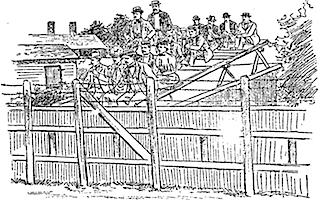
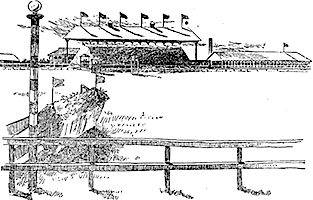
Five cent grand stand patrons at Duck Hill,
and their view of the race track
The race course did see an occasional game of baseball, too. On July 19, 1913, in an era when the track was mainly
used for auto racing, the Brooklyn Board of Real Estate Brokers defeated the employees of Realty Associates
on the Brighton Beach Race Track Field, 26 to 0 in just five innings. The Eagle reported:
Frank Fox, captain of the Realty Associates, was mystified at the poor showing of his team, and attributes
an inability to score to the absence of his best men, who are on their vacation. On the other hand, Charles
Warren of the brokers team declares that his nine was in such fine mettle that even a "pro" team would have had
little chance to score against him.

Long view of Brighton Beach Race Track, with grand stands at right
For a time the track was replaced by a heavily angled motordrome for motorcycle racing, but by the 1920s, the Brighton
Beach Race Track had been sold off and converted to housing lots.
Brighton Baths Field
Brighton Beach and Coney Island Avenues, Brighton 12th Street.
Late in its history, the Brighton Beach Baths featured a tiny playground field in the middle of
the complex. Local tradition applied, with the field placed into the available space so right field
was noticably shorter than left field. The Baths had become most famous by then for being, as the
New York Times put it, the "Rose Bowl of handball." This was not enough to save the institution,
however, and it was sold off in 1994 and developed into what is now the Oceana condominums.

Brighton Baths Field in 1996
Picture
from NYCityMap
West Brighton Little League Field
West Brighton and Sea Breeze Avenues, West 3rd Street.
This field was active in the 1980s, when local author and historian Sam Berkley, who went on
to captain the softball teams at Abraham Lincoln High and SUNY Purchase, was a star
pitcher on the West Brighton team. Sam's description sums up both field and neighborhood perfectly:
We scored a home run either by smacking the ball off the back of the pre-war building or by
hitting it over the right field fence to Seabreeze Ave., where the prostitutes hung out.
As Brighton Beach's demographics shifted fast, towards Russians far less interested in baseball,
the field was out of commission by 1992, although
its sign and diamond remained intact for another 14 years. In 2005, Kevin Walsh, keeper of the
Forgotten New York website, ventured to West Brighton and found an overgrown lot awaiting renewal.
Instead of renewal, however, a 22 storey tower known as The Sachi is now rising, in theory. In practice,
a concrete foundation has been laid, and nothing else has happened.
The West Brighton Little League sign, however, survives. Ira Fritz, who starred for Brighton McDonald's
in the late 1970s and early 1980s and once came within a single strike of pitching a perfect game, returned to the site
in January, 2008. With more than a little help, he left in possession of the sign, and the field
was demolished soon afterwards.
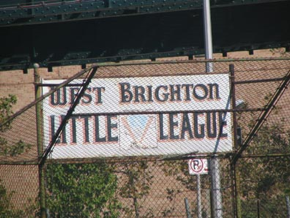
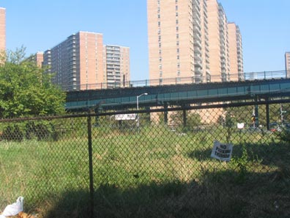
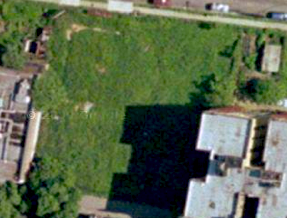
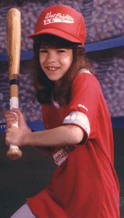
West Brighton Little League Field, 2005 and 2006, and late 80s star Sam Berkley
Sign and field photos courtesy Kevin Walsh
Portrait courtesy Sam Berkley
Overhead photo taken from Google Maps
Sea Beach Base Ball Grounds
Adjoining the Sea Beach Hotel, near where West 8th Street and Surf Avenue meet today.
This field was home to the Sea Beach Railway Company nine, which played matches on Sundays
throughout 1884, without incident, and made the grounds open to children for recreational
matches, too.
In 1885, however, things changed drastically. Charles
Byrne, president of the Brooklyn Base Ball Club, announced his intention to play on Sundays
at Coney Island, this being outside the Brooklyn limits at the time. The Sea Beach Grounds
were chosen, and plans drawn up for a grand stand and free stand, variously reported to
seat anywhere from 10,500 to 30,000 people. In February, reports were advanced, then denied,
that the club had already signed a 10 year lease and assigned contracting work to John Y.
McKane. Meanwhile, the owners of the Brighton Beach Race Track and the editors of the Brooklyn
Eagle weighed in heavily against the idea of pro ball on Sundays.
All eyes were now on Coney Island and its base ball field. Encouraged by the Brooklyn Club, and
no doubt by the revenue potential of professional matches, the Sea Beach Railway Company scheduled
a game against the Granite Club on Sunday, May 3. The match had no sooner begun than eight players
were arrested, at the direction of none other than local police chief John Y. McKane. The two
captains appeared before Justice Newton, at Coney Island, and the charges
were summarily dismissed "as they did not in any way disturb the peace." Justice Waring, at
Gravesend, was not so inclined, however. He fined the remaining six players $2 apiece.
The case dragged on, amid varying reports of work progressing, or otherwise, at the site. The
Brooklyn Club, not afraid to show an interest, filed briefs with the court in favor of the six
players, but the fines stood. The Brooklyns ended up playing Sunday games in Ridgewood between
1886 and 1889, and no professional base ball would be played at Coney Island until 2001.

The Sea Beach Hotel circa 1885, with what appears
to be the Sea Beach Base Ball Ground at back
Coney Island Base Ball and Bicycle Track Grounds
West of the Sea Beach Hotel, where the Big Elephant Hotel had stood.
On April 13, 1898, the Eagle reported progress at this site, a square lot with 300 feet on each side.
Financed by the Coney Island Base Ball and Bicycle Track Company, the ground was intended for amateur,
college, and semipro matches. A grand stand was planned, seating 2,500, and bleachers to seat 5,000
more, as well as a bicycle track a fifth of a mile long. The Greater New Yorks played here for a time,
taking on such opponents as the original Bloomer Girls, but the field eventually failed as a business
proposition. The land was incorporated into Sea Lion Park, destined to become the first incarnation
of Luna Park.
The Ball Field Adjoining Coney Island Police Headquarters
On July 16, 1889, a game was held here between Branch Number 204 and Branch Number 193 of the
Catholic Knights of America. In six innings, Branch 193 took the honors, 6 to 3. One notable
participant was the center fielder for Branch 204, Ryan, who had turned out for the mighty Eckford
Club some 25 years earlier. The Eagle's reporter was impressed by the efforts of all concerned,
considering the conditions: The game took place on the wretched excuse for a ball field which
adjoins the police headquarters of the Island, and never was a game played by good ball players
under such difficulties from a bad field as this was.
Dreamland Park
South of Surf Avenue at West 8th and West 5th Streets.
When Coney Island's legendary Dreamland amusement park burned down in May, 1911, the city was presented
with the opportunity to buy the lot and create a public park. This was done, eventually, after
a cleanup effort that did not end until July, 1914. Even then, Dreamland's metal pier and its supports
remained at the site.

The aftermath of the Dreamland fire of 1911
Dreamland Park was soon active - by August 1, the Parks Department had already
constructed a regulation diamond, for use in the Interplayground League. McKibbin Playground
won the first game, 5 to 0 over Williamsburg Playground, to win the 85lb class championship.
On September 8, Dreamland Park saw its finest game, as McCarren North defeated Pratt 2 to 0, with
Bennett pitching a no hitter. The unlucky loser, Dalton, gave up just three hits himself, and struck
out 12. 100 fans saw the historic match.
With neighboring Seaside Park also drawing much activity, and the automobile becoming an ever more
popular way to reach Coney Island, in 1923 the city decided to turn Dreamland Park into a parking lot.
It still fills that function today, and also houses the New York City Aquarium.

Auto polo on the Dreamland lot, 1913
86th Street and Stillwell Avenue
The Metropolitan Branch played its home games here in the Brooklyn Union Gas Company
League. On August 31, 1909, the employees of the Wholdesale Fruit Dealers visited
and were trounced, 7 to 1. Pitcher Etzrod, said to be "comparatively new in the
baseball field," struck out 12 and gave up just one hit.
In 1910, the Mets won the Gas Company pennant, surviving a desperately close race with
the Newtown Gas Company squad from Queens. When the Newtowns visited the Mets on August 3, they
were heartbroken as the home team scored a run in the bottom of the 8th, and held
on for a 7 to 6 victory. The Newtown Register told the story of the 21 Newtown fans who
took the two hour journey almost to Coney Island, and other incidents of the game:
The home crowd at the 86th street grounds acted like a band of wild Indians. To tell
the truth a whole bunch must have been inflated with B.U.G., the way they carried on.
One of the leading employees at the Metropolitan office, an old guy with glasses, went
around snarling and showing his teeth at every opportunity. Say, it's great what the
old game will do to a person.
B.U.G., neighbor, stands for Brooklyn Union Gas. The one in charge of baseball affairs
at the Metropolitan office had the affront to have the initials blazoned on the shirts
of the Mets, and his stupidity causes the team to get a roasting every time they play
off their grounds. They're bugs all right.
Newtown rooters stood up on the first base line until all hope of victory had gone.
They were there until the last man was retired, when Kelly grounded out to first base.
The rooters for the Mets included a frankfurter "bug," who must have had a stand at the
Island. He used the megaphone to taunt the Newtowners. They put men out of the Polo
Grounds for less than he committed to the "gab" line. He was the worst sort of a pest
and wouldn't dare visit Newtown.
Luna Park Playground
Between West 12th and West 8th Streets, north of the subway line on Surf Avenue.
This field sits at the south end of the Luna Park houses, next to the F and Q subway lines,
and features an artifically surfaced ballfield along with six basketball hoops.
Built on the site of Coney Island's most famous and widely imitated amusement park, the Luna
Park Houses have stood since 1959. The great park itself burnt down in 1944. The playground
was built by the Housing Authority between 1957 and 1962, then granted to the Parks Department.
Artificial safety surfaces and other improvements were added in 1989 and 1990, but as of 2010,
another round of repairs would not go astray.
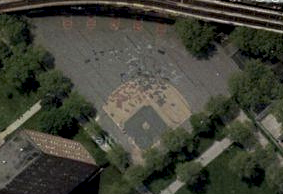

Luna Park Playground
Photo taken from Google Maps
Manhattan Beach Baseball Grounds
Behind the Manhattan Beach Hotel, between present day West End Avenue and Dover Street.
The Manhattan Beach Cycle track was built in 1895 for $30,000 in back of the Manhattan Beach Hotel.
Both were owned by magnate Austin Corbin. Grandstands held 6,000 people and bleachers another 4,000.
By 1906, when William A. Brady bought the grounds and replaced the track with a ballfield, the
stands held 10,000 and the bleachers 5,000.
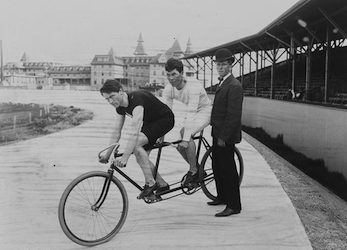
Tandem cyclists in the track, in front of the grand stand, in 1897
From the collection of the Museum of the City of New York
Home Run Johnson and the Royal Giants played the Manhattan Beach Club, yet another to feature the
twirling of Ernie Lindemann, on May 30, 1906, to christen the new grounds. The owners advised that
"those familiar with the track in the days of bicycle racing will not know it when the doors are
thrown open." Manhattan Beach won, 2 to 1, with Lindemann and Emory starring in the pitching duel
in front of 3,200 fans. On June 24, Brady tried to sneak a Sunday game past the authorities when
his Manhattan Beach nine played Altoona. He posted a sign advertising a band concert, and charged
admission for same, while also playing a ball game. Under the instruction of Captain
Lindemann, father of the pitcher (who was not playing at the time), plain clothes policemen arrested
four players after the first pitch was thrown, and that was the end of the match.
In June, 1907, engineer Charles Voorhies, who was in charge of infrastructure work at Manhattan
Beach, announced that the ballfield and stands were to be removed as part of a complete overhaul
of the area surround the hotel.
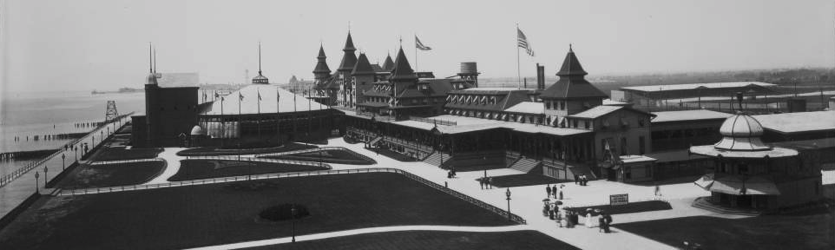
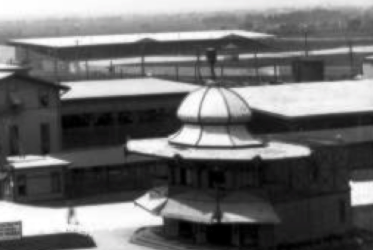
This rare photograph by George P. Hall shows the Manhattan
Beach Hotel, with the cycle track and grand stand at the back, circa 1905.
Niagara Club Grounds
Hoyt Street between Degraw and Douglass.
Jim Creighton played for the Niagara Club before moving to the Stars, then to the Excelsior. The Niagara seemed
a club unaware of its own strength. In September of 1858, they hosted Amity of New York, "expecting to get beat"
but "played careful and batted tip-top" to come up with a 31-8 victory.
Bedford Ground
Degraw Street (now Lincoln Place), Flatbush Avenue, and Ninth Avenue (Now Prospect Park West).
This ballpark, now on the site of Grand Army Plaza, was home to the Albion, Tippecanoe, and Bedford Clubs around 1858.
Matches of ice baseball were also played on the park.
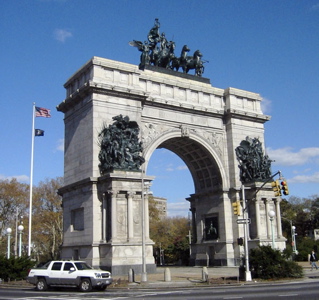
Grand Army Plaza today
Oneida Club Grounds
Lafayette Avenue and Oxford Street.
The new Oneida Club challenged the even newer Lafayette Club to the first recorded match here in 1860, confident of
victory. But the tyro Lafayettes proved too strong, and Oneida called a halt after five innings, trailing 23 to 6.
Ringgold Club Grounds
Washington and DeKalb Avenues.
For some weeks leading up to Thanksgiving Day, 1858, three local newspapers promoted an upcoming game
here between the Ringgold and Oakland Clubs. On the day, the visiting Oakland Club celebrated in style, winning
90 to 34.
Nostrand Oval
15th Avenue and 77th Street.
The Lefferts Park Club played here in the 1910s, against other southerly opponents such as the
Bath Beach Fawcetts. Other events included the 1917 P.S. 176 field meet, and 1914 Independence
Day celebrations with an "old fashioned country circus."
Bergen Beach Grounds
Near Bergen Avenue and Avenue V.
In 1900, the Invincible Athletic Club joined the Eagle Cup interclub
competition, announcing that they had secured new grounds at Bergen Beach. Despite
great anticipation for the Invincible team's first home game against the Knickerbockers, it was
postponed twice, the second time when rain interrupted after just three innings. The situation
did not improve in later years. In August, 1911, the Flatbush and Trinity Athletic Clubs held a
dual track meet at the Bergen Beach Grounds, with Flatbush sealing victory in the final event.
Unfortunately, however: There was to have been a feature baseball game, but the poor condition
of the grounds prevented the rival nines of the Flatbush A.C. and the Democratic Club from
meeting.
The same grounds were used in later years for games of the Royal Arcanum League, and served as home
to the Bergen Beach Baseball Club.
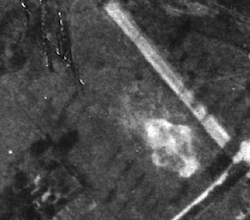
A ballfield at or near the
Bergen Beach Grounds in 1924
Steiner's Oval
Steiner's Hotel, Bergen Beach.
On the sporting fields attached to this beach resort, a match was held in 1909 between the Young
Men's Social Club and the Young Men's Hebrew Association. Steiner's Hotel was renowned for its
Hungarian food and wine, and free dance pavilion. Unfortunately, a fire in July, 1910 destroyed
the hotel.

Steiner's Hotel, Bergen Beach
Union Base Ball Club Grounds
Avenue L near the old road.
The Union Base Ball Club (originally the St. James Literary Union Base Ball Club) of Canarsie
played at these grounds through the 1890s, against such opponents as the amateur champion Sidney
Club and the local rival Alphas. Despite the tragic death of their captain, Frederick Hube, at
age 18 in 1896, the club carried on under the leadership of second baseman John Wilson. In
1898, a horse drawn roller was employed in laying out a new diamond at the grounds, with Captain
Wilson said to have had "every hope that the nine this year will give a good account of
themselves."
Holy Family Field
102nd Street and Flatlands Avenue.
Also known as Athletic Field.
The Holy Family Base Ball Club played games here under lights in the 1940s and 1950s. The team was part
of the Queens Alliance and later the Catholic Youth Organizations League. Holy Family fought for
local bragging rights with the Our Lady of Miracles squad, later known as the Canarsie Dons.
Holy Family won most games against most teams, or, as the Eagle put it, "Winning games became a Holy
Family B.B.C. policy long ago and at this late date the team intends to continue the habit." With
a catcher named Campanella on the squad, it is little wonder they were so good. On July 15, 1947,
the Springfield Cardinals visited Holy Family Field for a twin bill and were handily defeated, 11
to 4 and 14 to 3.

Holy Family Field in 1951
Picture
from NYCityMap
Canarsie Don Field
Avenue K and East 82nd Street.
Also known as Don's Field. This was home field to the Canarsie Dons during the late 1940s and early 1950s, and was
fitted with arc lights suitable for night games. On August 22, 1949, the Bonnie Paws defeated the Canarsie Braves,
11 to 3, in what was believed to be the first game in Brooklyn under lights contested by teams aged under 15 years. Paws
pitchers Tarantino, Saccente, and O'Neill held the Braves to just three hits.
On the football side, Don's Field was home to the Canarsie Bowl, a championship matchup between sandlot football
teams. The December, 1950 game featured the Trojans and Club Jinks.
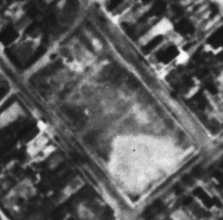
Canarsie Don Field in 1951
Picture
from NYCityMap
Flatlands Oval
East 33rd Street (now New York Avenue) and Avenue K.
Also known as Legion Oval and Flatlands Post Oval. This was a regular site for American Legion games
in the 1920s, featuring such squads as Flatlands Post, Atlantic Nationals, Clinton Field Club,
and the Eries. Baseball games were played on this field, without fail, every July 4 holiday as part
of the city's "Safe and Sane" celebrations.
For Memorial Day in 1921, the Flatlands Post team played the Waterman A.A. nine, then a more unusual
entertainment was planned:
After this game, Schoener's Starfish Giants and McDermott's Cake Eaters will take possession of the
field and stage a burlesque on the national pastime. Both teams will be attired in costumes that will
produce great hilarity. There will be a comedy band and comedy cops and a weird assortment of animals
will parade to the baseball field. Professional clowns will amuse the spectators, and motion pictures
will be taken of all events.
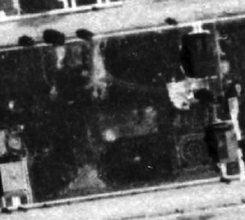
Flatlands Oval in 1924
Picture
from NYCityMap
National Lead Oval
Ralph Avenue and Avenue N.
Games here were often referred to simply as being "at Flatlands."
The National Lead Company Athletic Association called this field home in 1916, playing mostly opponents
in the Drug and Chemical League. On June 19, National Lead defeated the 1915 champion Fougera & Co.,
8 to 2, by a combination of "good hitting, coupled with the visitors' errors." Reif allowed just four hits,
while his catcher, Stewart, scored three runs. On August 16, National Lead scored every time up in a seven
inning game, defeating Lehigh Valley 14 to 5.
We believe this was also Flatland Oval, which hosted the Flatlands B.B.C. semipro team from around 1914 to
1917. Star pitcher for Flatlands in 1917 was Harry Courtney, who went on to pitch for the Senators and
White Sox in the American League. He also briefly signed with the Robins in 1926, but did not make the
team.
In 1918, this site was earmarked for purchase by students and alumni of Erasmus Hall, for an athletic field
to be name Gunnison Field, after the first principal of the school. The plan was well enough advanced that
the field was listed in the 1918 Brooklyn Eagle Almanac under that name. Sufficient money could not be raised,
however, and the proposal fell through.
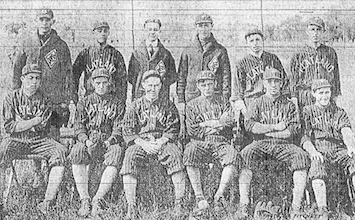

Flatlands B.B.C. in 1914, National Lead Oval in 1924
Overhead picture
from NYCityMap
Jacob Joffe Fields
Avenue K between East 58th and East 60th Streets.
This park was built on land acquired by the city in 1961, and named for Jacob Joffe, a
local immigrant who had founded a civic organization called Futurama in 1950. The ballfields
at the park were renovated in 2000 at cost of $550,000, provided by Concillor Herbert E. Berman.
This upgrade provided a special drainage system which ensures the fields do not flood. The
Brooklyn Meadows Softball League plays games here.
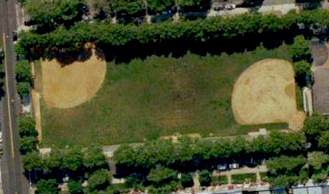
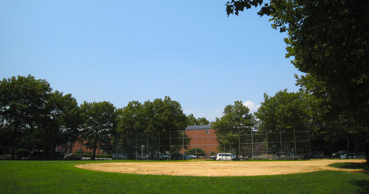
Jacob Joffe Fields
Overhead picture
taken from Google Maps
Washington Club Grounds
North Road and Bushwick Avenue, near Wyckoff's Woods.
The Washington Club chose this old cricket ground when they first organized in 1855. Their first practice at the ground
was on July 18 at which they "performed admirably." Later practices were reported with scores- on August 3, for instance,
the seven of Geo. Madden won over the seven of Jno. Strickland, 31 to 18.
The Flats Near the Junction of Court Street and Hamilton Avenue
Also known as the South Brooklyn Grounds. Games played at this very popular ground were not often
reported in the newspapers, but the Brooklyn Eagle was there on June 29, 1890:
Three or four thousand base ball enthusiasts grilled in the sun yesterday on the flats near the
junction of Court street and Hamilton avenue. This Sunday game is a great feature in South Brooklyn,
the attendance reaching as high as 5,000 or 6,000 people occasionally. There is no church in the
vicinity, and most of the residents not being at all Puritanical, there are no complaints. The
police do not interfere, wisely believing that many of those attending the game would be in worse
places otherwise. There is rarely any disturbance, and not a few people are to be found who say
that there are as good games played on the flats as anywhere. And then the game costs nothing;
there is no gate money; the spectators are not compelled to patronize the saloon keepers, who are
said to support the game with ulterior views of disposing of cool beer to the thirsty crowds when
the game is over. The games are generally played for a stake of $10 or $20 a side, which is
probably put up by some interested person. Yesterday the game was between the Nassau club, of South
Brooklyn, and the Hygeias, of Jersey City. A gentleman of color, said to be one of the Cuban Giants,
umpired the game and gave general satisfaction. The Jerseymen had no show and were easily defeated
by 18 runs to 3. The Nassaus were, however, reinforced by some of the best players of the Hamilton
club, which defeated the Nassaus after an exciting game the previous Sunday.
Larkin's Oval
Bush and Henry Streets.
Also known as St. Mary's Oval, Columbia Park, and Arcadia Oval (II). The Columbia Lodge nine played
here in 1902, the Arcadias of 1907 played here against such opponents as the Village B.B.C. and the
Original Pharos Superbas, and the Catholic League of Brooklyn scheduled matches here in 1909, with
St. Mary's C.C. at home.
On June 20, 1909, the following exchange appeared in the Brooklyn
Eagle:
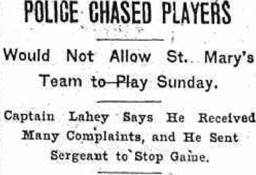
To the Editor of the Brooklyn Eagle:
As manager of St. Mary's C.C. baseball team I want to
protest against the way "Justice" was meted out to my men and their followers last Sunday. I had a
game arranged with another team, and we were ready to play when two officers informed me there would
be no game on account of a complaint by the people living in the neighborhood. As law-abiding
citizens we did as we were told, but noticed the officers, whether intentionally or not, failed to
see a game that was going on just across the street, to which an admission was charged. We
understood that charging admission to a ball game is illegal on Sunday, but know of no law which
prohibits free exhibition in an open field. We hope you will publish this letter to let our
Brooklyn sports know that some teams are being "pounded," while others seem to escape notice.
Hoping some of our friends will see this and give us advice in the matter. I remain,
respectfully yours,
THOMAS J. MULVEY,
Manager St. Mary's C.C.
P.S. Our field is St. Mary's Oval, Bush and Henry Streets.
Captain Lahey, when spoken to about the letter today, said that there was no favoritism
shown or intended. There had been many complaints about the Sunday games at St. Mary's Oval,
which is not St. Mary's at all, the Captain says, but really Larkin's Oval, Larkin being a man
who has a liquor saloon at the corner of Bush and Henry Streets, next door to the oval. The captain
says that the players have menaced the public safety there, according to according to reports
that had reached him, for the left field is in the middle of Henry Street, and once in a while
a ball, hot from a bat, gets there at dangerous velocity.
"This man Larkin," said the
captain this morning, "is something of a politician, and the people in the neighborhood call it
Larkin's Oval. It may be true that the young men of St. Mary's Church play there once in a while,
but it oftener happens that outside ball clubs, having no connection at all with church
activities, play there on Sunday. There is no admission charged, but at the end of the seventh
inning, as I have been informed, a tin dish is passed around the spectators for contributions.
Last Sunday I sent a sergeant and two men down to the ground to stop the game, and I believe I
did my duty.
"Concerning the Visitation Oval, I may say that as it is fenced in with a high
fence it is essentially a private ground, run by the young men of the Lyceum of the Church of the
Visitation, at the corner of Verona and Richards streets. If there is an admission charged I have
never heard of it. The Visitation field is conducted quietly, and there are no complaints of noise
or danger to the neighbors there. It was used by the Sunday School Athletic Union for its games,
and is not in any sense like the place that is so near Larkin's saloon."
Todd Field
Columbia, Lorraine, Bush Streets.
Properly known as Todd Shipyard Athletic Field. This field was used for track meets and soccer
as well as baseball, from 1918. In 1919, future Olympic sprint relay gold medallist Loren Murchison competed
here, and big soccer games were held into the 1930s. On August 14, 1920, pitcher Haley of the
Robins semipro squad shut out the New York Police nine, allowing only four hits in the 2-0
win. Mitchell was the unlucky loser for the Police.
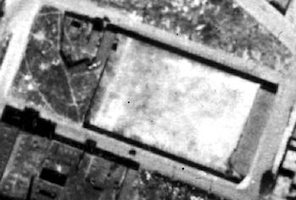
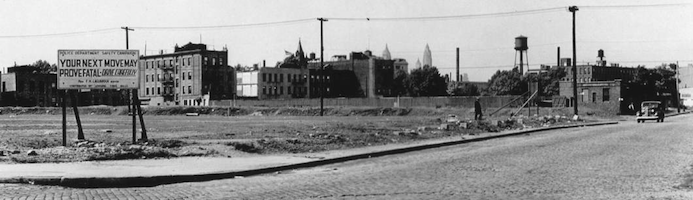
Barren looking Todd Field in 1924, Todd Field without fence in 1938
Overhead picture
from NYCityMap
In April, 1933, workers were tearing down the 20 foot high outer fence here when word spread
that the timber was to be given away as free firewood. The site was rushed by desperate
people who began tearing off pieces for themselves, causing a section of the fence to collapse.
Two victims were hospitalized and several others injured.
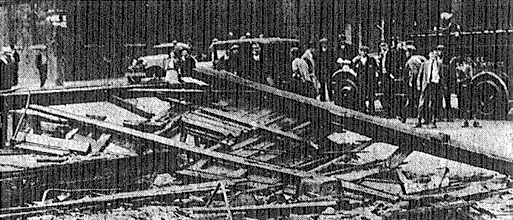
The aftermath of the Todd Field fence collapse
A Lot on Clinton Street
Clinton Street near the Gowanus River.
In August 5, 1934, a baseball game was captured for posterity at this site by Percy Loomis Sperr,
who recorded a great many scenes of life in the city during that era. Some of the players appear
to be dock workers on lunch break, perhaps. This site is probably now part of the Red Hook
Recreational Area.
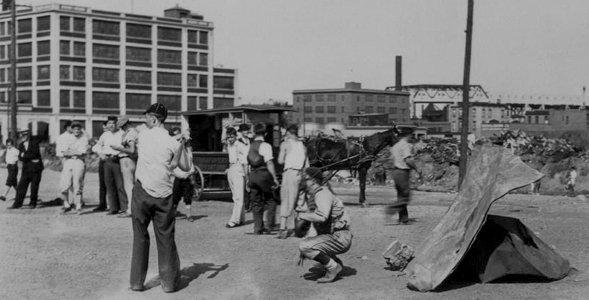
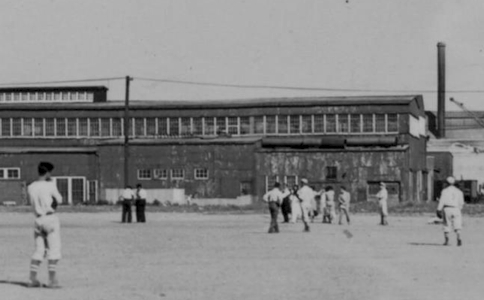
Photographs by the prolific P.L. Sperr
Coffey Park
East of King and Richards Streets.
If Red Hook did not already have enough ballfields, anyone who can't find a space in the massive
Red Hook Park complex can try the painted asphalt field at Coffey Park, which dates to 1901. The
rest of the park features picnic facilities, playgrounds, and century old trees. A renovation
costing almost two million dollars was completed in 1999.
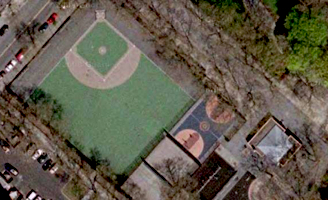
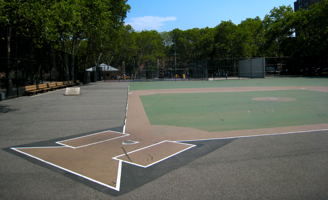
Coffey Park
Overhead picture
taken from Google Maps
Harold Ickes Playground
Van Brunt and Summit Streets.
This ballfield, named for the Secretary of the Interior under Franklin D. Roosevelt, was created
as a result of the massive Brooklyn-Battery Tunnel project. The land was passed to the parks
department in 1951, and houses a massive ventilation shaft for the tunnel, handball courts, and an
asphalt ballfield, complete with dugouts and rubberized diamond.
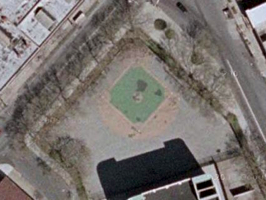
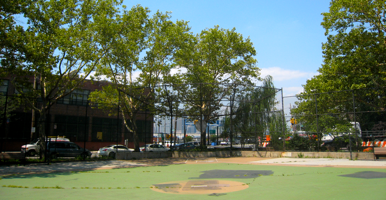
Harold Ickes Playground, in the shadow of the ventilation building
Picture
taken from Google Maps
Van Voorhees Park
Columbia Street and Congress Street, beneath the Brooklyn Queens Expressway.
The land for this park was originally acquired in 1864, then supplemented with further purchases
in the 1940s. It reached its current 5 acre size in 1956 when the BQE was constructed. A number
of renovations in recent years, the last in 2004, have resulted in a modern, nautically themed playground and a
popular artificial surface on the ballfield, which replaced the old asphalt. The Dugout Cafe serves
snacks for the local little leaguers on game days.
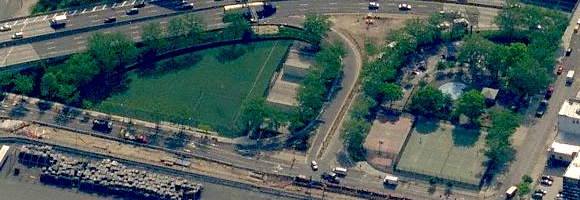
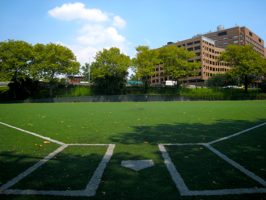
Van Voorhees Park, under the BQE
Aerial picture
taken from Windows Live Local
Severese Oval
Beard and Dwight Streets.
Predating San Francisco's McCovey Cove by more than 90 years, this waterside field must
have provided some interesting moments for the local marine life. In the only game that
rated a mention in the newspapers, the Arcadias and J.N. Robins played here in 1907.
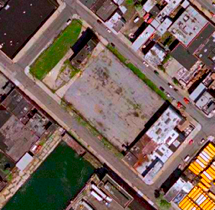
Severese Oval today
Picture taken from Google Maps
Patrick F. Daly School Playground
Van Brunt and Wolcott Streets.
This charming ballfield, one of many in Red Hook, is marked out on a vividly colored artificial surface,
which was beautifully renovated in 2008. On weekends here it is common to see fathers pitching gentle
batting practice for their youngest sons.
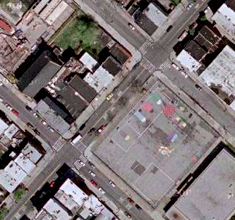
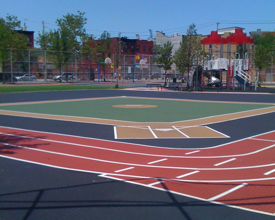
Patrick F. Daly School Playground
Overhead picture taken from Google Maps
Woodbine Grounds
Clinton, Court, Creamer, and Lorraine Streets.
In the 1890s, the Woodbine Club played here on a narrow lot requiring a degree of crowd control -
a policeman would use a rattan cane to keep fans from encroaching on the foul line. Star players
for the Woodbines included shortstop Cahill, whose disagreeable nature on the field earned him
the nickname Stick-in-the-mud, and outfielder Hagan, who played a fine game despite being deaf. Catcher
Richard Butler would later play for Louisville in the National League. One year the club lost
just a single game, 1-0 to Nassau of Greenpoint. Later the Woodbines became
the Hudson Club, and around 1903 many of the players moved to Gowanus to play for the Marquettes.
Heff's Grounds
Clinton and Bush Streets.
Mr. Heffernan, owner of a nearby gin mill, ran matches at this ground in the 1880s. Participating
teams included the Star, Nassau, Dock Rats, Welcome, and Wolcott Clubs. The Eagle reported that
3,000 spectators saw the games each Sunday during 1889, but the subsequent base ball war, and sudden
presence of three major league clubs in Brooklyn, saw attendance begin to dwindle in 1890. A band of gypsies
staying in a small lot behind left field showed Heff the solution, setting up a merry go round,
and turning the far corner of the ball field into an amusement park. Under the name of Splash, it saw
1,000 visitors a night during the summer of 1890, attracted by the carousel and the scups - a kind of
swinging ride - at a nickel a turn. The beer continued to sell, too. Mr. Heffernan was a smart man:
The only thing which mars the otherwise successful resort is the fact that it is not open on Sunday,
but this is where a wide awake Heff gets in his good licks, as the local authority says, by giving
a game of base ball free of charge. This keeps the interest centralized.
Pioneer Grounds
Columbia and Mill Streets.
Also known as Ryan's Oval and Ryan Grounds. In July, 1902, the Manhattan F.C. played the Bedford A.C.
here and made the long trip from Ridgewood worthwhile, winning 25 to 3.
In 1909 the Ryder Athletic Club played here against such opponents
as the Tacomas and the Oak Ridge Athletic Club.
The Pioneer Club opened its tenure here on April 28, 1912, with a victory over the Berkeley
Athletic Club. The Berkeleys did not get a hit until the seventh inning, and only finished with
two, although they did score four runs. The Pioneers, however, scored 20. Pitcher Sweeney and
third basebman Ryan scored four runs each. 500 fans saw the lopsided contest.
Mosquito Lot
Foot of Degraw Street.
Around 1914, the Sacred Heart baseball team played here, with Tony "Champ" Zambrano as the
pitching ace, and his younger brother Tom as team mascot. Tom would recall in the Eagle, years
later: After their games the players would undress right at the wharf and dive in for a
swim.
Wamsutta Grounds
4th Place and Henry Street.
Before World War I and before P.S. 142 was built at this site, there was the Wamsutta Club and a largely vacant space.
The men of the club allowed the local kids from Fourth Place to use their name, and the kids formed
the Wamsutta Base Ball Club. The kids bought equipment by running a raffle to buy "Hop," a local
who had lost a leg in a railway accident years before, an artificial limb. Of course, he already had
one. But they gave him the remaining proceeds and no one was any the wiser.
On April 28, 1912, the
Wamsutta team won a "hard-hitting game" over the White Lilies, 16 to 12. The Wamsutta boys rapped out
22 hits in the victory, while pitcher Gillen struck out 12.
Catskills Grounds
Bond and 3rd Streets.
In the 1910s, the Catskills Club fielded a "scrappy bunch of ballplayers" who were regular rivals
of the Washington Parks, from the other side of the Gowanus Canal. One former member of the Washington
Parks nine later rated the Catskills as their "most formidable foe."
Hamilton Ground
Gates and Grand Avenues.
As well as the Hamilton Club (not to be confused with its rival and namesake in Jersey City), this ballpark was also
home to the Liberty, Albion, Star, and Washington Clubs at various times. On October 8, 1858, the Hamiltons
defeated the Metropolitan Club, 15 to 14. Hamilton pitcher Maxon achieved a rare feat for that era in
the third inning, disposing of the Metropolitans with just three pitched balls, each recording an
out.
Putnam Playground
Throop Avenue, Monroe Street, Madison Street, Marcus Garvey Boulevard.
Dating to the 1880s, P.S. 44 (now the Marcus Garvey School) is a long time Brooklyn fixture.
This playground sits adjacent to the school, and has basketball and handball courts as well
as a baseball diamond, with rubberized paint on asphalt. The sports facilities were created in 2005,
along with an official renaming to Raymond Bush Playground, for a legendary local basketball coach.
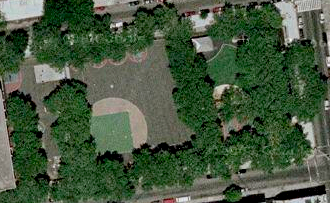
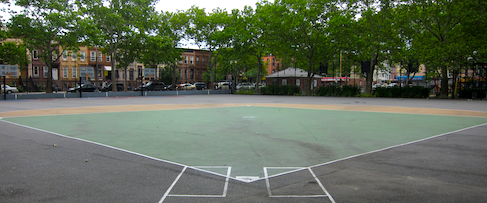
Raymond Bush Playground in 2008
Picture
taken from Google Maps
Jackson Grounds
Grand Avenue and Hickory Street.
The Jackson Base Ball Club of Bedford, organized in September, 1858, played matches here and practiced
on Saturday and Wednesday afternoons.
Brooklyn Base Ball Club Grounds
Bedford and Flushing Avenues, Hewes Street.
On July 4, 1860, a match was held here between the married and single members of the Brooklyn Club, which
a team not mentioned often in the papers.
Firemen's matches at this ground, however, were written up. The firemen of Hose 7 and Hose 6 played a match
here on September 15, 1865. The Sixes defeated the Sevens, 45 to 42. On July 12, 1867, Myrtle Hose 17
and Washington Hose 6 crossed bats, with the Washingtons emerging victors, 42 to 39. Although he wound up
on the wrong side of the result, McDonald of Hose 17 scored 8 runs and was not even once put out.
Hickory Club Grounds
Bergen Street between Underhill and Vanderbilt Avenues.
The Hickory Club was organized in 1860, with John Murphy as president and W.T. Carroll as secretary.
Resolute Club Grounds
Penn and Rutledge Streets, Bedford and Lee Avenues.
Also home to the Phoenix, Oriental of Bedford, and Arctic Clubs. The Phoenix may not have been a great base ball
club, but match notes do mention their post game meals. After a Niagara Club victory on August 31, 1859, they were
"sumptuously entertained" by the locals and "at a late hour took their departure for home, highly pleased."
The Brooklyn Base Ball Club played matches here on Mondays and Thursdays in 1862.
Fawcett Oval
78th Street and 18th Avenue.
Home to the Bath Beach Fawcett Club. In September 1917, Branch pitched a two hitter
against the Colored Giants, but six errors behind him meant he gave up four runs. The Fawcett team
scored nine, however, to win the game.
Glenmore Oval (I)
79th Street and 15th Avenue.
Also known as Missouri Oval.
Having started out playing football games on a disused lot at Cropsey Avenue and Bay 9th Street, the
Glenmore A.C. moved here in time for summer of 1910 and their baseball debut, and stayed through 1912.
The club invited teams to play at West End Oval on Saturdays and here on Sundays. In
their first four football games in 1910, the Glenmores swept all four, scoring 76 points and giving
up none. On September 11, 1911, a game against the local rival Bath Beach Field Club ended in
controversy. Glenmore led 4-2 after eight innings, but Bath Beach rallied in the top of the ninth,
scoring two and having a man on first with none out. The umpire then called the game on account of
darkness, and the score reverted to 4-2, a Glenmore win.
The strong semipro Missouri Pacific Railway Baseball Club also called this field home in 1911, dispatching such
opponents as the Parquettes with ease, and offering to travel up to 200 miles for the right
inducement.
Felbar Oval
20th Avenue and 80th Street.
Also known as Glenmore Oval (II) and Bensonhurst Oval.
The Parkway A.C. played here in the early 1900s, fielding a first and a second nine. The
Bensonhurst Field Club also played home games here around 1907.
The Glenmores played here in 1914, again mixing home games between their own grounds
and West End Oval. On June 27, in their first match here, Glenmore lost a remarkable game to
the Clarion Club, 6 to 4. Starting pitcher Farrell gave up six runs, and left after getting only
two outs. In relief, Bischoff gave up only two hits the rest of the way, but Clarion's lead held up.

McKinley Park
Fort Hamilton Parkway, Seventh Avenue, 75th Street, 73rd Street.
McKinley Park was opened in 1903, and named for recently assassinated President William
McKinley. The Junior Eagle League, around 1917, played games in its Bath Beach and Borough Park
section at McKinley Park. The McKinley Park Club also played here, advertising for
strong amateur opponents. Sports still play a prominent role at McKinley Park, despite the
modern day lack of ballfields - tennis here dates back 100 years.
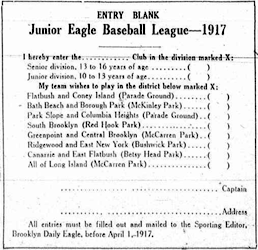

Entry form for the Junior Eagle League, McKinley Park today
Overhead
picture taken from Google Maps
Bath Beach Oval
15th and Cropsey Avenues.
Also known as Thirteenth Regiment Field.
The Bath Beach Field Club played matches here in from 1910, offering a "fair inducement" for fast semipro
clubs to visit. Opponents included the Hollywood Field Club, Curlie's Colored Giants, Trinity Travelers,
St. Brendan's Lyceum, and West End Field Club. At the end of the 1909 season the club advertised that its
new diamond would be "one of the best in Brooklyn." In 1915, the Associated Banks Baseball League played
matches here, as did the Thirteenth Regiment team for a few years, although that squad was more famous for
its feats in indoor baseball at the regimental armory.
On July 20, 1913, the Elmore Athletic Club visited the Thirteenth Regiment squad at Bath Beach Oval, and took
a tense match, 6 to 5. The highlight of the game came in the home team's half of the seventh inning, when
Williams batted with the bases full and none out. He sent a fly ball to right field, where Kenney made the
catch, and the resulting confusion on the basepaths led to a triple play.

Bath Beach Oval in 1924
Picture
from NYCityMap
Elmore Oval
Cropsey Avenue and Bay 11th Street.
Home to the Elmore Athletic Club. On June 16, 1913, the Elmores found themselves down 11-4 against
the Ozanam A.C. of New York after 4 innings, but rallied strongly for a 16-11 victory. Pitcher
Howie helped his own cause with a single, three doubles, and a triple.
Bath Beach Playground
Shore Parkway and Bay 16th Street.
This park dates to 1937, and remains a haven of quiet in this corner of Brooklyn. Large scale renovations
in 1984 and 2000 saw many sports facilities added or improved, and a fresh surface for the little league field.
In 2004 the field was named in honor of the late Victor V. Allegretti, a local businessman and philanthropist. This
field is one of many the Knights of the Dyker Heights Athletic Association call home. In April, 2009,
Community Board 11 heard from Pete McCarthy, president of the association, who complained of the large
amount of waste that needed to be cleaned from the field before games. We leave details to the reader's
imagination.
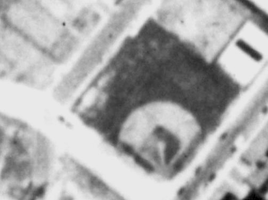

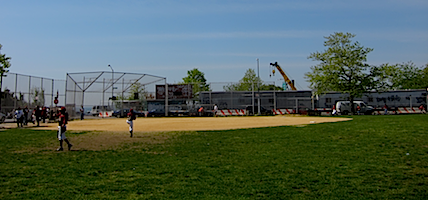
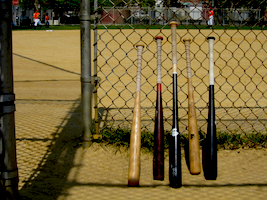
Bath Beach Playground: 1951, 2006, 2010
Overhead photos from NYCityMap and Google Maps
Bay 15th Street and Benson Avenue
In June, 1905, the Married Men of the Woodburn Club played a match against the Single Men. The Singles
took the contest, 7 to 6. The trip to Bath Beach was a considerable one - the Woodburn Club was located
at Sands and Gold Streets in downtown Brooklyn.
Ætna Field
East New York.
The Ætnas, commonly spelled Aetnas or Etnas in the newspapers, are
not to be confused with a club of the same name in Jersey City. This was an athletic club in East
New York that fielded teams for track and field, bowling, and basketball as well as baseball.
On June 4, 1906, the Eleanor A.C. visited and were handed a 26-5 thrashing. Every Ætna player
tallied at least two runs.
Rival Oval
Evergreen Avenue and Pilling Street.
This field was home to the Rival Athletic Club around 1907, hosting such visitors as the Original
Saratogas and Newport A.C. The Rivals were a busy team. In 1908 they defeated the Barnards on
May 23, but not content with that, followed up on May 24 by defeating Original Tigers and
Excelsior Juniors.
Howard Field
Atlantic, Ralph, Howard Avenues and Pacific Street.
Also known as Howard Oval and the Orphan Asylum Playground.
Home to the Howard Club, formerly of Saratoga Park and Wallace's Ridgewood Grounds, and also
home to the Brooklyn Hebrew Orphan Asylum nine and the St. Benedict's Club. In an 8-2 win over Federal
Shipyard on May 21, 1922, the Howards pulled off the first triple play at the field, courtesy of shortstop
Peck. The Brooklyn Eagle reported:
Schafer started the inning with a single, and Patte got a short single, putting Schafer on
second. Nasher at this stage hit sharply to Peck, who made a hurried throw to De Castro. De Castro
threw to Kuhn, whose throw to Zackman nabbed Schafer, who was trying to make home on the play.
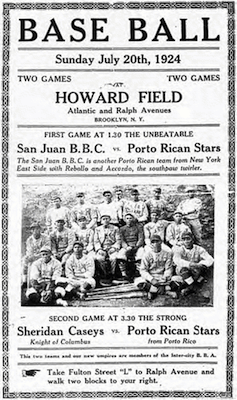
The Porto Rican Stars, a semipro outfit which sadly received almost no newspaper attention
at the time, also called Howard Field home in the 1920s, playing the likes of the Socony Athletic
Association and the Sheridan Caseys.
Like many ballfields, Howard Field had very short right field line, made up for with a net raised
above the right field fence. This net was the cause of a heated dispute on May 1, 1922, when Bushwick High
played the Hebrew Orphan Asylum. With a half inning remaining, Bushwick led, 9 to 8:
In the last half of the seventh and final inning, Spillane walked Mahler, Halprin singled, sending
Mahler to third, Dzigan was called out on strikes and Houser received a base on balls. Mahler was nailed
at the plate on Slotkin's roller to Richards. Rothberg drove the ball into the net stretched along the
right field fence. The ball stuck in the net and Halprin trotted home. Umpire Koftoff, supposed to be
neutral, ran down toward third and coached Houser to cross the plate with the second run. Then the fun
began.
Coach Cohen of Bushwick objected to the second run, declaring that the ball was dead. He called the
arbiter's attention to the rule agreed upon which allowed one base on a ball hit over the right field fence.
The umpire disagreed, saying that a net ball was good for all the runner could get. Coach Cohen demanded
to know why the rule was not made in the beginning of the game. The coach of the orphans' team replied
that it had been made known.
Neither side would give in to the argument that ensued. Finally Coach Cohen asked Umpire Koftoff whether
or not the ball was dead. When the latter replied in the negative the Bushwick mentor claimed the game,
as the fielder had caught the ball after he had shaken it from its resting place. The umpire left the
field when McGinty of Bushwick asked him, "Why did you go toward third base and instruct the second
runner to cross the plate?" The Bushwick players joined in a cheer and everybody left the oval.
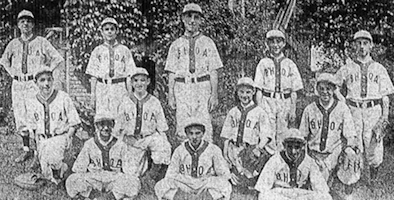
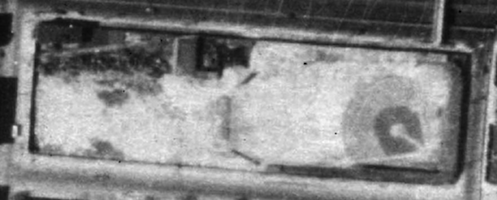
The Brooklyn Hebrew Orphan Asylum squad of 1916, Howard Field in 1924
Overhead
picture from NYCityMap
Crawford Athletic Field
Avenue U, 58th and 60th Streets.
Also known as Monsignor Crawford Field.
These two smaller sized fields have been city parks since 1956, and were revitalized in 2000 at a cost
of $630,000, which was provided by Councillor Herbert E. Berman. Four blocks to the north is
Mary Queen of Heaven Church, which was founded by Father Thomas J. Crawford, after whom the fields are
named, in 1927. In May, 2009, the children of Mill Basin showed off their skills in a Major League
Baseball Pitch, Hit, and Run clinic here. Amity Little League and Good Shepherd Sports
both play at Crawford Athletic Field.
In recent years, the Brooklyn College softball team has played home games at Monsignor Crawford Field.
On April 17, 2011, the Bulldogs took both ends of a doubleheader from the Gryphons of Sarah Lawrence College,
8 to 0 and 13 to 1. Ashley Allen, playing first base, drove in 7 runs over the two games.
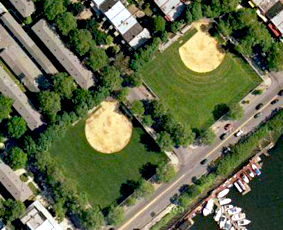
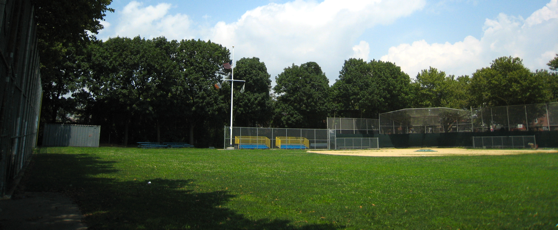
Crawford Athletic Field
Overhead photo taken from Google Maps
Hurley's Oval
Utica Avenue and East 49th Street, north side of Avenue N.
This field was not often mentioned in the papers, but a July 4, 1909 match was scheduled here between
the Elmount and St. Joseph Athletic Clubs. A field remained in place at the same site in the mid 1920s,
but a Transit Authority forerunner built over the lot in 1931.

Hurley's Oval in 1924
Picture
from NYCityMap
James Marshall Power Playground
Utica Avenue and East 49th Street, south side of Avenue N.
This playground opened in 1959, replacing the northern half of a bus depot, and featured a turf softball
diamond at the time. The field became worn over the years, and was replaced by an artificial surface during
1998 renovation work. The handball courts, featuring a wall painted with a giant American flag, are very
popular here, but the bocce court is completely overgrown. The ballfield seems to fall somewhere in between
the two extremes.
The playground is named for James Marshall Power, a veteran of World War 2 whose law work and civic
service in Brooklyn were tireless before his premature death at age 35, in 1957.
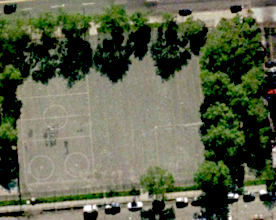

Power Playground
Photo taken from Google Maps
Dean Playground
Dean and Bergen Streets, 6th and Carlton Avenues.
This playground was acquired and opened by the city in 1948, and renovated in 1970 and 2000. Its
name was only officially bestowed in 1987, although locals had called it the Dean Street Playground
all its life. The artificial grass ballfield is a new addition, replacing a cracked asphalt diamond in 2009
at a cost of $1.8 million. The field has proven popular for baseball, with children spotted playing pickup
games there even in the cold weather of November, 2009.
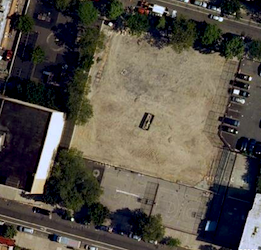
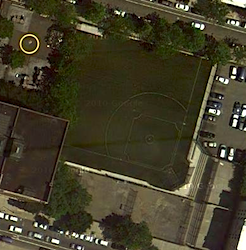
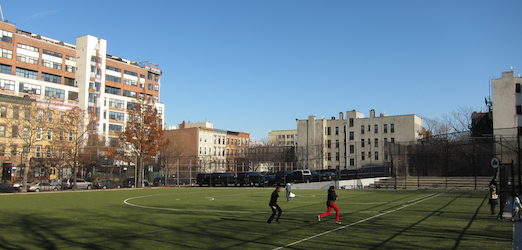
Dean Playground during and after renovation
Overhead photos taken from Google Maps
Franklin Ground
Degraw Street and 6th Avenue.
On September 28, 1858, the Franklin Club hosted the Rough and Ready Club for a junior match here.
The Franklins won, 17 to 9, and the Eagle commented: The young players exhibited considerable
skill in batting and catching.
The Block on Fifth Avenue, Between Garfield Place and First Street
From the Brooklyn Eagle of September 11, 1887:
THE BLOCK ON FIFTH AVENUE, between Garfield place and First street, is
unoccupied and is a favorite resort for the small boy with base ball inclinations. The law forbids him
to enjoy his favorite pastime on Sundays, but he is there just the same and his interest in the game becomes
so extreme about noon that he does not perceive the stealthy approach of the mounted policeman along
Sixth avenue and down well shaded First street toward the opening to the inclosure. But a moment later
there is a sudden sound of galloping hoofs, a shout from the left fielder, "De cop's coming," and
every mother's son yields to the impulse of self preservation. Through the fence and over the fence
they go. One or two even try to climb the trees in search of escape from the fearful "copper" who is
rushing down upon them with his horse. The yard is nearly cleared when the policeman reaches the Fifth avenue
end where the game is in progress, but one or two small urchins are overtaken and collared as the officer
quickly dismounts from his steed. They are not chief offenders, and, grasping them tightly by the
shoulders, the officer shakes them and, after uttering a dire threat as the future, lets them go.
A Lot on York Street
In 1865, the Eagle told the tale of the men who had practised base ball here:
In the fall of 1854, a body of men used to meet in York street, in an open lot where now stands the
Station House, for Base Ball practice. The thought of any future renown never entered their minds, and still
this was the nucleus of the present Champion club of the world. In the spring of the year they became
associated with many of the Atlantic Market boys of South Brooklyn, among whom were Caleb Sniffen,
Lowery, Watson, Peter O'Brien, together with Wm. V. Babcock, George Sexton, Thomas Tassie and others,
and they formed April 14th, 1855, what was then and is now known as THE ATLANTIC
BASE BALL CLUB.
Plank Road Hotel
The Plank Road, Valley Grove.
The Plank Road eventually became Flatbush Avenue, and the Valley Grove area is now part of
Prospect Park. The fledgling Atlantics played a practice match at the hotel on August 16,
1855, in which Loper pitched his eleven to victory over Sniffin and his eleven, 38 to 31 in
three innings. This is the earliest recorded game of the great club.
Oriental Club Grounds
Union Avenue between E and F Streets, Greenpoint.
Play began on this ground in when the Oriental Club of Greenpoint was organized in 1858, with the visiting Niagara
Club winning 28 to 10. The Washington Club of Greenpoint also played here, defeating Live Oak of New York
29 to 18 on June 24 of that year.
National Club Grounds
Hamilton Street and Park Avenue.
Also home to the Morphy Club. The National Club was home to such stars as Lip Pike and Joe Sprague before they went
on to bigger things at the Atlantic and Eckford Clubs.
Borough Park Oval
16th and 17th Avenues, 56th Street.
Also known as Blythebourne Oval. The Blythebourne Club fielded senior and junior nines at this field
from around 1907, taking on such colorfully named teams as Mayflower and Imperial. On August 26
of that year, the visiting St. Joseph's junior squad defeated Blythebourne 19 to 5. The Borough Park
squad played home games here around 1914.
Bath Playground
Bath Avenue and Bay 37th Street.
Ths park was planned in 1963 to accompany the new Junior High School 281. Construction began
in 1968 and the park was opened on September 30, 1970. In 1999, the play area was reconstructed
at a cost of $410,000. The baseball/softball field is asphalt surfaced with painted lines, including
facility for tennis courts, and is also used as a parking lot when out of season.
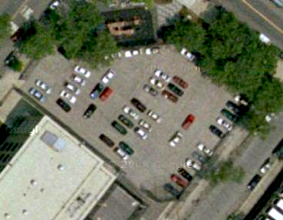
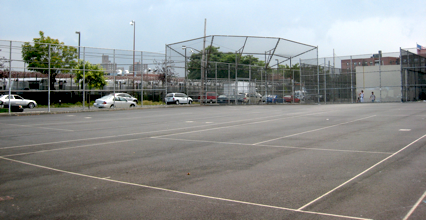
Bath Playground, with and without cars
Overhead photo taken from Google Maps
Scarangella Playground
Stillwell Avenue, Avenues U and V, West 13th Street.
Formerly known as Lafayette High School Playground, this park dates to 1929. It was renamed for
policeman John G. Scarangella, who had died in the line of duty, in 1992. The park was renovated
in 1997 with $92,286 of city money, focused on resurfacing the play area. The ballfield section,
while beautifully green, was very uneven and in need of repair, until a complete resurfacing with
artificial grass in 2011.
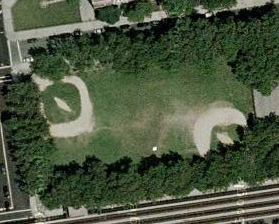
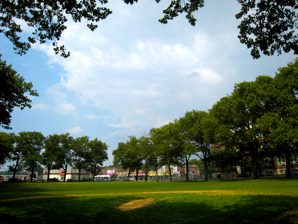
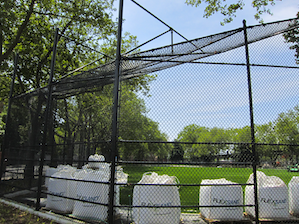
The small but beautiful fields of Scarangella Playground, 2009 and 2011
Overhead photo taken from Google Maps
Lafayette Playground
Stillwell and Benson Avenues, Bay 43rd Street.
This asphalt ballfield is immediately across the street from Scarangella Playground, and shares
its name with another park in Brooklyn, which hosts a basketball court. Both baseball and softball
lines are painted on the surface. This park was opened in 1960, and is jointly maintained by the
Parks Department and the Board of Education.
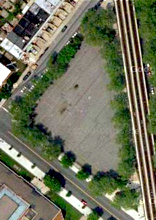
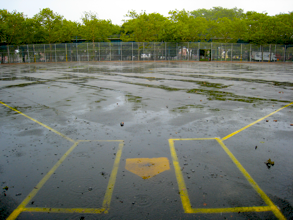
Lafayette Playground, with short center field
Overhead photo taken from Google Maps
Military Field
Knickerbocker Avenue, Johnson Avenue, Morgan Avenue.
Also known as Freeman Oval.
The Military Athletic Club played home games here in 1906, taking on the likes of the Iolas
and the Tammany Tigers in Sunday double headers. The New York Times reported that the July 4
celebrations of 1912 were to include a musical recital at the "Brooklyn Baseball Grounds" here.
On April 11, 1915, 600 fans gathered here for the season opener featuring the Newtowns of Bushwick
and the Bradford B.B.C. The Newtowns won, 4 to 2, behind the excellent pitching of Martinez:
at no time was he in any danger of losing his game.
Ridgewood Exhibition Company Grounds
Maujer Street.
The New York Times and World nines played here on August 11, 1887. The Ridgewood Exhibition
Company was the same one that operated Wallace's Ridgewood Grounds, but this location is far
away in Williamsburg.
The Grounds, Underhill and St. Mark's Avenues
On May 25, 1894, the Brightons played the Duponts here. Things started well for the Brightons,
scoring three runs in the top of the first, but the Duponts hit back, scoring five themselves.
The Brightons, not discouraged, crossed the plate six times in the second inning, and seven
times in the fourth, eventually taking the contest 25 to 10.
St. John's Recreation Center
Bergen Street, Troy Avenue, Prospect Place, Schenectady Avenue.
This park was built between 1950 and 1956 as part of Robert Moses' vision of year-round
active recreation facilities. The three ballfields were opened in 1953, while the indoor
center was still in progress. The asphalt ballfields, fields B and C, are badly cracked with
weeds growing in the gaps, while field A is an excellent grass field with painted brick
bleachers. This is one of the parks which hosts the HealthPlus Citywide Baseball League for
children aged 5 to 15.
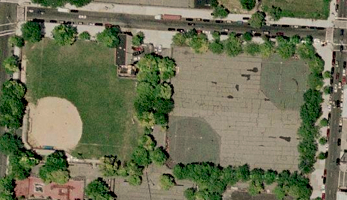
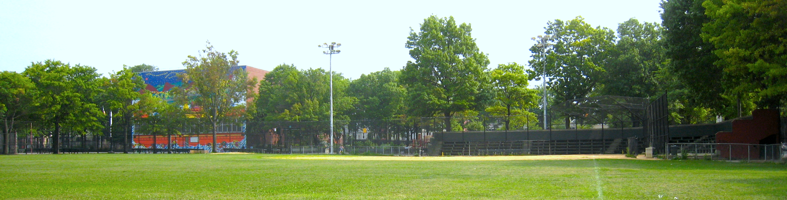
The fields of St. John's Rec Center
Overhead photo taken from Google Maps
St. John's Field
Albany and Troy Avenues, Prospect and Park Places.
Also known as St. John's Oval (III). Just a block away, there once stood St. John's Field, where the St. John's alumni team
played from at least 1912 through 1944. Vic Ehrhorn starred for the Jacks as a hurler, holding the
Brooklyn Shawnees to just three hits on May 21, 1922. Seven years earlier, as a student at St.
Augustine's, he had pitched a one hitter at the Parade Ground.
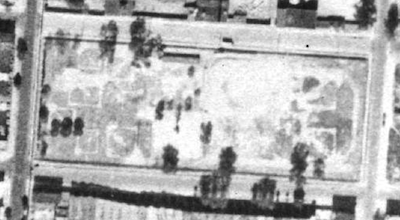
Diamonds of all sizes on St. John's Field in 1924
Picture
from NYCityMap
Maria Hernandez Park
Suydam Street and Knickerbocker Avenue.
The city purchased land for this park and built it by 1896, when it was named Bushwick Park.
The field remained a showpiece for some time, with games of baseball, including the Junior Eagle
League, and croquet a regular feature. On September 20, 1914, the Bushwick Park 85lb baseball
team hosted the team from nearby McKibbin Playground, champions of Brooklyn. On this occasion, however,
Bushwick won a famous victory, 11 to 2. Winning pitcher Kmetz allowed just one hit, although he did
walk ten. A whopping 29 bases on balls were given away during the match.
A new diamond was purpose built in 1930, and rebuilt in a 1941 W.P.A. renovation, but the
park did not prosper in the years to come. Its gradual decline coincided with that of the Bushwick
neighborhood, reaching a low point when anti-drug campaigner Maria Hernandez was shot dead in 1989.
The park was subsequently renamed in her honor, and was substantially cleaned up in 1993. The ballfield
today is rubberized asphalt.
In 1897, in a game at a vacant lot at the same intersection,
13 year old Charles Riesigel was critically injured by a bat that slipped from the hands of 17 year
old John Dreitling, who was arrested after the incident.
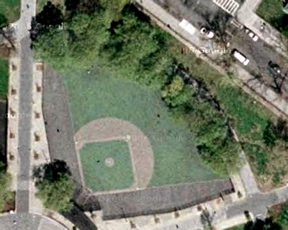
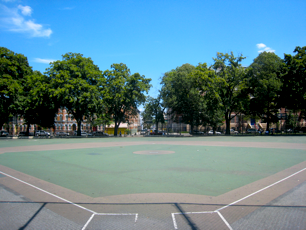
The ballfield at Maria Hernandez Park
Overhead photo taken from Google Maps
McKibbin Playground
McKibbon, White, Bogart, and Seigel Streets.
From the Parks Department's annual report of 1914: Adjacent to the playground, upon a lot
lent to the Department by the Wall Rope Company, the Park forces graded a field for a baseball
diamond and erected a back-stop.
The new diamond was an immediate hit with the local children, so much so that McKibbin Playground
won the 85lb class championship of the Inter-Playground Baseball League. In the 105lb class,
McKibbin won an exciting match at home against Red Hook, 6 to 5 on June 1, 1914. Right fielder
Brodsky rapped out three hits and scored twice, while Nelson's "work behind the bat for the winners
was a feature."
McKibbin Playground, now known as Gilbert Ramirez Park, no longer features a diamond, although its
basketball courts are extremely popular.
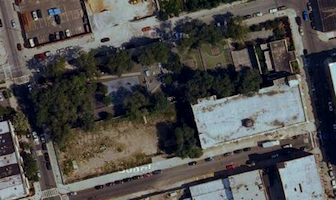
Modern day Gilbert Ramirez Park
Photo taken from Google Maps
Brooklyn Boulevard Grounds
Brooklyn Boulevard (now Eastern Parkway).
Also known as the Boulevard Grounds.
This field hosted baseball and football games from around 1898 to 1903. Scores here were often
high - in a double header on May 30, 1899, some 59 runs were scored by the Seminole and Hercules
Athletic Clubs. The Seminoles took the morning game, 15 to 13, but the Hercules nine took revenge
in the afternoon by a score of 20 to 11. Just four days later, the Seminoles took on the Arcade
Athletic Club and led 11 to 4 at one point before scraping home 13 to 12.
Christ Chapel Oval
New York and Brooklyn Avenues, Brooklyn Boulevard (Eastern Parkway).
Also known as the Brooklyn Avenue Grounds, the Brooklyn Avenue and Boulevard Grounds, and the Indian
Athletic Club Grounds. These grounds were in use as early as 1898. Strangely enough, on June 3, 1899, the
same day as the 13 to 12 game at the Boulevard Grounds, the Hancock Athletic
Club defeated Kings County Juniors here, also by a score of 13 to 12.
From 1906, this field was used by Christ Chapel of the Protestant Church League.
In an 8-1 win over the local rival Pioneers on May 13, 1906, shortstop Douglass' home run was "the
longest hit ever made on Christ Chapel Grounds." Two weeks later, the Lidgerwood team of the Factory
League visited and was "literally overwhelmed" in a 21-4 defeat. The Christ Chapel infielders scored
14 runs between them. On June 9, "Smiling Charlie" Dawe of Christ Church pitched his team to a win
over St. Mark's, despite being knocked unconscious by a batted ball in the fifth inning.
The Indian A.C. was a junior team, and keen to play only teams of the
right age. An advertisement in 1909 included this warning: No dates will be entertained
with clubs who will not give their right average. In 1912, the Indian A.C. squad survived a
long series of playoffs to claim the Junior Eagle Championship of Brooklyn.

Indian Athletic Club's champion 1912 squad
Bushwick Houses
Bushwick and Flushing Avenues.
This ballfield serves the Bushwick Houses complex, completed in 1960, and was originally the
property of the NYC Housing Authority before being handed to the Parks Department in 1983.
There are also pools, basketball, and handball courts here. The ballfield was renovated in 2009,
with $1.4 million from the city and $200,000 in federal funds. The new field is surrounded by
an undulating running track, and features covered dugouts and artificial turf with a brown infield.
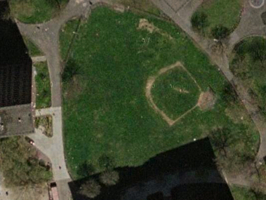
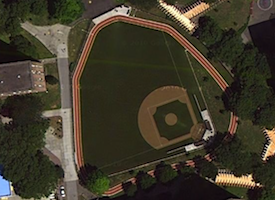
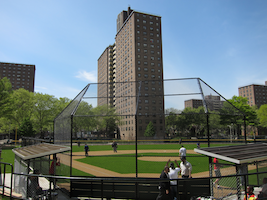
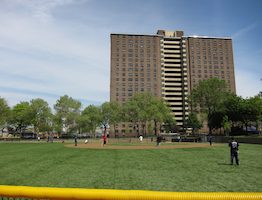
The Bushwick Houses ballfield, overgrown before
renovation and pristine afterwards
Overhead photo taken from Google Maps
Zouave Grounds
Bushwick Avenue and Broadway.
The Zouave Club was formed in August, 1860, by thirty gentlemen "well known to the Eastern District."
Sargeant Thomas Griffin of the 6th police precinct was elected captain. The Eagle expressed optimism:
The character of the gentlemen who compose the club is a guarantee that the Zouaves will make
themselves felt.
Bushwick Ballfield
Knickerbocker Avenue, Grove and Menahan Streets.
Also known as the Bushwick II Houses Playground.
The community ballfield here was created here on a date which remains a mystery to us, although the
sourrounding Bushwick II Houses were part of the Bushwick II Urban Renewal Plan, which began after the
blackout of 1977 and the subsequent riots in this neighborhood. The land was acquired by the Parks
Department from the Housing Authority in 2001.
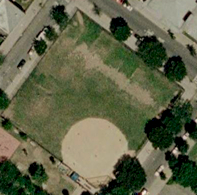

Bushwick Ballfield
Overhead photo taken from Google Maps
Tompkins Houses
Park, Throop, and Myrtle Avenues, and Marcus Garvey Boulevard.
The massive Tompkins Houses project was completed in 1964 and houses over 3000 people. The
ballfield is very well kept by the Parks Department, and the houses have lovely gardens throughout,
despite a poor reputation. The field is regularly used by local residents for softball, as well
as running laps to keep fit.
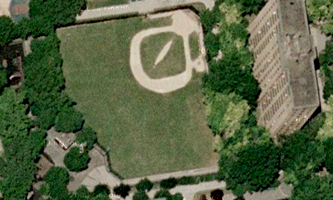
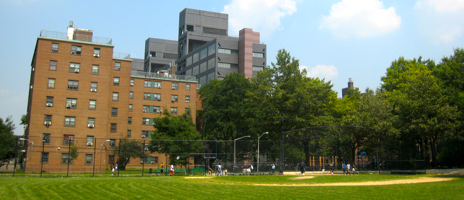
Tompkins Houses Ballfield
Overhead photo taken from Google Maps
Herbert Von King Park
Lafayette and Marcy Avenues, southeast corner.
Originally known as Tompkins Park, this park dates to 1871, although it has seen numerous
changes through the years. The formal design was submitted by Olmstead
and Vaux, and major renovations took place in 1915, 1927, and 1973. The Inner City Sports
Bed-Stuy Little League plays games on the ballfield here, which is a small masterpiece of design.
The outfield fence is decorated with bunting, American flags, and figures in stylized baseball
poses. Aluminum bleachers are available for spectators behind each dugout.
In 2006, after $3,500 in baseball equipment was stolen from the park, the Bed-Stuy Little
League was in jeopardy, but leagues from around the city rallied to raise cash for replacements
and the season was saved.
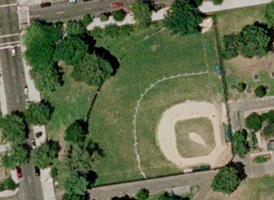
The ballfield at Von King Park
Overhead photo taken from Google Maps
Banneker Playground
Lafayette and Marcy Avenues, northwest corner.
The original park at this site was built by the W.P.A. in 1937 on land owned by the Board
of Transportation. In 1957, neighboring P.S. 256 was built and the park became known as P.S.
256 Playground. In 1985, the city bestowed the name Benjamin Banneker Playground, after the
renowned 18th century mathematician. A major renovation in 1997 saw safety surfacing added,
including a rubberized diamond on the dramatically asymmetrical softball field. When we
visited in 2009, the green rubber had been partially painted light blue.
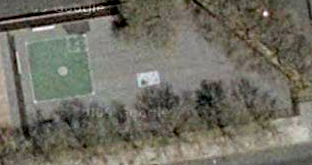
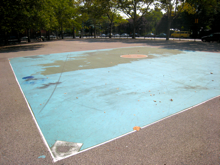
Banneker Playground
Overhead photo taken from Google Maps
Marcy Houses Playground
Myrtle Avenue between Nostrand and Marcy Avenues.
Also known as Marcy Playground.
The Marcy Houses development was completed in 1949 and houses over 4,000 people. The extensive
playground at the south edge offers volleyball, basketball, tennis, and handball as well as
this artificially surfaced ballfield with a highly unusual shape in the outfield. The field saw
good use early - in August, 1951, Seitz Brothers defeated Becker Company 9 to 5 in a six inning
game. Leonard Seitz and Pemberton each homered for the winners, while their teammate Marty Bloom
was 3 for 3 with a triple.
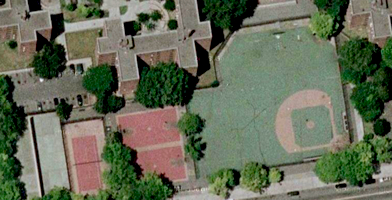
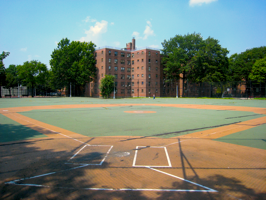
The ballfield at Marcy Houses
Photo taken from Google Maps
Thomas Boyland Park
Furman Avenue and Broadway.
This park, named for the late state assembleyman from Brownsville, was built on land transferred
from the Housing Department to the Parks Department in 1985. $375,000 was spent on renovation
in 1996. Thomas Boyland Park is home to the EBC/ENY Lady Eagles high school softball team, which has
had problems getting matches together in recent years. In a schedule packed with forfeits and
cancellations, the squad officially won and lost many more games than it actually played from
2007 to 2009. The only two home games played in that stretch were heavy losses, 19-2 against
William H. Maxwell, and 26-3 against Brooklyn Studio.
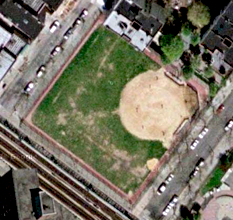
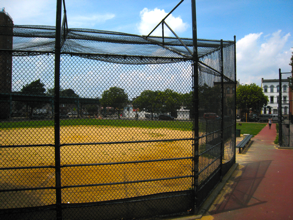
Thomas Boyland Park
Overhead photo taken from Google Maps
Tiger Playground
Evergreen Avenue and Covert Street.
The playground of Intermediate School 296 - the Tigers - features an asphalt ballfield with
rubberized diamond. There is also a running track around the field, cutting the diamond at
second base, and a basketball key in left field. The Long Island Bombers squad, a team of blind and
visually impaired players, visits I.S. 296 annually to demonstrate beepball, a form of baseball
with buzzing bases and a beeping ball, designed for the blind.
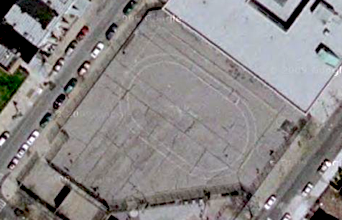
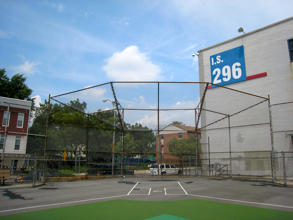
The ballfield at Tiger Playground, before and after renovation
Overhead photo taken from Google Maps
Reinaldo Salgado Playground
Madison and Monroe Streets, Patchen Avenue.
This park was originally laid out in 1944, and known as Patchen Playground. In 1997 it was
renamed for Police Officer Reinaldo Salgado, who had died of leukemia not long before. He had
been a great supporter of the Police Athletic League of the 81st Precinct, which plays
its games here. In 2004, $1.15 million was spent to update the field to artificial grass, with
the new design laid out by designers Dennis Flynn and Randee Stewart. Guests at the re-opening
on May 19 were given peanuts and Cracker Jack.
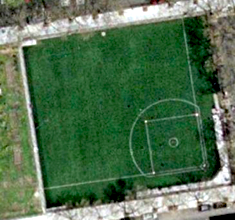
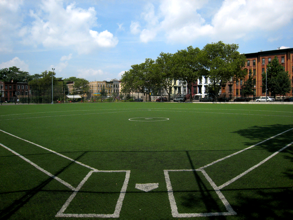
Reinaldo Salgado Playground's modern surface
Overhead photo taken from Google Maps
Green Central Knoll
Central Avenue, Evergreen Avenue, and Noll Street.
For many decades the Rheingold Brewery stood at this site, providing German style lager to America.
After changing hands several times in the 1960s and 1970s, the land was taken by the city for
nonpayment of taxes. Eventually, in 1997, the park was developed. After a $2,961,000 renovation
project, it features a charming man made stream and a very unusual baseball field.
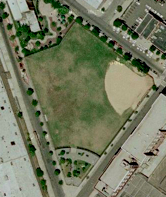
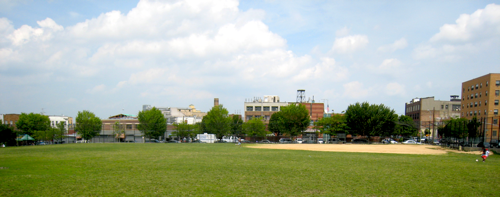
A curiously shaped ballfield - Green Central Knoll
Photo taken from Google Maps
Callahan and Kelly Park
East of Sackman Street, between Truxton and Fulton Streets.
This plot of land, left over from a mass of transit construction in the Brownsville area, was
turned over to the Parks Department in 1945. Although it still features a subway vent, it also
features an artificial ballfield and floodlit handball courts. The park is named for two
soldiers killed in the First World War.
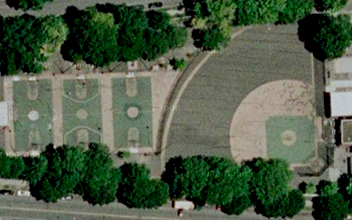
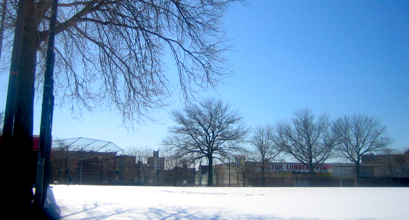
Callahan and Kelly Park, 1951 and 2006
Overhead pictures
from NYCityMap Google Maps
Tiger Oval
Hamburg (now Wilson) Avenue and Halsey Street.
Tiger Oval was home to the Tiger Field Club in 1907. The Tigers hosted such clubs as the Granadas
and the Elbiron Athletic Club.
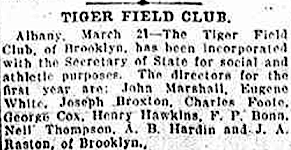
Roberto Clemente Ballfield
Division Avenue, between Kent and Wythe Avenues.
This $2.6 million ballfield, named for the legendary Puerto Rican ballplayer and one time Dodger
prospect, opened in 1998, close to the East River in Williamsburg. Former major
leaguer John Candelaria - of Puerto Rican heritage himself - was on hand for the opening. The Roberto
Clemente Little League plays here from April each year, as well as in New Jersey. The field features
a digital scoreboard donated by Keyspan Energy.
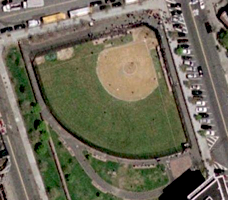
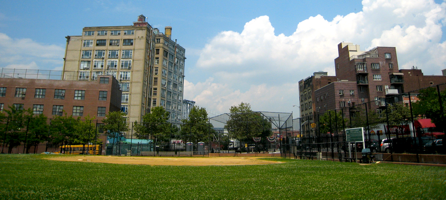
Roberto Clemente Ballfield
Overhead photo taken from Google Maps
Wallabout Grounds
Near Bedford and Division Avenues.
This field was active around 1907, and featured such matchups as St. James Catholic Club vs
E.W. Bliss Base Ball Club. In speaking against a Sunday baseball legalization bill that year,
Canon William Sheafe Chase singled out the Wallabout Grounds:
The claim has been made by advocates of this plan that it will keep the people away from
the saloons and from Coney Island. In reply let me inform you that the liquor interests are
unanimously in favor of the bill, for it will add immensely to their revenues. Near my own
church the Wallabout Grounds are located and a neighboring saloonkeeper permits the players
to dress on the premises and even furnishes the equipment for the teams. The measure I
understand prohibits the sale of liquor on the ball field, but the nearby saloons will reap
the reward. Possibly the enactment of this measure may keep attendance down at Coney Island,
but it will establish a hundred Coney Islands in the heart of our city.
A New Athletic Field
Hart Street and Nostrand Avenue.
On May 13, 1912, a new athletic field at Nostrand Avenue and Hart Street opened for the use of local
children, to be available between 3:30 and 6 o'clock daily. The field measured 200 feet by 300 feet.
Ralph Fairchall, of Boys High School, was in charge of supervising the lot, which had been set up by
the city's director of physical training, Dr. Crampton. He had visited the field a week earlier,
finding it covered in stones, and found willing labor in a group of boys from nearby Public School 54,
to clear the stones from the lot in order that they might have a field to play ball.
Brooklyn Park
59th and 60th Streets between 2nd Avenue and New York Bay.
Also known as Congress Park.
The former Kent homestead became Brooklyn Park, a private seaside resort, around 1896. A legal
dispute soon followed, after proprietor William Wolfe was refused a permit to run a carousel at
the site. Amateur baseball nines from South Brooklyn and Bay Ridge played matches on the Brooklyn
Park Grounds around 1899.
On May 27, 1899, St. Luke's Boys Club played Brooklyn High School No. 2, and established a
remarkable pattern during the first four innings of a seven inning game:
                              1  2  3  4  5  6  7   R. H. E.
St. Luke's Boys Club..........1  2  3  4  7  0 10--27 22  5
Brooklyn High School No. 2....0  0  0  0  3  0  0-- 3  9  7
Highlawn Oval (I)
78th Street near 10th Avenue.
The Highlawn Athletic Club played at this ground from around 1907, advertising for opponents aged
14 to 16 years. On July 4, 1908, the Vernon A.C. was the Highlawn club's holiday opponent. The field
remained in use for at least two decades afterwards, although matches no longer made the papers.
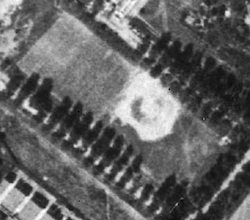
Highlawn Oval (I) in 1924
Picture
from NYCityMap
Highlawn Oval (II)
Bay Ridge and 13th Avenues.
In August, 1911, the Monitor Athletic Club hosted the Postal Field Club of the Bronx at this ground.
10th and Bay Ridge Avenues
The Cresco Field Club played All Bay Ridge here in July, 1909.
Underwood Oval
52nd Street and 20th Avenue.
Home to the Underwood Typewriter Company nine
around 1907, hosting such opponents as the Priestley Cravenettes. On July 15, 1907, the
Underwoods took on their obvious rival, the Remington Typewriter Company. The Underwoods
won 13-8 in a "lively batting contest," highlighted by a seven run outburst in the fifth
inning.
Mohonk Oval
56th Street and 8th Avenue.
Also known as St. Alphonsus Grounds. The Mohonk Athletic Club played here around 1907,
against the likes of Spalding A.C., Tinker A.C., and St. Joseph's Juniors, drawing crowds of
up to 1,000 fans. On On April 30, 1907, the Mohonks defeated the Tinkers in ten innings.
The winning run scored on a squeeze bunt by Clair, with Coakley coming home to score.
The St. Alphonsus Catholic Club played here
from around 1900. In 1904, the team was dragged into a court case after being arrested for charging
money for programs on a Sunday, but after Assistant District Attorney Smith said to Magistrate
Tighe, "I don't think there is much to it," the charges were dismissed. In a wild match on May 27,
1906, the Montauk Field Club took the honours over St. Alphonsus, 16 to 14. The teams scored 15
runs between them in the fourth inning. Despite all that scoring, Jack McCree of St. Alphonsus hit the
only home run.
The Alpines of Bay Ridge also called this field home.
Sunset Oval
Between 40th and 42nd Street, and 9th and 10th Avenues.
Also known as the Sunset Ground. The Sunsets played here in the early 1900s. On September 3, 1906,
the Sunsets displayed their prowess in defeating the Bradfords 16 to 3, and followed up with a
10-0 win over a picked nine. This field also hosted matches in the Commercial League in the
mid 1910s.
Puritan Ground
6th Avenue and 47th Street.
The Puritans, playing other South Brooklyn and Bay Ridge teams in the 1910s, featured two star pitchers, Jack Donnelly and
Charley Smith, along with a highly talented shortstop in Bill Taylor. Various members of the local
Hartley family also played for the Puritans, most notably track star Jim and football player Joe. Their
sister, Lilly, was also an excellent pitcher.
Hilltop Field
46th Street and 7th Avenue.
Not to be confused with Hilltop Park in Manhattan. The Hilltop Club and the Glenwoods called
this field home in the 1910s. The Glenwoods had a feared slugger in Lou Alters, who "could hit the
ball a mile."
Asbury Ground
3rd Street and 9th Avenue.
In a "lively and interesting game" in July, 1887, the Asburys hosted Danchy Advertising.
In the middle of the sixth inning, the score stood at 14 to 6 in favor of the home team,
but the Danchy nine launched a devastating rally. Asbury barely held on, however,
winning 15 to 14. The complete inning by inning score:
Asburys.... 0  1  3  4  2  4  1  0  0--15
Danchys.... 2  0  1  0  3  4  2  2  0--14
Marquette Oval (I)
4th Avenue between 7th and 8th Streets.
Also known as Aquinas Field (I).
The Marquette Athletic Club, connected with the local Church of Thomas Aquinas, held track and field
contests at this field from 1899 through 1902, and fielded a baseball team from 1900, facing such
teams as Browne's School of Business and the Borough Park Field Club. In 1901, lights were installed
at the field and night track meets held. In August, 1902, the Marquettes advertised for opponents
for Labor Day, boasting of a 27-5 record to that point in the season.
In 1899, the Schoenek Medal was presented by Assemblyman
Charles Schoenek to J. Madden for scoring the most points
in the Marquette A.C. track meets on July 4 and Labor Day.
In 1917, the church opened a parochial school on this site, which remained active until 2005. The building
is now PS 133, William A. Butler School, and its playground has just enough room for a small diamond, with
the tiny right field so typical of children's ballfields in Brooklyn.
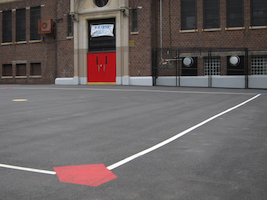
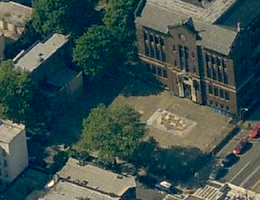
The asphalt diamond of PS 133's playground
Aerial picture from Bing Maps
Marlboro Oval (I)
58th and 60th Streets, 10th and 11th Avenues.
The Annex Athletic Club, which had run track meets for some years, played baseball here in 1906,
although the club was more famous for promoting boxing matches at the Atlantic Park Casino. The
Marlboro Field Club nine also played here from around 1908, losing a fine game on August 17 to
the Original Hustlers, who rallied from a five run deficit to win 9 to 7. From 1914, the old Marlboro Oval
was home to the Unicorns, a champion junior nine of the Bay Ridge circuit.
Marlboro Oval (II)
Gravesend (now McDonald) Avenue, Avenue C, West Street.
This ground was home to the Marlboros in 1912, playing Saturdays on opponent's grounds, and Sundays
and holidays at home. The club advertised for "such opponents as the Midwoods,
New York Life, Cornells, Harmons, and teams of like strength." In May, Marlboro defeated the Kensington
Travelers 5 to 1, with pitcher Cooley allowing just three hits and no walks.
Marlboro Oval (III)
Gravesend (now McDonald) Avenue, Avenue N, Avenue O.
The Marlboro Field Club moved its baseball games here around 1914. Here they played
such "excellent attractions" as the U.S. Marines. The Brooklyn Rapid Transit League also played
some games here, with the excellent pitching of Von Essen seeing Greenwood to a 6-1 win over
Eastern on May 25, 1915. On August 12, 1925, the Iroquois Athletic Club defeated the Parkway Cubs
8 to 4 at this ground, taking the championship of the Flatbush Community Baseball League.
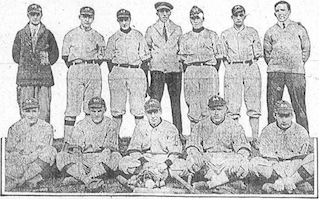

The 1914 Marlboro Club of Gravesend, Marlboro Oval (III) in 1924
Overhead picture
from NYCityMap
Bierlein's Donnybrook Park
Dykes Meadow, near Fort Hamilton.
Run by Mr. Gustav Bierlein, who moved from place to place quite often and was reputedly "considered
a bad man to trifle with," Donnybrook Park lasted only a short while in the late 1880s and early 1890s.
It was mostly a picnic ground, with liquor laid on liberally for the patrons. On June 20, 1889, the
Coney Island Firemen visited Bierlein's Donnybrook Park for a friendly base ball game with the
Fort Hamilton Engine Company, which instead "the bitterness of base ball rivalry was roused in the
first inning" and things only got worse from there. The kicking of the Fort Hamilton players caused
the umpire to be changed twice during the match, which was also cut short at five innings when the Coney
Island players took their leave rather than stay for the aparently inevitable fist fight.
Homewood Field
18th Avenue and 69th Street.
Also known as Kingsboro Oval and Homewood Oval. A space was especially cleared in the new development
of Homewood in 1899, so that games could be played on "Saturday afternoons and Sundays as well as in
the early evenings of pleasant days." Homewood Field was home to the Kingsboro B.B.C. for a time in
the early 1900s, and also hosted matches of the Drug and Chemical League in the mid 1910s, featuring
such clashes as Thompson-Norris against E. Fougera Company.
On May 16, 1909, a much anticipated game was played between the Prospect Camp and Long Island Camp
teams at Homewood Oval. Prospect Camp won, 25 to 16, in a game that was "a thriller from start to
finish." On September 13, 1909, Kingsboro hosted the Lawyers Title Insurance and Trust Company,
and handed out a 17 to 3 thrashing in front of 400 spectators.

Homewood Field in 1924
Picture
from NYCityMap
St. John's Oval (I)
33rd and 34th Streets, 3rd and 4th Avenues.
Also known as Niagara A.C. Oval.
The St. John's Catholic Club played here in 1905, occasionally featuring three games in a day.
The junior squad would play a preliminary before the seniors played two. On May 21, 1905, the
Osceola Club of Manhattan visited the St. John's Club with high hopes, but came away
the loser by a score of 10-0. Not only did pitcher Egan allow just three hits, but in the
eighth inning a seemingly sure run for Osceola was cut down at the plate by a superb direct throw
from Davitt in right field. Just a week later, 23 arrests were made when the St. John's team tried
to play the Washington Field Club as Police Commissioner McAdoo ordered a crackdown on Sunday
baseball.
The Niagara Athletic Club played here in 1907, against such opponents as the Hustler Field Club.
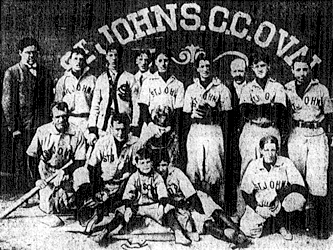
The St. John's C.C. team circa 1905
Arcadia Oval (I)
6th Street and 2nd Avenue.
The alphabetically delightful matchup of Acme and Ambrose Athletic Association took place here
in 1907. That same year, this field was the regular home of the 44th Precinct Police team. Their
signature victory was on July 29, an 11-3 win over the men of the 2nd Precinct from Manhattan,
who were "utterly helpless before the curves of Battam." Other stars were center fielder Matthews,
a former Prospect Park batting champion, and Sullivan, whose fielding at shortstop was
"sensational."
Arcadia Oval (III)
34th Street and 2nd Avenue.
The peripatetic Arcadia squad wound up here around 1910. In an epic match on May 22, 1911,
St. Agnes led the Arcadias 6 to 4 after seven innings, but gave up 6 runs in the eighth,
only to score 4 themselves in the ninth to tie the game. After two more scoreless innings,
the game ended in a tie "that kept the rooters of both teams cheering throughout."
St. John's Oval (II)
28th Street, 2nd and 3rd Avenues.
Also known as Bradford Oval. The St. John's team moved here in 1906, and changed
name to the Bradford Athletic Club during that season. On June 17, 1906, the Bradfords played the
Oaks in a match to
benefit the widow of Charles Zimmerman. Zimmerman had been killed in a baseball game at the Parade
Ground in 1905. In 1912, the Brooklyn Eagle reported that the Oval was to be taken over for
manufacturing purposes.
Bush Terminal Piers Waterfront Park
Foot of 44th and 51st Streets.
This proposed park is part of the Sunset Park 197-a Plan, which aims to revitalize the waterfront
area between 15th and 65th Streets. The land is currently a brownfield, with some toxicity in the
soil that must be addressed in order to create the park. The project was originally announced in 2006
by Mayor Bloomberg and Governor Pataki, and plans have been revised several times since. Costs are expected
to run as high as $70 million for the whole renovation, with a $1 million maintenance bill annually
to be offset by concession revenue and private funds from loval business. The park will include three
ballfields, two of which overlap, all in artificial turf. Construction, once it begins, should take
two to three years.
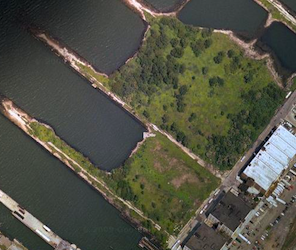
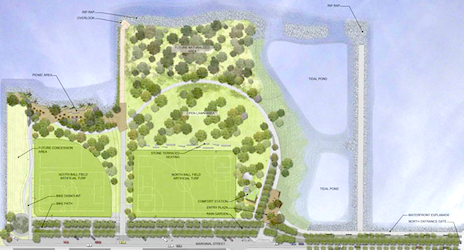
The present and future of Bush Terminal Piers Waterfront Park
Overhead
photo taken from Google Maps
Olympic Club Grounds (I)
Division Avenue and Rutledge Street.
In the space of four days in September, 1859, the Brooklyn Eagle referred to Olympic Grounds
both at this location in the Eastern District and the one below in South Brooklyn. The Eastern
District location had seen the Olympics thrashed by Somerville, NJ's Independent Club, 59 to 31,
on October 14, 1858.
Olympic Club Grounds (II)
Smith Street between Union and President Streets.
On June 9, 1859, the Olympics lost an epic match to the Hiawatha Club here, 32 to 31.
Columbia Club Grounds
Division Avenue, South 9th Street.
The Columbia Club, comprising "thirty members, principally merchants and clerks," was organized
in July, 1855. They practiced at these grounds on Tuesdays, Thursdays, and Saturdays from 5 till
7 o'clock.
Fireman's Oval
Rockaway Avenue (now Rockaway Parkway) and Flatlands Avenue.
This field was home to two sporting clubs of Canarsie: the Elks Athletic Club and the Oval
Athletic Club. Visitors came from all over the borough and farther away, including such well
named opponents as William Duddy's Pleasure Club. The Canarsie Council team of the Royal
Arcanum League also played here, in 1911. In a superb game on July 7, 1912, the Elks defeated
the Young Bushwicks, 5 to 4 in eleven innings. Dovan, the pitcher for the Bushwicks, picked
six men off at first base.

Elk Athletic Club baseball squad, 1912
Amersford's Oval
Avenue M and East 91st Street.
The Amersford Field Club, a junior team with players aged 12 to 14, competed here in 1908. On August 27,
Brighton of Harlem visited and their pitcher, Staar, struck out 14, but he emerged the loser of a 2 to 1
decision in 11 innings. Golden was the winner for Amersford. 600 fans saw the game. On September 27,
with Golden in center field, "Happy" Nat Vincent pitched an even better game, defeating the Spartan Baseball
Club and pitcher Buck 1 to 0 in 12 innings. The Amersfords made just 8 hits, but Vincent kept the Spartans
to only 4, and struck out 18.

A diamond was still visible at the same site in 1924
Picture
from NYCityMap
Star Club Grounds
Old cricket ground near Division Avenue.
The newly organized Star Club began practice at this ground on Saturday afternoons in September,
1855, before moving to Red Hook.
Martense Oval
13th Avenue and 37th Street.
In a rare loss for a squad used to having its own way, the Martense Athletic Association went down to
the Murrays, 12 to 4, at this field in 1909. Other opponents in 1909 included the Hawthornes and the
Danbury A.C. of Brooklyn. The Martense club also fielded a football team, and
competed in track meets. In 1910, the Martense baseball nine moved to Hawthorne Field, and quit playing
home games altogether soon afterward. The club would remain a travel team, and was described in the
Eagle in 1912 as "one of the fastest semipro teams in the area."
Paerdegat Park
Farragut Road between E 40th Street and Albany Avenue.
Dating to 1941, Paerdegat Park was renovated with $1 million from Councillor Lloyd Henry
in 1999. As part of this renovation, the ballfields were constructed along with facilities for
handball and basketball, as well as spray showers and chess tables.
When we visited in 2009,
the local kids were trying a new batting practice variation for a 95 degree day. The hitter would
smack the ball to the other end of the field, then argue with the pitcher about who should fetch
it until someone else became annoyed enough to get it themselves.
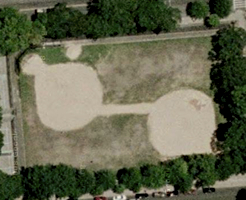
Paerdegat Park's well equipped fields
Overhead photo taken from Google Maps
Nostrand Playground
Foster Avenue between New York and Nostrand Avenues.
This park was opened in 1953, and saw major renovations in 1999 and 2009. The ballfield, however,
remains as the standard asphalt and rubber type. Nostrand Playground sits imediately south of
Flatbush Gardens, formerly known as the Vanderveer Estates - one of the most notorious housing
projects in the city. As well as the ballfield, the park features several basketball courts.
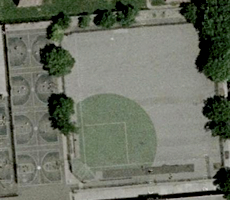
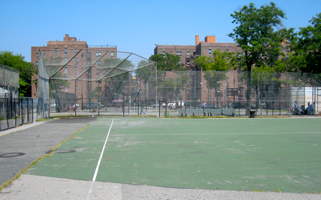
Nostrand Playground
Overhead photo taken from Google Maps
Brooklyn Athletic Association Grounds
DeKalb Avenue, Willoughby Avenue, Classon Avenue, Graham Street (now Taaffe Place).
Previously the Williamsburgh Athletic Club Grounds- the club changed name in 1885. In the late 1880s,
also referred to (somewhat inaccurately) as the Brooklyn Athletic Club Grounds (II).
The Brooklyn Magazine referred to the Williamsburgh Athletic Club Grounds in glowing terms:
Excellent taste is displayed in furnishing its parlors, meeting, reception and reading rooms. It has bath
rooms, and excellent gymnasium, ball, lacrosse and tennis field, together with a fifth of a mile track;
the whole forming one of the most complete athletic quarters in our land. Its new club and grounds were
formally opened on May 30th, Decoration Day, 1884.
The grounds were home to many sports, as noted, including a team fielded by the Brooklyn
Athletic Association. The lot was long and thin, most ideally suited for the running track, with a grand stand
and free stand at one end. Not mentioned by the Brooklyn Magazine are the billiard tables and bowling alley
in the club house.
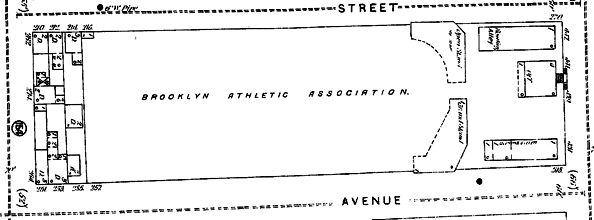
1888 Sanborn map of the Brooklyn A.A. Grounds
In 1888, the grounds hosted a match between the Retail Grocers' Association
of the Western District and the Retail Merchants' Association of the Eastern District. On May 30,
1889, the Brooklyn Ls (Elevated Railroad team) played a double header with the Brooklyn Athletic
nine. The visitors took the first game, 16 to 6, but were edged out in the next, 7 to 6 in ten
innings. But the most notable contest was on September 15, 1886 between the Fat Men and the Lean Men of the Association.
The Lean Men took the contest, 19 to 14, and the Fat Men were presented with a loser's banner
of cardboard decorated with black ink.
In 1887, when the growing Crescent Athletic Club was first looking for a new home, the Brooklyn A.A. offerered
to merge, with the combined club using these grounds. The Crescents refused, heading eventually to Bay
Ridge. The Brooklyn Athletic Association disbanded in late 1889, and the field was developed
for housing. The various buildings were auctioned off for ridiculous prices on December 28 -
the bowling alley went for $200, while the grandstand fetched just $50.
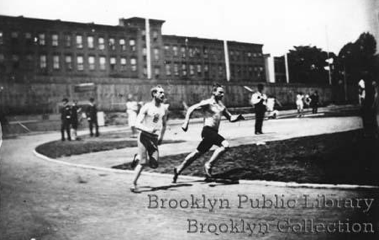
George Brainerd's photograph of a race at the grounds, in the early 1880s
Photograph courtesy Brooklyn Public
Library—Brooklyn
Collection
St. Patrick's Oval
Nostrand and Willoughby Avenues.
Home to the St. Patrick's Catholic Club nine around 1910. When the All Manhattans visited on May 21, 1911,
St. Patrick's "thoroughly outclassed the visitors, and won as they pleased" in a 13-3 game. Appropriately
named pitcher Christman had 11 strikeouts, and gathered 3 hits batting cleanup. The Brooklyn Eagle profiled
the team in mid September, 1911, when they sported a 20-5 record, with wins over such top flight semipro
clubs as Farmers, Martense, and the New York Colored Stars.
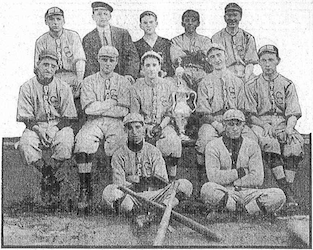
St. Patrick's CC baseball team, 1911
Paramount Park
Metropolitan and Morgan Avenues.
Home to the Paramounts of Williamsburg, Max Rosner's first attempt to build a semipro squad.
After the Paramounts defeated Passaic, 7 to 2, on June 4, 1905, seven men were arrested for
violation of Sunday blue laws.
Lindower Park
Mill and Strickland Avenues.
This land has been owned by the city since 1959, and was named Lindower Park in 1965, to
honor Alex Lindower, a community activist in the Mill Basin area. The park's two ballfields
are available for public use, and are also home to the Hornets of Midwood High School, who
made the PSAL playoffs in 2004 with a 13-3 record. Park benches are set up outside the field,
taking the place of bleachers.
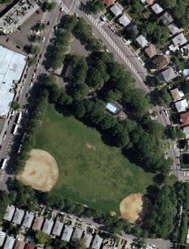

Lindower Park
Overhead picture taken from Google Maps
Grace Playground
Belmont and Pitkin Avenues, Vermont and New Jersey Streets.
Grace Playground, a joint venture of the Education and Parks Departments, was put together
in a series of purchases between 1936 and 1989. In 1994, $1.3 million was spent on renovation,
dramatically increasing the size and sporting facilties here, including the addition of the
beautiful turf ballfield. The William H. Maxwell High School softball team plays home games
at Grace Playground. A disappointing 2-14 season in 2009 was highlighted by a 34-2 home win over
George Westinghouse, with Sasha Seerattan and Katasha Watson each scoring five runs. The game
lasted only three innings.
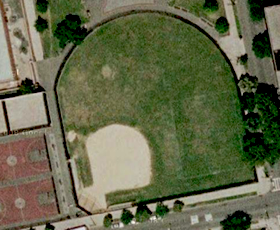
Grace Playground's distinctively shaped field
Overhead picture
taken from Google Maps
Sutter Ballfields
Barbey Street, Sutter, Schenck, and Belmont Avenues.
The Sutter Ballfields are a small oasis in one of the most dangerous areas
in Brooklyn. Clearly designed with a great deal of care, the park includes such details as
concrete baseballs on the decorative pillars outside the fence, and a series of stylized
baseball figures identical to those at Von King Park. Alas, the facility seems to be sadly
underused. None of the usual trappings of a resident little league can be seen, and
Parks Department records show a consistent pattern of failing inspections
due to unacceptable levels of litter, graffiti, and even broken glass.
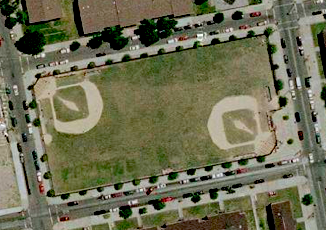
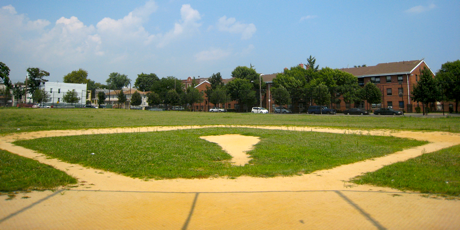
Sutter Ballfields
Overhead picture taken from Google Maps
Brownsville Recreation Center and Playground
Hegeman and Christopher Avenues, Linden Boulevard.
Also known as Brownsville Playground (II) and Brownsville Boys' Club. The Brownsville Boys'
Club started at this site in 1953, in a one room clubhouse. A major fundraising effort over
the next two years saw the outdoor area developed for sports, and the lot was gifted to the
city in 1954. and opened as a public park in 1955. A series of subsequent renovations culminated
in July, 2008, with the opening of a new Imagination Playground designed by David Rockwell.
A fresh artificial grass surface was installed on the ballfield at the same time.
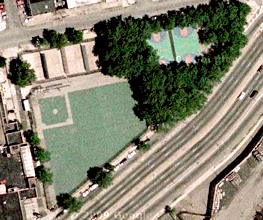
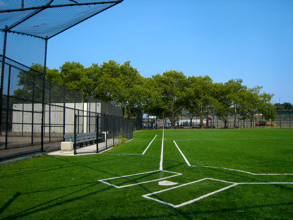
Brownsville Playground, before and after
Overhead picture taken from Google Maps
Floyd Patterson Field
Christopher and Riverdale Avenues.
Previously known as Nanny Goat Park. That asphalt covered lot was a gathering place for the youth
of Brownsville for decades, through good times and bad, and all sorts of ethnic communities
moving in and out. Activities included baseball, stickball, handball, basketball, and everything
else kids do on weekends and after school.
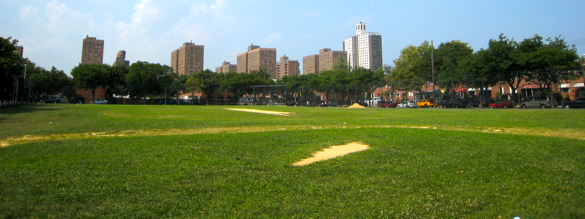
Floyd Patterson Field in 2009
Modern Floyd Patterson Field, named for the two time heavyweight boxing champion, neatly fits
in two ballfields and a cricket pitch, and hosts soccer and football, too.
The area was acquired by the city in the early 1970s, and redeveloped and renamed in 1981.
In 1997, an $885,000 reconstruction was done. Several high schools play occasional
home games at Floyd Patterson Field.
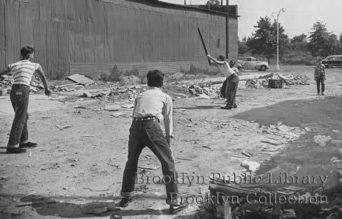
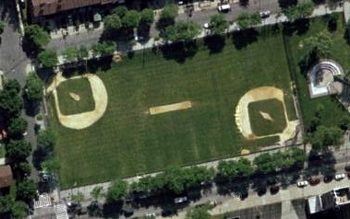
Stickball at Nanny Goat Park in 1953, Floyd Patterson Field from overhead
Action
shot courtesy Brooklyn Public Library—Brooklyn
Collection
Overhead picture taken from Google Maps
McLaughlin Park
Jay and Tillary Streets.
This downtown park, first acquired in 1894, is far better known for basketball nowadays, being
something of a a Brooklyn equivalent to Rucker Park in Harlem. But once there was a McLaughlin Park
baseball team, which played the McCarrens among others. In October, 2006, a $3 million city funded
renovation began, including a new multi-purpose synthetic field for softball, baseball, and
soccer. Brooklyn Friends School softball moved in when the field was completed.
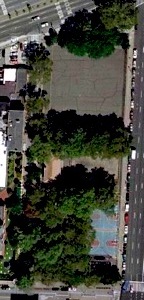
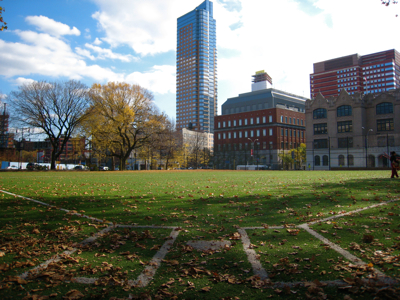
McLaughlin Park before and after renovation
Overhead picture taken from Google Maps
Bridge Park 2
Jay and York Streets, Brooklyn-Queens Expressway.
This park dates to around 1971, after a strip of Brooklyn near the waterfront was reshaped
by the new expressway. The trio of Bridge Parks provided a small oasis in what is now the up and coming
DUMBO neighborhood, but was then a relatively desolate area. Bridge Park 1 has trees and benches, and
Bridge Park 3 has a playground. Bridge Park 2, however, has a large concrete surface with a baseball cage,
dugouts, and a miniature football field painted on, complete with faux Super Bowl trophy logo. The cage is
made beautiful by a heavy growth of ivy.
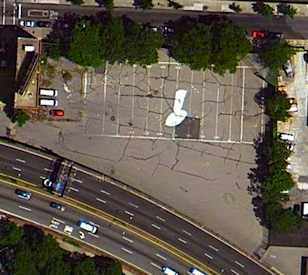
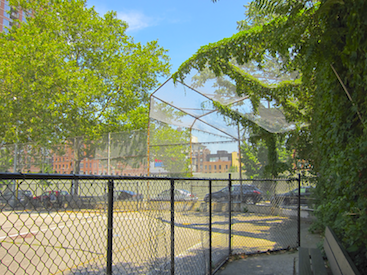
Bridge Park 2 in 2012
Overhead picture taken from Google Maps
Bishop Loughlin Playground
Lafayette Avenue between Clermont Street and Vanderbilt Avenue.
More formally known as Eastment-Miles Track and Athletic Field.
Bishop Loughlin High School moved to this location in 1933. Despite the spacious playground,
the school's softball and baseball teams play at Prospect Park and the Parade Ground. Of course,
the two large handball walls in the outfield might have something to do with this. The
lot is most famous as host of the weekly Brooklyn Flea, a massive open air flea market which
draws people from across the city.
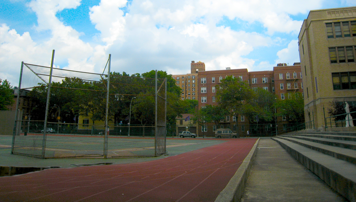
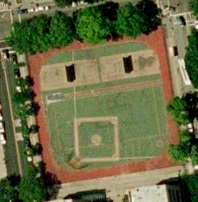
Bishop Loughlin High School's playground
Overhead picture taken from Google Maps
Corner of DeKalb and Clermont avenues
The Ridgewood Club defeated the Alert Club 17 to 15 at these grounds, on July 18, 1859.
Sternberg Park
Lorimer and Boerum Streets.
Controversially created in place of crowded tenements in 1924, this was originally
called Williamsburg Park, then Lindsay Park, and finally renamed Sternberg Park in 1990. A
$3.8 million renovation was completed in October, 2006, providing a new artificial baseball
surface, as well as basketball, handball, and other facilities. Mr. Met was on hand for the
unveiling ceremony. The playing surface slopes gently but significantly from the northeast to
the southwest, making the two diamonds play very differently. The Kids Against Drugs Little
League plays matches here.
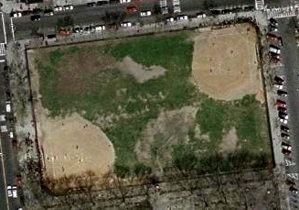
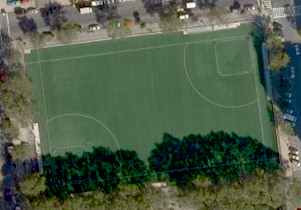
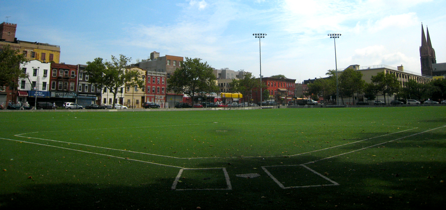
Sternberg Park, before and after renovation
Overhead pictures taken from Google Maps and Bing Maps
O.L.P.H. Field
3rd Avenue and 64th Street, beneath the Belt Parkway and Gowanus Expressway.
In 2006, the City Council approved a measure to designate the section of Third Avenue here
as Al Christman Way. Al Christman helped to start the Our Lady of Perpetual Help Baseball and Soccer League,
and worked for years to turn the vacant lot here into a ballfield for the local children. The lot
is now more formally known as Father Tom Joyce Athletic Complex.
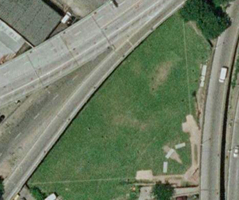
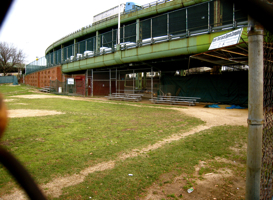
Views of O.L.P.H. Field
Overhead picture taken from Google Maps
Mystic Club Grounds
3rd Avenue and 63rd Street.
The Mystic Club hosted the Baltics here on September 21, 1863.
St. Patrick's Little League Field
Between 3rd and 4th Avenues on Shore Road.
In 1974, the Catholic Church sold off this Bay Ridge little league park to a developer, who
failed, amid great protest, to complete a proposed 17 storey residential development known as Verrazano Towers.
In 1976, the New York Times reported on the dangerous, disused site:
"It used to be beautiful here," said Michael Courtney, kicking a bit of toppled-down chain-link fence
above the 10-foot drop into what would have been the Verrazano Towers' laundry room. "The fathers used to keep
the grass cut nice, and the little guys playd out here all year round."
After the bank foreclosed, a new low rise development called Watersview was eventually completed in 1982.
St. Patrick's Youth Sports Baseball now plays at the Andrew Lehman Fields.
Christopher Hoban Ballfield
5th and 6th Avenues, 66th and 67th Streets.
Christoper Hoban Ballfield is actually two fields,
standing in the western half of Leif Ericson Park. The park dates to 1925 and has a long history of
renovations. The Christopher Hoban fields are named for an alumnus of nearby Xaverian High School
who was killed in the line of his police duty in 1988. The fields were built between 2001 and 2003
at a cost of $695,000.
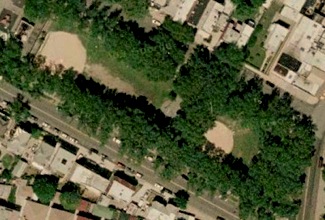
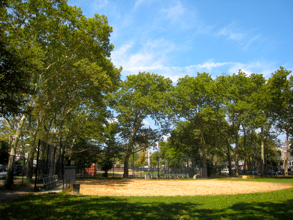
Christopher Hoban Ballfield(s)
Overhead picture taken from Google Maps
Parkville Youth Sports Complex
65th and 66th Streets, east of 8th Avenue.
Since 1963, the Parkville Youth Organization has offered baseball, softball, and other sports
to children in a wide range of age groups. The Parkville fields are arranged in three sizes,
with the two smaller ones lacking much of the unnecessary outfield space seen on many little
league fields. The main diamond is of regulation size, and is named the John C. Gallo Field.
The Parkville leagues feature such teams as the Dodgers, the Tornadoes, the Vikings, and
the Red Lightning.
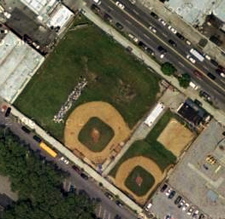
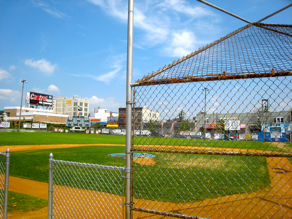
The baseball fields at Parkville Complex
Overhead picture taken from Google Maps
A very rocky diamond filled with hummocks
86th Street near the corner of 3rd Avenue.
On May 5, 1894, the Young Lady Champions of the World met the Fort Hamilton Club at this address,
and were defeated by a "score of no one knows how many to one." About 700 people attended the affair.
Some of the fans later joined the game as members of the Young Lady team tired of the farce and
repaired to the beer wagon. Pitcher Maud Nelson and Emily Foster at third base were by far the pick
of the Young Lady Champions, while the Fort Hamiltons were said to be a "loose limbed lot of
fellows" and showed little mercy during the match.
Gelston Oval
86th Street near 5th Avenue.
Also known as Algona Oval. Games at this ground provide an excellent demonstration of the multi-faceted
loyalties of players for the local teams in Bay Ridge at this time.
The Algona Field Club played here from 1909 to 1911, agaist such opponents as the Hoink Field Club and
Brown's Leaguers. In a game against the Hoinks in May, 1909, the "sensational catches" of left fielder Joe
Lamorelle saved two home runs, and the Algonas rallied from an 8 to 2 deficit, scoring 11 runs in the last
two innings to take a 13 to 8 victory.
The semipro Gelstons, who played here in 1911, had a few players in common with Algona - Walsh, Malarkey,
and Maher. Walsh, who played a number of positions including catcher and second base, was nicknamed Hoink,
which may imply a connection to the local Hoink F.C., also. Walsh scored three runs in an 11 to 3 romp over
the Parkway Athletic Club in June, 1911. Ray Schroeder held the Parkways to just four hits. Schroeder, on
the other hand, pitched for Brown's Leaguers in a 1911 win over Walsh and the Algonas, 11 to 1.
In August, 1909, Hoink brought his two brothers to play for the Algonas, who took the field with three
Walshes and three Murrays for a 13 to 9 win over the No Hope A.C. The Murrays scored just one run between
them, while the Walshes scored eight.
Wahcondah Field
84th and 86th Streets, 3rd Avenue.
Also known as Wahcondah Oval. The Wahcondah Athletic Club played here in 1909, against such opponents as
the Cresco Field Club, the Unity Base Ball Club, the Goose Hill Base Ball Club, and the Delta Base Ball Club.
The Wahcondahs were also a football team to be reckoned with, and played in other years as the Mohawk
Athletic Club.
Sheepshead Bay Race Course
Ocean Avenue and Vorhees Lane.
In 1880, the Coney Island Jockey Club opened this new track, then bounded largely by pristine
forests within sight of Manhattan Beach and Sheepshead Bay. Other sports events were held
here, too, though: aviation shows, and even baseball games, including a hard fought 6-5
comeback win for Knickerbocker F.C. over Bedford Y.M.C.A. on June 5, 1910. Just 13 days later,
a race meeting was interrupted by a severe storm, and lightning struck the judges' stand.
In 1915 the track was sold and converted for auto racing.
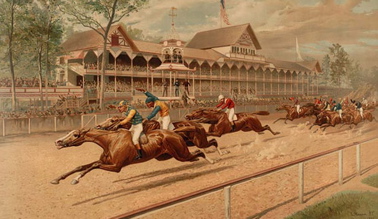
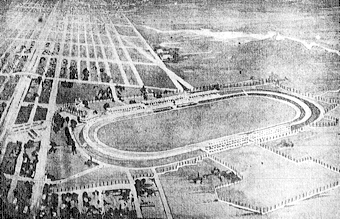
The 1889 Futurity race at Sheepshead Bay, 1915 plans for the speedway
Sheepshead Bay Oval (I)
Ocean and Emmons Avenues.
The Sheepshead Bay Field and Athletic Club called this park home from 1905. Their matches were said
to cause great excitement amongst the local racing community - the Sheepshead Bay track was
just a few blocks away - and racing people would often participate in or umpire the matches.
These games did not, however, amuse Mrs. Anna Gilbert, whose house stood immediately next to the field,
and whose windows had on several occasions been broken by baseballs. The first such occasion was described
in the Eagle on May 20, 1905:
Mrs. Gilbert formerly took pleasure in sitting by the dining room window, which overlooks the ground
now occupied by the baseball club, to do her sewing. It was a source of delight to gaze over the beautiful
expanse of grass and budding woodland. One day, however, as Mrs. Gilbert was sewing, a baseball came crashing
through the window pane and hit her underneath the eye. Mrs, Gilbert screamed, but the ball players paid
very little attention to her shouts. The man who was getting around the bases at that moment had licked out
a home run and was hustling toward home, without going within twenty feet of any of the bases. The opposing
pitcher was waiting for the return of the ball, but the sphere never did come back and one of the players
declares there are two dozen baseballs on the Gilbert premises.
The man responsible for the home run hit was dismissed from the team on May 19 after Mrs. Gilbert complained
via her lawyer, Mr. Finnerty. Further, the club promised no further disturbance. On May 21, however,
J. Driscoll Tucker, a member of the club, found himself in front of Magistrate O'Reilly of
the Coney Island Court, asked to explain "why the team persisted in playing baseball in the rear of
Mrs. Gilbert's home." The matter was adjourned for further hearing, the results of which we have been
unable to locate.
Sheepshead Bay Grounds
Avenue Z and Ocean Boulevard.
The Sheepshead Bay Grounds were sometimes referred to simply by the address, or as Sheepshead Bay Oval (II).
The grounds had several diamonds, and were located in the far southwest corner of the huge lot containing the
Sheepshead Bay Race Course. The Royal Arcanum League played games here from around 1910. On June 12, 1911,
Dauntless lived up to their name in thrashing De Witt Clinton, 18 to 7. In a much closer game two days before,
Bedford Presbyterian won out over Corona Methodist Episcopal, 4 to 2. Games here continued for some time -
in 1927, the Sheepshead Bay nine trounced Brooklyn A.C., 12-0, with Dooly allowing just three hits.
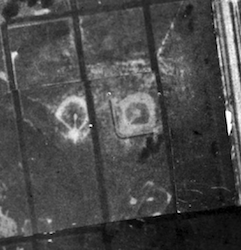
Sheepshead Bay Grounds with three diamonds in 1924 - the
streets marked are proposed only, and were run through later
Picture from NYCityMap
Gravesend Race Track
Gravesend (now McDonald) Avenue, Ocean Parkway, Kings Highway, Avenue U.
Also known as the Prospect Park Fair Grounds. Before it was a race track, this large lot hosted
annual agricultural fairs, and, briefly, Buffalo Bill's Wild West Show in 1883.
As the Gravesend Race Track, home to the Preakness from 1894 through 1908, this site was a local icon
of horse racing until a state gambling ban forced its closure in 1910. When the ban was repealed
in 1913, other tracks reopened, but not Gravesend. It did, however, briefly see baseball
as a fill-in venue for the Royal Arcanum League in 1915. On August 2, Gilbert defeated Palm
18 to 10, with Johnson and Kessler each scoring four runs.

The Gravesend Race Track grand stand
Woodlawn Park Picnic Grounds
22nd Avenue, 65th Street, and the Sea Beach Rail Road.
On Labor Day, 1895, two thousand members and friends of the Catholic Knights of America enjoyed a picnic
at Woodlawn Park. In addition to the many available festivities, a base ball match was played between
the teams of St. Patrick's branch and St. Charles' branch. St. Charles won, 17 to 12. The advertised
semi professional match between the Atlantic F.C. and the Lyceum Club failed to take place, however.
On June 1, 1900, Browne's Business College held its first annual outing at Woodlawn Park, featuring a
double header of base ball. The junior nine defeated Packard's Business College 4 to 3, and the seniors
won over the Long Island Business College, 11 to 3.
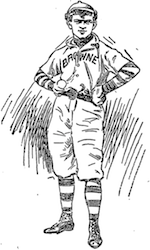
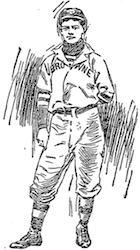
J. J. Heuther and J.R.M. Bunn, Browne's
battery for the successful 1900 season
Bowling was also available, indoors, as well as basketball and track sports, but shooting was for
many years the most famous activity at Woodlawn Park.
Unionville Grounds
Unionville, Gravesend.
The Unionville Club attended the National Base Ball Convention of 1865, but was not often mentioned
in the newspapers. In a home game only mentioned after a return match, Unionville defeated Eagle of
Flatbush on July 27, 1867. Other rivals included Pacific of New Utrecht.
Eureka Grounds
Unionville, Gravesend.
On July 14, 1890, the Eureka Club played a match against a picked nine from the Brooklyn Yacht Club.
According to the Eagle: The grounds presented a most inviting appearance, due to the attention given
to them by Mr. Edgerton. A goodly number of spectators, including women, who were there in full force,
witnessed the game and applauded the brilliant plays. In something of an upset, when the game was
called due to darkness after eight innings, the yachtsmen had managed a tie with the ball players, 24
to 24.
Reilly's Oval
Gravesend (now McDonald) Avenue and Kings Highway.
On July 21, 1909, the Young Men's Catholic Club of Brooklyn announced their new home grounds,
known as Reilly's Oval, and declared their intention to take on the fastest semi-professional
nines in the area. On August 1, the Y.M.C.C. was scheduled to host the All-Manhattans, but
the visitors cancelled at the last minute, "giving as the reason that their club would not allow
the baseball players to use the uniforms." When the Y.M.C.C. discovered that the All-Manhattans
had in fact played a game in New York that day, they contacted the Eagle immediately to warn
other clubs. Fortunately, the Parkville nine stepped in to play, and the Catholic Club won an
entertaining game, 9 to 5.
Central Field
Avenue S, East 18th Street.
Also known as Central Oval. The Central Club consisted of players aged 16 to 20, and fielded
a first and second nine. On June 4, 1905, the two nines faced off at Central Field, and the
first team, despite making ten errors, rapped out 28 hits and thrashed the second team 24
to 6. In 1907, the American Trading Company nine called Central Oval home, facing such
opponents as the United States Steel Product Export Company, whom they defeated handily,
14 to 7.
Kings Highway Oval
Avenue R, East 17th Street.
The Kings Highway Club baseball team of 1909 was formed from the Yale Park Club of 1908, and, with
a few extra players, proved to be a powerful aggregation. On July 25, All Avonia visited Kings
Highway Oval and raced to a 7-0 lead after the first inning, but Schroeder came in from center
field to replace Brown in the box, and kept the Avonias to just one more run the rest of the way.
Kings Highway gradually pegged back the score, eventually scoring two in the ninth for a 9 to 8
victory. Schroeder completed his day by making the winning hit to right field.
In another high scoring affair, the Mulrenan and Keeley Athletic Clubs met at Kings Highway Oval on
August 22. Despite scoring 13 runs in the last three innings, the Keeleys went down 21 to 20. Every
player on both teams made at least one hit and scored at least one run, with Mulrenan second baseman
J. Bohan scoring four. 900 fans watched the contest.
East 37th Street and O'Brien Boulevard
On April 21, 1907, the Clermont Field Club defeated the Clermont Stars in a dramatic junior contest.
Each team scored four runs in the first inning, but after the Stars put up one run in the top
of the second, the Field Club batted in five to take the lead. A late flurry by the Stars
was to no avail, as the Field Club won 15 to 12. Fielding let the Stars down, with Muire's four
errors at second base being the main contribution to a team total of 15.
Tuck's Oval
Avenue I and East 37th Street.
Also known as Midwood Field (I), Midwood Oval, Midwout Oval, and Oliver A.C. Grounds. In 1906
this was home to the Oliver Athletic Club, and in later years to the Midwout junior club, a good
baseball team and a near unbeatable football combination. In May, 1906, the always controversial Oxford nine
visited the Olivers, and went away unhappy after a truly bizarre match. The Brooklyn Eagle reported:
The Oxfords are waxing warm over the treatment they received at the hands of Umpire Owens
on the Oliver A.C. Grounds, Avenue I and East Thirty-seventh street, Sunday. According to the
Oxfords, Owens' decisions were on the Spanish garlic order, in favor of the home team. The feature
was a triple play by Dooley, Welch, and Burns. The score:
       Oxford               |         Oliver A.C.
  Name        r.1b.po. a. e.|   Name        r.1b.po. a. e.
Whitley, cf...2  2  0  0  0 | Tully, ss.....2  1  0  3  0
Dooley, 2b....4  2  7  3  0 | Iles, lf......4  0  2  0  0
Oram, c.......4  3  8  9  0 | Peterson, 2b..1  0  6  2  0
Welch, 1b.....3  5  8  3  0 | Fredin, cf....5  0  3  0  0
Burns, 3b.....2  2  5  2  1 | Burns, 1b.....4  0 14  0  0
Harkins, ss...2  0  0  4  0 | Sweeney, rf...1  0  0  0  0
Franks, p.....2  3  0  2  2 | Ruthig, 3b....1  1  2  2  4
Conroy, lf....1  1  1  1  0 | Bowie, c......3  2  3  1  1
Fields, rf....0  2  0  0  1 | Case, p.......0  2  0  0  0
             -- -- -- -- -- |              -- -- -- -- --
Total........20 20 29 24  4 | Total........21  6 30  8  5

                 Score by Innings:
                      1  2  3  4  5  6  7  8  9 10
------------------------------------------------------
Oxford................6  3  0  0  0  0  4  0  4  3--20
Oliver................1  0  6  2  2  0  1  0  5  4--21
------------------------------------------------------

Struck out--By Franks, 3; by Case, 3.
Bases on balls--Off Franks, 31, off Case, 7.
Sacrifice hits--Welch, Oram, Conroy, Dooley.
Time of game--2 hours and 45 minutes.
Umpire--Mr. Owens.
So the Olivers scored 21 runs on 6 hits and 31 walks. The Oxfords may have had a point.
Trinity Field
Avenue K, Avenue J, Coney Island Avenue.
Also known as Trinity Oval (I).
Home to the Trinity Club, which competed in the Amateur Athletic Association League here from 1906
to 1908, before moving to Poly Field (I) in 1909. The Trinity Club also fielded an intermediate and a junior
squad. Other teams playing here included the Rivals and the visiting Bronx Cayuga Club. The Brooklyn Eagle also
organized Junior Eagle Athletic meets here.
On June 24, 1906, the visiting St. Edward's Altar Boys "literally smothered" Trinity in a 28 to 2 mismatch,
scoring 11 runs in the second inning alone. While the St. Edward's boys did pound out 22 hits, many of them
for extra bases, and draw 10 walks, the Trinity fielders made matters far worse by committing 14 errors.
St. Brendan's Oval
Avenue L, Avenue M, and Coney Island Avenue.
Also known as Oxford Oval. Oxford F.C. played home games here from 1905.
Other than a 5-2 defeat of Maujer-X, we can find few records of their results, but perhaps
that is just as well. A letter to the Brooklyn Eagle in 1909 read thus: Dear Sir- In your issue of
Sunday, September 26, on the sporting page, there appeared the score and account of a game between the
Waverly A.C. and the Oxford F.C. The score, as sent by them to you, is entirely erroneous, as is the
claim of the Oxfords to be champions of the district. We have played the Oxford F.C. five games, and
have defeated them decisively in every game but the last.
Also known as Greenfield Park, after the local neighborhood, when home to the Critchley soccer team in
1906, and Greenfield Oval/Ground, when home to the Le Roy A.C. nine in 1909 and the Apas A.C. baseball
team in 1910. St. Brendan's Lyceum, formerly of Buhre Oval, played here from around 1915. Star twirler Golden
pitched a one hitter against Montford Lyceum in August, 1915. St. John's Prep played occasional home games
here in the early 1920s, also.
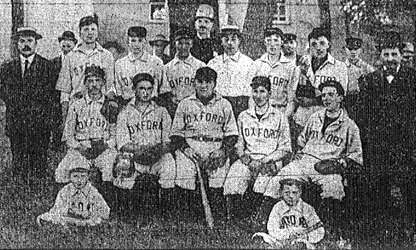
Oxford F.C. baseball team, 1905
Dolgon Playground
Avenue V between Haring and Brown Streets.
The Sheepshead Bay Houses were built in 1948, along with this playground. It had fallen into
a state of severe disrepair by 1996, when a $405,000 renovation was begun. This added many
charming features to the area, including trees which have now grown to substantially beautify
the asphalt ballfield, and such whimsical touches as gorilla and hippo statues. The park is
named for Herman Dolgon, whose efforts saw a great deal of housing built in the Sheepshead Bay
neighborhood. The Dolgon Playground ballfield is one of the few asphalt diamonds that has a
curved outfield fence, rather than the usual right angles.
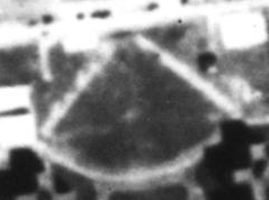
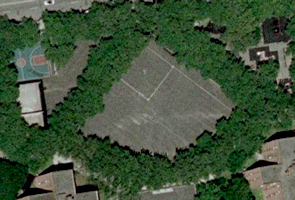
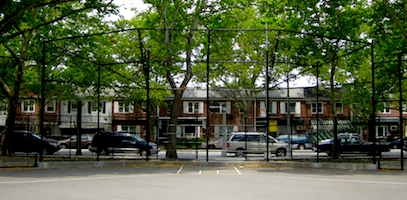
Dolgon Playground: 1951, 2006, 2010
Overhead
pictures taken from NYCityMap and Google Maps
Bill Brown Memorial Playground
Bedford Avenue, E 24th Street, Avenues X and Y.
In a similar vein, although lacking the unusual shape, is the Bill Brown Memorial Playground,
dating to 1932. A complete reconstruction in 1986 saw $785,000 spent here. Bill Brown was a
local resident who gave his life in World War I. Students of the local Dag Hammarskjold and
Joseph F. Lamb schools play ball here, and social softball games are a regular feature in summer.
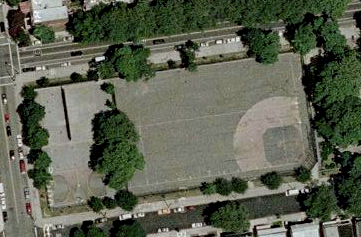
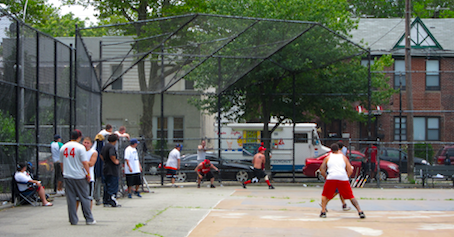
Bill Brown Memorial Playground
Overhead picture taken from Google Maps
Royal Arcanum League Grounds
Coney Island Avenue and Neck Road.
This was the official park of the Royal Arcanum League in 1915, although games took
place at many fields in Brooklyn and Queens. On June 30, Fraternity defeated
De Long 7-1, with O'Connor giving up only two hits to the "heavy hitting of De Long" and
striking out 18. The Suburban Cubs also called this field home around 1914.
Homecrest Oval
Avenue U and East 23rd Street.
One of several fields which saw games of the Royal Arcanum League in
1915. In other baseball here, the Homecrest Athletic Club squads of 1912 and 1915 racked up
long winning streaks, beating top amateur teams and semipros alike. On May 24, 1915, McIntosh, "the
diminutive twirler of the Homecrest team," allowed the Ozone B.B.C. just two hits, while
Herbold gave Homecrest three. Four Ozone errors let Homecrest A.C. escape with a 4-0 win.
Mellett Playground
Avenue V, between E 13th and E14th Streets.
A combined project of the Works Progress Administration and the Parks Department, this playground
opened on June 5, 1941. It was named, in 1950, for brothers Francis and John Mellett, who gave
their lives in World War II.
The surface was always an artificial one, and the original softball field was
accompanied by a large play area for pre-school kids. 48 trees, which dominate the landscape today,
were planted in the new playground. The softball diamond was lost in a 1995 renovation, replaced
by basketball and handball courts.
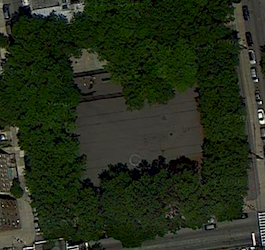
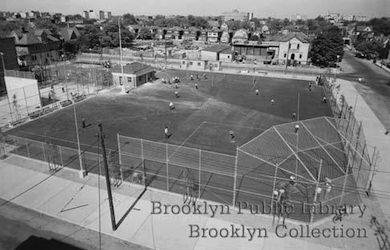
Mellett Playground in 2012 and brand new in 1941
1941 photo courtesy Brooklyn Public Library's
Brooklyn Collection
Overhead picture taken from Google Maps
Amersfort Park
Avenues I and J, 38th and 39th Streets.
This small park has no baseball facilities to speak of nowadays, but on July 4, 1918, the celebrations
here included "a burlesque baseball game between teams comprising of men and women." Joseph's
team defeated Heffernan's team, 14 to 11.
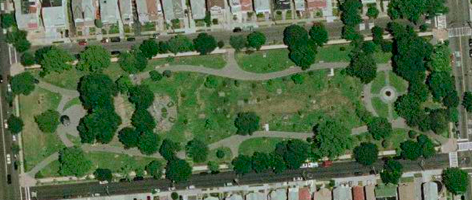
Amersfort Park, 2006
Picture taken from Google Maps
Avenue S and West 4th Street.
Another venue which saw games of the Royal Arcanum League in
1915. On June 30, Fulton defeated Morning Star, 11 to 5.
Mapleton Oval (I)
13th Avenue and 56th Street.
Mapleton Oval was home to the Mapleton Park Club around 1913-1915. Star players included Duffy,
Euler, and Doc Jackson. The club advertised that it would meet "all first class amateur uniformed
teams."
Mapleton Oval (II)
62nd Street and 20th Avenue.
This venue hosted Royal Arcanum League games from 1915, and was referred to from 1916 till
at least 1920 as Mapleton Oval, or just Mapleton Park. The Mapleton Park nine took on such teams
as the Knickerbocker Club and Brooklyn White Sox here. On July 5, 1916, De Witt Clinton scraped
past Fraternity, 7-6, en route to an undefeated season and the Royal Arcanum championship.

De Witt Clinton's 1916 championship squad
Cherry Oval
79th Street and 23rd Avenue.
Also known as Cherry Lots.
This venue saw games of the Royal Arcanum League from 1915 and 1916, including an
overwhelming 21-3 win by Fern over Brooklyn on August 28, 1915. The Harmon Athletic Club and the Benson A.C. played here
around 1915, also. Featured pitchers included Bill and Arkie Lindemann, brothers of the famous Ernie.
On August 6, 1916, the Bensonhurst Yacht Club Married Men defeated the Single Men 13 to 12, after
pitcher Lorenzo walked in the winning run with two out in the bottom of the ninth. 600 fans
watched in the sweltering heat.
Parkville Oval (I)
41st and 39th Streets, 16th Avenue.
Sometimes referred to as the Forty-First Street Grounds.
This was home to the Cortelyou Athletic Club in the early 1900s, and one of the Royal Arcanum
League's grounds from around 1912. On June 24, 1913, the powerful De Long team thumped the
Brooklyns here, 16 to 1. Soccer matches featuring Clan Chisholm were also played here. The Parkville
Athletic Association semipro team was the home sqad here for some years, of course, taking on
such teams as the Alpine Colored Giants and the Lincoln Giants. In a tense pitching duel to
open the 1923 season, "Tut" Jackson and Garry Pape of Parkville outpointed Kahn and Lamb of
Westinghouse, 2 to 0.
Eagle Grounds
Flatbush.
On August 28, 1867, Unionville of Gravesend accepted an invitation for a return game with Eagle of
Flatbush. The Eagle Club failed to avenge its earlier defeat, as Unionville hit five home runs, and scored
in every inning, including 22 runs in the fourth, on the way to a 69 to 22 victory. Unionville catcher
Morris scored 12 runs without making a single out.
Homecrest Playground
East 12th Street, north of Shore Parkway.
Also known as Homecrest Park. This playground was constructed in 1942 with a baseball field, which
was home to the Homecrest Park team, which competed in the District 6 Parks Department League. In 1951,
Homecrest Park lost to Flatlands, 9 to 3, in the semi finals. The field nowadays has aging, cracked asphalt,
and was ignored during a 1993 renovation, while the basketball and handball courts were completely revamped.
A tall chain link fence curves around left field to prevent hits landing on Shore Parkway.
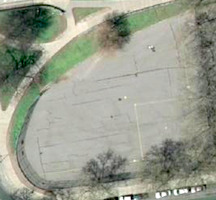
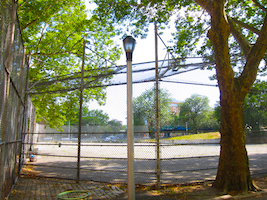
The cracked asphalt of Homecrest Playground's ballfield
Overhead photo taken from
Bing Maps
Bay Academy Playground
East 15th Street, south of Shore Parkway.
Bay Academy, or Intermediate School 98, has an asphalt playground with a ballfield at the north end of
the campus. The outfield has a curved outline, with the fence following the curl of East 15th Street as
it meets Shore Parkway. In left field there are basketball hoops, and two handball walls are in center
field and right field. Four tennis courts are also marked out on the surface.
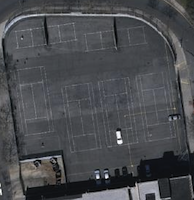
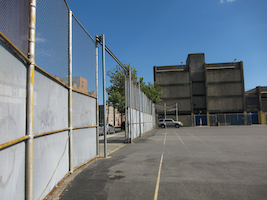
Bay Academy Playground
Overhead photo taken from
NYCityMap
Columbia Grounds
Park Avenue and Spencer Street.
This Columbia Club, distinct from the earlier mentioned one, was a junior team organized in June, 1858.
Bensonhurst Park
Bay 28th Street and Cropsey Avenue.
This public park, which first saw use in 1895, has a stunning waterfront view of Staten Island and the Verazzano Bridge.
As well as baseball and softball fields, there is facility for tennis and basketball. Bensonhurst Park is one
of the many fields hosting games of the Prospect Park Baseball Association.
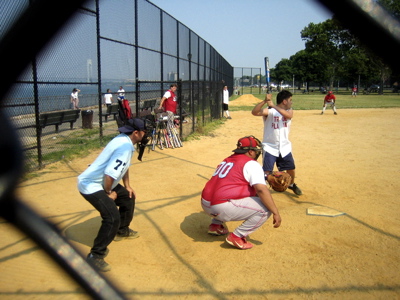
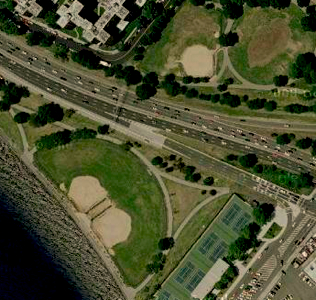
Softball at Bensonhurst Park
Overhead photo taken from Google Maps
Seth Low Park
Avenue P, West 12th Street, Bay Parkway, Stillwell Avenue.
Named for the former NYC mayor and Columbia president, Seth Low Park has been a Bensonhurst institution since 1924.
Between 1988 and 2000, almost $900,000 was spent on improvements here including a new parkhouse.
Stickball at Seth Low, with the official Spaldeen, was a constant for many years, along with softball,
which persists today on the asphalt field. In a September, 2008 matchup, the Longshots took both games of a doubleheader
against the Ballers, 6 to 4 and 6 to 3.
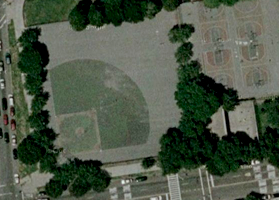
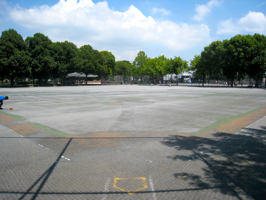
The Seth Low Park softball field
Overhead photo taken from Google Maps
55th Street and 16th Avenue
This field saw regular use in the Brooklyn Union Gas League of 1910, with the Meter Repair
and Kings County Lighting Company playing home games here. On June 1, Citizens Branch visited
Kings County and won a loosely played affair, 22 to 16. On June 7, Williamsburgh Branch
survived a late comeback from Meter Repair to hold on for a tense 13 to 11 win.
Jewish Community House Field
Bay Parkway and 79th Street.
The Jewish Community House was a massive complex, taking up an entire block, opened in 1927.
Most famously in the sports realm, the J.C.H. Basketball League was highlhy competitive and long lived.
For many years, regular summer camps were held here. Organizers promoted the fact that kids
who only wanted to play baseball would be exposed to arts and music as well, and that kids who didn't
even know what a baseball was would learn to play. Non-camp baseball was played here from time to time,
also. On May 21, 1932, the Majestics A.S.C. baseball team beat the Majors, 6 to 3, with Mandel
and Rothfeld hitting home runs, but lost to Le Rois the next day, 13 to 12. The Majestics punchball
team did take a doubleheader from Le Rois, though, 6-2 and 5-2.
Neptune Ground
5th Avenue and Pacific Street.
Also home to the Dreadnaught Club, appropriately continuing the aquatic theme at Pacific Street.
In May, 1859, Neptune lost 25 to 23 against the Vernon Club, with Vernon catcher Bergen scoring
7 runs without making an out.
Nassau Grounds
Cumberland and Willoughby Streets.
The Nassau Club should not be confused with its namesake from Princeton. In September, 1859, Nassau
defeated again unlucky Neptune at these grounds, 18 to 17, in a "well contested" match.
Jefferson Field (I)
Weirfield Street and Knickerbocker Avenue.
Also known as Jefferson Oval. This field was home to the Jefferson Field Club, a junior nine
aged 9-11, around 1907. The club played Sunday matches against such rivals as the Borough
Field Club, Lexington, and Arvern Athletic Club, drawing crowds of 1,500 or more.
Linden Park
Linden Boulevard, Vermont Street, Stanley and Van Siclen Avenues.
Also known as Linden Playground and J.H.S. 166 Playground. This park was opened in 1955, and acquired
the Linden Park name in 1997. While its football field and running track are made of high tech surfaces,
the baseball field is pure ashpalt, cracked and aged, with basketball hoops and backboards in
the outfield. High school track meets, part of the Spring Series, are held here each year. Erasmus
Hall also hosts invitational track meets at Linden Park.
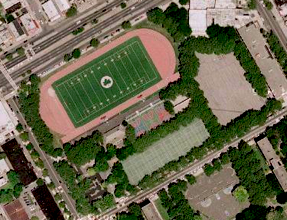

Linden Playground
Overhead picture taken from Google Maps
Jefferson and Saratoga Avenues
This vacant lot saw many uses over time. In 1904, it was taken over by an evangelical group, and
the Union Gospel Tent was erected. But in May, 1906, it also saw baseball. In a strong hitting
exhibition, Antlers A.C. defeated Kingston A.C. 13 to 7.
Halsey Street Ground
Halsey Street and Sumner Avenue.
The Glendale Club, which spent most of its history in Queens, played games here in 1887,
defeating the Stuyvesants 14 to 8 on August 19.
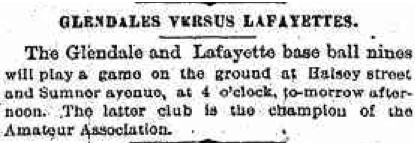
Elms Club Grounds
Halsey Street and Patchen Avenue.
On June 23, 1888, the Bayside Athletic Association team of Bay Ridge visited the Elms, and "gave them a
drubbing." The Baysides scored at least two runs in each of the six innings played, and ran out winners
by a score of 20 to 3. Fagan and Clark were said to be the batting stars.
Manhattan Field Club Grounds
Weirfield Street and Irving Avenue.
The Manhattan Field Club was a junior team, average age 15, formed in 1902 for Sunday play with
William Ennis as captain. Regular opponents included the Brighton Field Club from Wallace's
Grounds, just nearby. On June 20, 1909, the Original Phoenix A.C. of Flatbush defeated the
Manhattans 17 to 3, pulling off one of the rarest plays in baseball: a triple steal.
Dover Oval
Albany Avenue and Midwood Street.
The Dovers called this field home in 1909, hosting such clubs as the Nationals and the Pioneer
Field Club.
Young Prospect Diamond
Prospect Place near New York Avenue.
On April 10, 1894, the Young Franklins took on the Young
Prospects here and won the day, 6 to 2 in five innings. Pitcher Charles Cangly was the star
performer for the Franklins.
Brower Park
Park Place, Kingston and Brooklyn Avenues.
April 10, 1894, was a busy day for base ball in Crown Heights. Not
far away from the Young Prospect Diamond, the Young Kingstons and the Deans played a match here, although it only
lasted two innings. The Kingstons took away the honors by a score of 10 to 4. In May, the Young
Emburys defeated the Young Ben Hurs, 8 to 4, in a game that lasted the full nine innings. Nowadays there are too
many trees at Brower Park for a practical game of baseball.
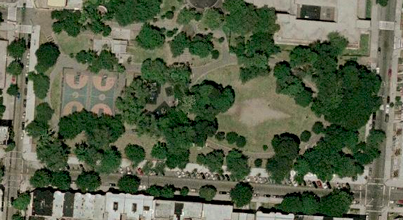
Modern day Brower Park
Picture taken from Google Maps
Albany Avenue and Rutland Road
The Flatbush Gas Company played home games here during the Brooklyn Union Gas Company
League season of 1910. The Flatbush squad was a solid third place team that year - unable
to get past the powerful Metropolitan and Newtown teams, but well ahead of the remaining
five. On June 1, Flatbush garnered 24 hits and sent Williamsburgh home on the wrong end
of a rousing 16 to 7 score. On August 22, Flatbush was spared blushes against Kings
County Lighting, scoring twice in the bottom of the ninth to escape with a 6 to 5 win,
after making 12 errors.
Kings County Athletic Field
Dean Street and Albany Avenue.
In 1896, Boys High School leased this field from the Kings County Athletic Club for early season
practice. Players Duncan and Lambert represented both the club and the school at that time. The Kings
County nine was managed by Billy Pansch.
Ben Hur Grounds
Kingston Avenue, Dean and Bergen Streets.
Also known as Boys High Field (I). The Ben Hur Athletic Association played here around 1894 to 1896,
facing such opponents as the Laurels.
A few weeks after announcing the arrangement at the Kings County
Athletic Field, Boys High began preparing a new diamond for the 1896 season at these grounds, barely a
block away. The space was offered to the school by the owner, Mr. Bliss. Star players such as Duncan,
Weir, and captain Lambert played there in front of the Howlers, the school's official rooting society.
The Eagle opined: The members of the society gave the yells in a manner that showed a decided
improvement on the old go-as-you-please way.
Gregorian Field
Brooklyn Avenue and Crown Street.
On May 30, 1912, the Gregorians, representing St. Gregory's Church, opened this field against
the St. Matthew's Catholic Club team in front of 1,000 fans. The home nine scored four runs in the
first inning, and held on for a 5 to 4 win. Gregorian pitcher Peterson struck out thirteen, while
left fielder Kiernan made three hits for the visitors. The second leg
of a doubleheader failed to take place, as the Fairmonts did not appear. The Gregorians, aided
by a strategy of recruiting excellent reserves to back up the starting nine, went on to win
45 of their 50 matches for the 1912 season.
Morse Oval
Foot of 52nd Street.
Also known as King's Star Oval, McKeon's Oval, and Bemis Oval.
This ground was home to the Cherry Pickers, Caffrey's All Stars, the Nassau B.B.C., and McKeon's Blue Sox
at various times in the 1910s. On June 20, 1915, the Adirondack Council of the Royal Arcanum visisted the
Blue Sox and came away with a dramatic 4-3 win, scoring the winning run in the top of the eighth inning.
Severinson, pitching for Adirondack, scattered six hits and struck out eleven, besting Grover, who struck
out 16 but allowed ten hits. Kerrigan made three hits for the Blue Sox.
Most famously in the late 1910s, this was the home of the Morse Dry Dock soccer team, which reached the
later stages of two national cup tournaments and won the Southern New York State Association Cup in 1919.
But the Morse Base Ball Club also played here from 1918 to 1920, part of that time under the charge of
former Superbas star Bill Dahlen. They took on such opponents as the Cuban Giants. On June 8, 1918, the
Morse Dry Dock nine defeated the Submarine Boat Corporation of Newark, 9 to 3. 3,000
fans crowded the grounds, seeing both the game and a performance by the Garde Republicaine band. The whole
affair was a "benefit for the purpose of obtaining tobacco for the French sailors and soldiers in
American waters."
In the 1930s, in a much reduced form as Bemis Oval, this was one of many fields in the Bay Ridge
area used by the Home Talk League. The Francis All Stars, a team formed at a cafe called Francis'
Coffee Pot, played home games here at that time, also. In February, 1932, junior players in the area
got off to an extremely early start for the season at Bemis Oval. On February 18, the Senators defeated the Cyclones,
3 to 2, playing errorless ball despite the cold conditions. On February 22, the it was the
Red Wings' turn to make no errors, but the Senators still won, 4 to 2. Great versatility
was shown by Senators players King, who played first base and pitched, and Fox, who switched
between catcher and shortstop.
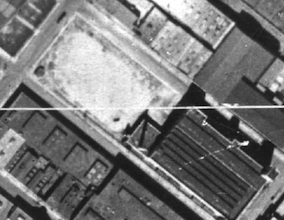
Bill Dahlen, and the remains of Morse Oval in 1924
Saint A's Field
53rd Street, east of 21st Avenue.
Home to the St. Athanasius little league teams- the Angels, and host to other matches within the
78th Precinct and Prospect Park associations, this kid-sized field has been in place since the 1940s.
The right and left field lines measure little more than 170 feet.
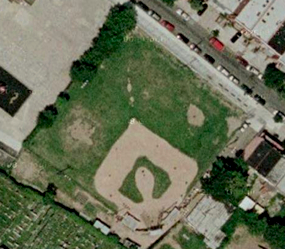
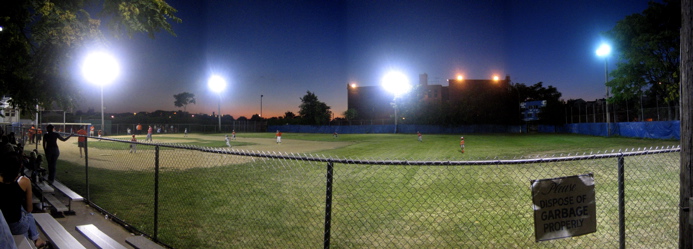
Saint A's Field from overhead, and lit for a night game, August 2006: Bulldogs 19,
Bonnies 1
Overhead photo taken from Google Maps
Gravesend Park
18th Avenue and 56th Street.
Although this park, dating to 1917, is some way north of Gravesend, it acquired the name for nearby Gravesend
Avenue, now McDonald Avenue. The fields here were in a desperate state for many years, but
over $3 million in renovation funds saw the whole park overhauled. The ballfields, reopened
in May, 2008, are now pristine. Bocce and handball are also popular here.
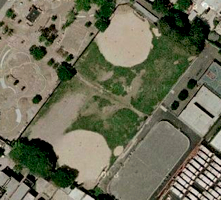
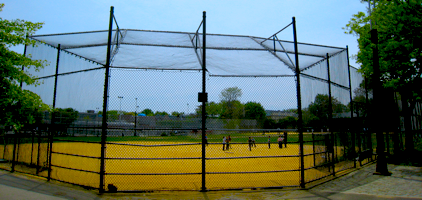
Gravesend Park, before and after renovation
Overhead photo taken from Google Maps
Dauntless Oval
Nostrand Avenue and Avenue J.
Presumably named for its proximity to the Dauntless Council, this field was one of several used for the
1912 Royal Arcanum League schedule. The grand season opener here pitted De Long and Long Island, who were
honored by Grand Regent Roswell H. Starrett throwing out the first ball.
Lenox Oval
Clarendon Road and East 37th Street.
This field should not be confused with Lenox Oval in Manhattan, home of the famous Lincoln Giants.
The Lenox Athletic Club, another of many semipro outfits in Flatbush, played here from 1906 to 1908.
On May 30, 1906, the Star Athletic Club visited and won a tense, back and forth encounter by a score of
9 to 8, with the winning run being made in the ninth inning. Of the 18 players involved in the game, only
Lenox left fielder Sheering failed to score - everyone else scored exactly once. The Stars won despite
making 10 errors and being easily outhit, 19 to 6.
As part of the July 4 slate of holiday games in 1908, the Lenox team hosted the Woodruff Field Club here
for a morning game, before making the trip to nearby Lawrence Oval for an afternoon game with the Lawrence
Field Club.
Flatbush Field (I)
Avenue F (now Farragut Road), East 37th Street.
Also known as Flatbush Oval (I). Home to the Flatbush Athletic Club from 1910. The Brooklyn Eagle reported
that "an excellent diamond has been laid out and two stands erected." In 1913, the Flatbush
A.C. gave up on other sports and became the Flatbush Base Ball Club. That 1913 club won 32
of 43 games, with star pitcher Neyenhouse starting 28 games and winning 25. In September, Neyenhouse
shut out the visiting New York Superbas, giving up just one hit and striking out 17 in a 4 to 0 win.
So impressed was the new Flatbush B.B.C. with its season, that the players held a minstrel show at the
Cortleyou Club to celebrate. Royal Arcanum League games and other local matches were also played at
Flatbush Field.
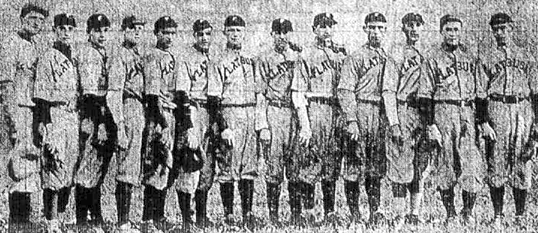
The Flatbush B.B.C. of 1913
Flatbush Oval (III)
Fillmore Avenue and East 53rd Street.
Also known as Fillmore Oval, Greys Field, and Flatbush Greys Oval.
The semipro Flatbush Greys, managed by former Dodger Artie Dede, played here from 1936 and won
most games against local semipro and amateur squads. In 1940, Dede moved on, and some of the players
reformed as the Flatbush Club. In 1939, the Greys won 14 games on end, including an epic tussle with
Wakefield, 4 to 3 in 13 innings. Pitcher Woody English drove in the winning run.
Not to be outdone, on August 25, 1940, Tom Cummings pitched all 14 innings of a win over Morristown.
Other visitors included the Hilldale Colored Stars, Visitation B.B.C., and the Brooklyn Barons.

1937 Greys scorecard
Colonial Oval (I)
Flatbush Avenue, Avenues I and J.
In 1907 the Aztec Athletic Club called Colonial Oval home, opening their season against
the Unity Field Club. The Colonial A.C., a strong semipro team, was the main tenant.
Linden Field (I)
Tilden, New York, and Snyder Avenues, East 32nd Street.
Also known as Linden Oval, Lawrence Park, Holy Cross Oval, and Lawrence Oval. This field was home to various
nines in different years. Tenants included the Linden Field Club in 1905 and 1906, the Lenox Athletic Club
around 1905, and the Linden Athletic Association in 1909. In 1912, new stands were built for the Holy
Cross Lyceum squad, a powerful semipro outfit from a club that also competed strongly in boxing, bowling,
and running.
In June, 1906, employees of the Edwin C. Burt Company played a match at Linden Field, Office vs. Factory.
Office ran out convincing winners, 24 to 9, with Doyle and Murphy forming the victorious battery.
On May 12, 1912, Holy Cross Lyceum scored 5 runs in the seventh and 3 in the eighth to defeat the Idle Hour
Athletic Club, 10 to 5. 500 fans saw "Smiling" Charlie Golden, former star of the Amersford Juniors, strike
out twelve batters. The Eagle reported: The game was interesting throughout, with many lightning plays
and hard batting to keep the large attendance enthused.
Linden Field (II)
Foster and Ocean Avenues.
The lack of a grand stand at this field did not stop the fans. The Eagle reported on April 25,
1910, that some five hundred baseball spectators had lined Foster and Ocean avenues and "witnessed
one of the most exciting games ever played at that field." The Linden BBC defeated the St. Mark's
Church team 9 to 7, scoring four runs in the eighth, and two in the ninth. Hernandez made four
base hits for the Lindens, and Rand hit a home run.
Kings Field
Newkirk and Foster Avenues, East 31st and 32nd Streets.
After years of broken windows caused by foul balls from baseball games on this lot, the owners
of the local waterworks built a proper field in 1932 as a service to the community, promising
a "modern backstop." This field was home to the amateur Flatbush Robins, whose regular opponents
included the Rams, Icons, and Grazianos. On July 14, 1947, Johnny Holmlund of the Grazianos
pitched a two hitter in shutting out the Robins for a 2-0 win. Confusingly, in the early 1940s
this park was referred to in soccer circles as Flatbush Oval, making it Flatbush Oval (IV).
The lot is now part of a housing project.
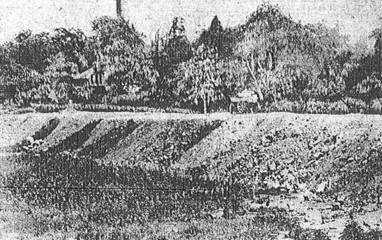
The new ballfield under construction
Flatbush Insane Asylum Grounds
Winthrop Street, Albany, Clarkson, and Troy Avenues.
On Labor Day, 1896, the otherwise notorious Flatbush Insane Asylum hosted musical and dramatic
entertainments, and held a match on the grounds between picked nines of patients and medical staff.
The staff's battery of Tompkins and Dr. Warren proved no match for a powerful patient lineup,
conceding the honors in a 23 to 14 match. Murtha and Quinn formed the winning battery. Some 400
inmates cheered their team on from the grounds, along with "many more from the windows of the
wards."
Ebbets Field Parking Lot
Bedford Avenue between Sullivan Place and Montgomery Street.
In July, 1952, the Brooklyn Dodgers received a letter from the Talmudical Academy, asking
for a softball back. A player from their team had smacked a home run from the parking lot clear
over Bedford Avenue and into Ebbets Field, a 350 foot shot. No one could find the ball,
so a new one was provided.
62nd Precinct Ballfields
Avenue X, south of West 8th and West 11th Streets.
In July 1967, 13 boys from Coney Island protested a city land auction, trying to prevent
the sale of their ballfields. Along with Herman Epstein of the 62nd Precinct Youth Council, they
explained that the city had leased them the field for $15 a year, and that they had improved the
area immensely since 1960, creating two diamonds and installing dugouts so 13 local teams could play.
The Real Estate Department could find no record of the lease, but Commissioner Carl Madonick
intervened and removed the property from auction anyway. The diamonds survive today as the Ty
Cobb Fields. These are home to the Ty Cobb Big Apple League, offering co-ed baseball for ages
5 to 16, and the Brooklyn Titans baseball and softball organization.
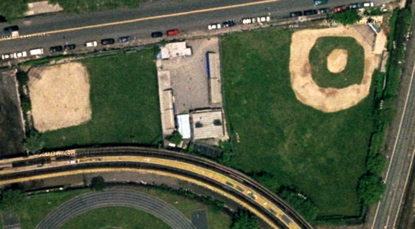
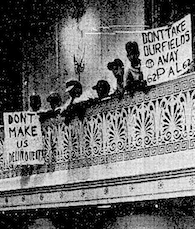
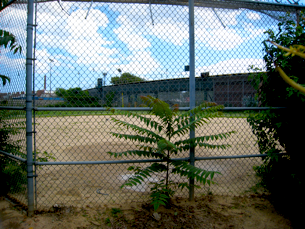
Ty Cobb Fields in 2006, kids at the 1967 city auction,
and the fields looking overgrown at the end of the 2009 season
Overhead photo taken from Google Maps
Steeplechase Field
Coney Island Boardwalk, between West 16th and West 17th Streets.
This field, immediately south of Keyspan Park and sharing a common pavilion style, was
built at the same time and made ready for Spring of 2001. Playing areas were
laid out for junior soccer, field hockey, and of course baseball and softball. The juniors of the
NATs - Neighborhood All-Star Teams - were at home here each summer. Every year
on Father's Day a picnic was held here by the NYC Dads organization, too. Admission could be
a little tricky - not everyone who used the field was aware that this was a public park and
not the private property of the Cyclones.
Steeplechase Field was part of an area scheduled by the Bloomberg administration
to be rezoned and replaced by Steeplechase Plaza, a proposed amusement and entertainment
area. In October, 2011, the field was demolished as construction of the amusement area began.
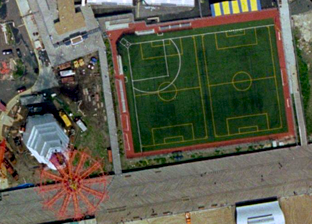
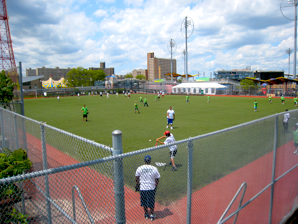
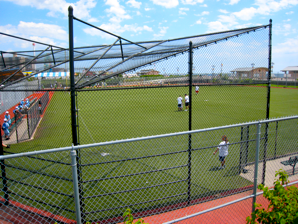
Charming Steeplechase Field
Overhead photo taken from Google Maps
Grace Field
Between West Street and Village Road East, south of Gravesend Neck Road.
This pristine field in Gravesend is more formally known as Our Lady Of Grace Field. The Grace Gravesend Little League
is part of the Gravesend Athletic Associations, founded by the local church in 1955. In 1992 the associations
took over the nearby Gil Hodges Little League, also.
On August 5, 2008, the team from Wyckoff, NJ defeated the Brooklyn Bonnies 11 to 10 in eight
innings at Grace Field to win the Gil Hodges World Series for players 11 and under.
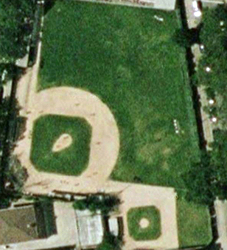

Grace Field, 2009
Overhead photo taken from Google Maps
West Playground
Avenue Z and West Street
This park dates to 1951, when the land was donated to the Park Department by the
Trump Construction Company, which was building a series of large apartment buildings to
the south. The ballfield is asphalt with painted lines. The park underwent major renovations
in 1986 at a cost of $609,000, and more minor work in 1996.
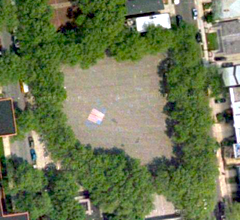
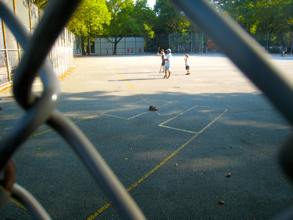
West Playground
Overhead photo taken from Google Maps
Gil Hodges Field
Between Shell Road and the MTA Depot, north of Shore Parkway.
On May 4, 1963, Brooklyn Dodger legend Gil Hodges threw out the first pitch here, and 350 young players
of the South Highway Little League had a new place to play. Gil Hodges Field has been in
continuous use ever since, nowadays hosting many little league tournaments as well as high
school and college softball. The South Highway Little League was later renamed for Gil Hodges, and
merged with the Grace Gravesend Associations in 1992.
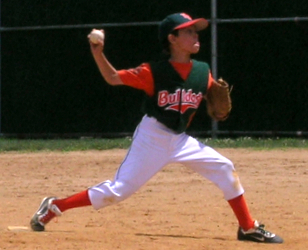
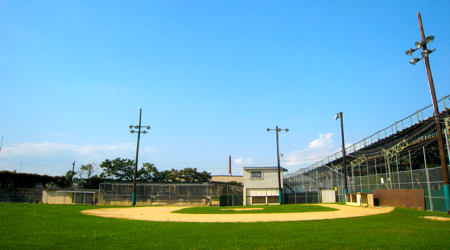
Gil Hodges Field, 78th Precinct Bulldogs in action
Action shot courtesy Attila Piros
The southern field, with lights, is by far the better maintained
of the two nowadays. The stands at Gil Hodges Field can seat 1250 spectators.
For a time from the late 1980s, Gil Hodges Field also included two extra diamonds, on the southern side
of Shore Parkway, where a Brooklyn Union gas plant had stood for many years. These were closed down in
1996, however, due to contamination of the soil discovered when the plot was put up for sale.
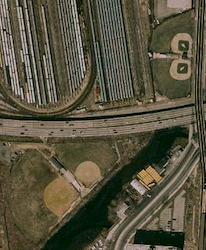
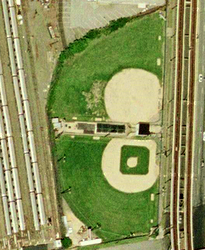
Gil Hodges Field, 1996 and 2006
Photos taken from Google Maps and NYCityMap
Kings Bay Field
Coyle Street and Avenue Z.
Although it features an excellent diamond, Kings Bay Field is far better known as a football
venue - high school teams such as Xaverian
play here, as well as Kings Bay youth teams and the Brooklyn Mariners semipro team. The
Mariners have graced Kings Bay since 1957, and were national semipro champions in 1991. The
outside wall of the football field is prominently painted with an eagle, a flag, and the
phrase "God Bless America."
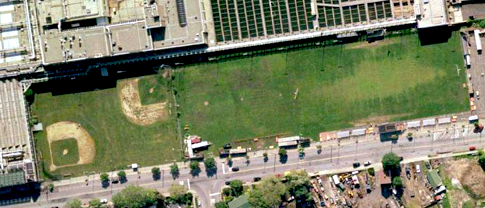
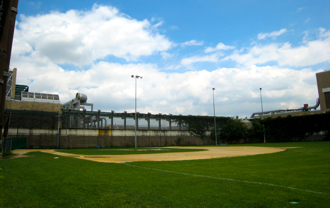
Kings Bay Field hosts football and baseball
Picture taken from Google Maps
Kings Bay Sports Center
Voorhies Avenue between Coyle and Bragg Streets.
Confusingly, some little league websites refer to this location as Kings Bay Fields. The Kings Bay
Youth Organization has hosted baseball at these well tended fields since the late 1950s.
Along with the nearly perfect turf, the backstops and chain link fences are painted in Fenway Park green,
which lends an authentic old time baseball atmosphere.
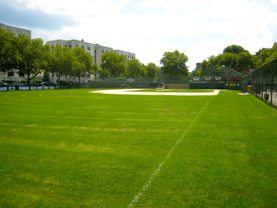
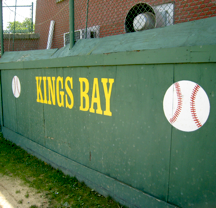

Kings Bay Sports Center, the Little League's answer to Fenway Park
Regular Little League here encompasses ages 5 to 16, and KBYO also runs the Challenger Division for
children aged 4 to 18 with disabilities. KBYO claims that their "two beautifully manicured fields are the best
in Brooklyn." Who are we to argue?

Kings Bay Sports Center - best in Brooklyn?
Picture taken from Google Maps
Mark Twain Field
Neptune Avenue and West 24th Street.
The Mark Twain Intermediate School on Neptune Avenue used to have its own turf ballfield, despite
being situated right next to Kaiser Park. The lot is the one at the far right of the Kaiser Park
photographs, above. Mark Twain Field was used by the Coney Island League in the 1940s and 1950s.
In September, 1949, the former players of the Coney Island Redwings team played the Coney
Island League All Stars in a benefit match at Mark Twain Field for the family of Teddy Cantor,
who had died suddenly a few weeks earlier. Cantor had been a Redwings player before joining the
Army, where he had pitched in a military game against Johnny Vander Meer and lost a beauty,
1-0. Today, the Mark Twain ballfield is an asphalt one, with spray painted batter's box.
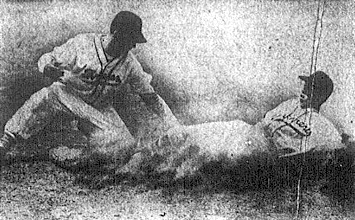
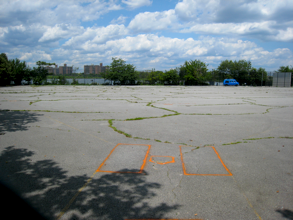
1954 - Coney Island All Stars beat the Parade Ground All Stars, 4 to 1, and 2009 - an asphalt lot
Coney Island Ball Grounds
Adjoining the Coney Island Railroad depot.
A new ball ground at Coney Island was constructed in May, 1864, and its arrival was much anticipated,
according to the Brooklyn Eagle:
OH! FOR THE COUNTRY. - No pleasanter ride in the
country can be had than along the line of the Brooklyn and Coney Island Railroad. Yesterday the cars were
crowded with pleasure-seekers. The base ball grounds are also attracting the attention of all interested
in this healthy game, and on Sunday last a large number visited the grounds for the purpose of surveying
them. The cars for the Island leave every sixteen minutes and are all that the pleasure-seeking public
could desire.
On June 20, 1864, the men of Company G of the Fourteenth Regiment wrote to the Brooklyn Eagle, suggesting
a friendly match with the Thirteenth to inaugurate the new Coney Island Ball Grounds. Reference was made
to an offer by the proprietor, Mr. Quevedo, who offered "the free use of special cars to the Island and back,
and the providing of suitable refreshments for the members of the 14th Regiment and their lady friends on
the occasion."
Coney Island Baseball Field
Neptune Avenue, Stillwater Avenue, West 15th Street.
On April 23, 1905, the Brooklyn Eagle reported: The Island awoke yesterday to the fact that it was to
have a big baseball park this season. It is to be at West Fifteenth Street and Neptune Avenue, and
there was much speculation yesterday as to who were behind the new amusement scheme. There was a
rumor that big Sunday games are planned.
The man behind the scheme was ex National League player Kid Carsey, who specialized in arranging semipro
contests on local fields. He set up a Coney Island Field Club squad to play the likes of the Royal Giants
and the Passaic Nine. This did not last long, however, and soon Carsey was promoting his games in
Manhattan instead. In late May, a game was held at the ground between Engines 1 and 2 of the Luna
Park "Fire and Flames" exhibit. Such was the rivalry that former Brooklyn catcher and notorious
American Association umpire Peeples was recruited to officiate.
Coney Island Field (I)
Neptune Avenue between West 12th Street and the subway tracks.
Also known as the Coney Island Velodrome, Coney Island Oval, and B.M.T. Oval.
In 1928 and 1929, the B.M.T. All Stars baseball team played here. The field was enclosed before
the 1929 season, in time for the visit of the New York Bloomer Girls squad. Other opponents
included the Bedford Circles, the Woodhaven Aldines, and the Wayne Field Club. On July 23, 1928,
B.M.T. pitcher Tomasula carried a no-hit bid into the eighth inning against the Ashton Blue Sox,
before fading. He did, however, pick up the win, 5 to 4.
In 1930 the ballfield was converted into the Coney Island Velodrome, and saw cycling, midget auto racing, boxing,
and wrestling for another 20 years. Nowadays, hidden between the houses on the site, the
Neptune Playground - not to be confused with an old name for Kaiser Park - is considerably smaller,
and houses volleyball and basketball courts.

Coney Island Velodrome in the 1930s
Harmony Grounds
Myrtle and Division Avenues.
The Harmony Base Ball Club, which was considered a powerhouse locally until beaten by the Atlantics in 1855,
played here on their own grounds, in back of the Franklin Hotel. Regular play days were Tuesday and Friday.
The Harmony Club continued to play in 1857, despite having lost many of its better players - Rapelye, Boerum,
Price, Phelps, Bergen, and Ireland - to the Atlantic Club during 1856.
Pratt's Lots
DeKalb Avenue, Myrtle Avenue, Grand Avenue, Schenck Street.
This large group of partially developed blocks formed a far more informal sort of Parade Ground for the
children of the Seventh Ward in the 1890s. Former big league outfielder and pitcher Jimmy
Bannon coached the local kids here.
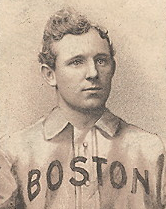
Jimmy Bannon, local ball coach
St. Andrew's Playground
Herkimer Street, Atlantic and Kingston Avenues.
In 1945, the city purchased the former Brooklyn Orphan Asylum to build this playground.
The baseball field here features lights for evening games, and handball and basketball
courts are also available. The Marcy Avenue Campus co-ed softball team played some home games at this
field before the program was dropped in 2008.
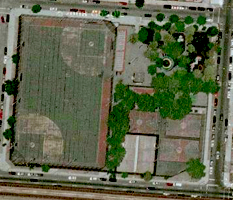
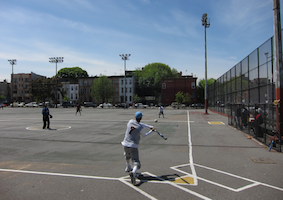
St. Andrew's Playground, with two overlapping ballfields
Overhead photo taken from Google Maps
Linton Park
Blake and Miller Avenues.
Also known as Linton Oval. While today's Linton Park has no room for baseball, it was once home to the Linton Park
Athletic Club, whose 1907 visitors incuded the Flatbush Club and the Spartans of East New York.
The Penn Glens also played matches here in 1909, against the Monroes and Lincolns, among others.

Modern day Linton Park
Picture taken from Google Maps
Bay Ridge Oval (I)
75th Street and 5th Avenue.
This was home to the Bay Ridge Field Club around 1905. In a dramatic contest on August 7, 1905,
the Bay Ridge F.C. defeated All Bay Ridge, a team made up of players from other squads in the area.
All Bay Ridge rallied from an early 6-1 deficit, scored five in the fifth, and took a two run lead in
the top of the ninth. But Frey of Bay Ridge F.C. doubled in two runs in the bottom of the ninth to
tie the game and send it to extra innings. In the eleventh, All Bay Ridge scored once, but Frey hit
another two run double to win the game, 12 to 11.
Bay Ridge Oval (II)
68th Street and 5th Avenue.
Also known as Minor's Bay Ridge Park.
Home to the Bay Ridge Athletic Club team from 1905. Opponents were many and varied: St.
Michael's Field Club, the Baltimore Colored Giants, and Wall's All Professionals were some of the visitors
in 1905 alone. In 1914, when the stands were rebuilt to seat 4,000, such opponents as the Manhattan
Bloomer Girls played the locals. Advertising for that match focused
on the Manhattan pitcher, Mamie O'Rourke, who had impressed major league players in practice games and struck
out Giants manager John McGraw.
Bay Ridge Baseball Park
49th and 51st Streets and 2nd Avenue.
Also known as Bay Ridge Oval (III).
The Bay Ridge Club played here under the management of Edward Dougherty in 1906.
In June, Dougherty and Nat Strong, then manager of the Manhattan Beach team,
were arrested for violating Sunday baseball laws by placing contribution boxes at
the exits of the ground after the crowd started to leave. Magistrate Tighe
dismissed the charges. Other attractions included matches between such clubs as the
Superba and South Brooklyn Field Clubs.
Bay Ridge Oval (IV)
81st Street and 5th Avenue.
This had been the home of the Bay Ridge Field Club baseball team some time prior to 1908,
when it was secured for the use of the St. Michael's Lyceum football squad.
On May 13, 1912, a large crowd ventured to this Bay Ridge Oval to cheer on the Standard Oil Company
teams of New York and New Jersey in the deciding match of the best-of-three series. The New York
squad won out, 11 to 4. New York pitcher Freely struck out 14, while first baseman Lindberg
rapped out four hits and scored three runs.
Bay Ridge Oval (V)
84th Street and 4th Avenue.
This venue hosted games of the Royal Arcanum League in 1916, featuring such matchups as
Fraternity vs. Bedford. In 1920, the Arbor Vitae Masonic Lodge team played home matches
here also.
86th Street and 11th Avenue
Shore Ridge played the Bay Ridge Stars here in May, 1932, and won handsomely, 12 to 1. The result
was never in doubt after a seven run first inning. Shortstop Denyse enjoyed a fine game, scoring
three runs on three hits, including a double, and making three assists in the field. This field
was also used in the Home Talk League of 1933, seeing such matches as Garnets vs Belmonts and
Shore Ridges vs Camosets.
This field was never built over by houses, but the site is now part of the Dyker Beach Golf Course.
Bay Ridge Oval (VII)
43rd and 44th Streets, 2nd Avenue.
This field saw constant use as a high level soccer venue from 1932 to 1948, initially as home to the
Greenock West of Scotland Football Club, but was also host to occasional baseball, including matches
of the Home Talk Baseball League from 1932, and was home to the Bay Ridge nine that
same year. In an exciting back and forth match in August, 1932, the Bay Ridge Club scored four
runs in the sixth inning to turn a 5-2 deficit into a 6-5 win over the West Side Club. All five
of West Side's runs had been scored in the fourth inning.
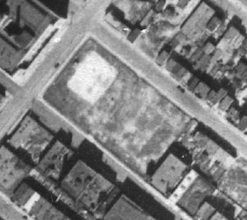
Bay Ridge Oval (VII) in 1924
Picture
from NYCityMap
Varuna Park
58th Street and 1st Avenue.
Varuna Park was a regular venue for both American and Association football during the 1890s. There
was also base ball, however, with the Varuna Club branching out from its usual sport of rowing to try out
the diamond. On June 29, 1890, The Varuna and Oriole teams met, with over three
hundred spectators on hand. The Orioles led 4-1 after the first inning, but Varuna pitcher J. Worth
had them in his pocket after that, and the Varunas piled on five runs in the sixth, and four runs
in the ninth on the way to a 16-4 victory.
In 1892, as the Varunas piled up wins behind star pitcher Harrigan, the Eagle offered this description
of their home field:
The Varuna baseball park is a pleasant spot, for no matter how hot it may be in the city there is
generally a breeze to be found at Bay Ridge. The distance from the home plate to the left field fence is
very short, and as a hit over it counts for a home run the interest is likely to be taken out of a contest
by a player sending the ball out of the grounds. The rule should be altered so as to make such a hit
count for only two bases. The Varunas argue that the present rule is as fair for the visiting team as for
them. Most of the visiting teams play only one or, perhaps, two games there during the season while the
Varunas play there every week. Some of the oarsmen have the fence down fine and can be relied upon for a hit
over it at least once during a game. To make it a two bagger would be fairer all round.
On the Fall sports side of things, "the most desperately contested foot ball contest ever seen on the
Varuna Park gridiron" took place on November 21, 1897 between St. Peter's and Willets Point. The two
elevens struggled through a scoreless match until the very end, when Benjamin "was forced through
the Willets Point center and carried over the line for a touch down." There was not even time left to
kick the goal after the score.
Daubert's Field
Ocean Boulevard, Kings Highway, East 2nd Street, Avenue Q (now Quentin Road).
Also known as the Parkway Driving Club. This ground opened for harness racing in October,
1892, as a more civilized alternative to the nearby Gravesend Race Track. In the venue's later years,
it saw some action as a social baseball field. In April, 1910, the Coney Island and Elizabeth Street
police precincts played such a game, with Coney Island emerging winners, 11 to 9. The Eagle reported:
There was a large attendance on both sides and the rooting was enthsiastic.
In 1914, Brooklyn Dodger captain Jake Daubert (acting as a front man for Charlie Ebbets)
formed a semipro team called the Oakland Club, and the old Parkway Driving Club grounds were renamed Daubert's
Field, with the intention of being a Sunday venue for the team. A grand stand was built to seat an extra 5,000
fans, and on April 19, 2,000 fans showed up to see the Oaklands take on the Dodgers, but police prevented any play. Daubert
and Oakland captain Deedy had already been summoned to appear in court for organizing a game the previous
Sunday, when the Brooklyn Yannigans (Dodger rookies) had shut out the Oaklands.
The property was
sold to the Garden Land Company in 1921, and 200 houses replaced the old track and oval at a cost of
$5 million.

Jake Daubert, Dodger captain and part time semipro magnate,
the Parkway Driving Club clubhouse in 1907
Kreyer's Base Ball Park
Kings Highway and Coney Island Avenue.
Kreyer's Hotel was best known for its bowling alleys, but the grounds also hosted football and base ball
matches. On May 26, 1895, the Berkeley Base Ball Club met the Bohanna Club on the diamond in a seven
inning game. The Berkeleys won, 11 to 6, with the play of E. McCormack in center field a highlight,
taking three difficult catches and throwing out a runner at the plate.
On Thanksgiving Day, 1896, the South Brooklyn wheelmen played a football match at Kreyer's Grounds.
Because many of the cyclists were novices to the game, a set of rules was furnished:
- The two sides shall toss up, the winner having the choice of goal or kick off.
- The side having position shall stand at least ten (10) yards back from center line in their
own territory until ball has been kicked.
- Full backs only to kick ball. Other players may run or toss same.
- When a down occurs players shall line up at the spot where ball is downed.
- The ball must be passed from center to quarter, then to another player before it is in play.
- Ball may be tossed, passed, kicked, or pushed through goal, which counts one (1) point.
- Side having most points wins the game.
- Game shall consist of two halves of thirty (30) minutes each. Twenty (20) minutes intermission.
- Tackling allowed between knees and shoulders only.
- No punching or slugging allowed.
- Foot ball or bicycle costume in vogue.
- Players must have long hair.
In 1926, the Brooklyn Standard Union reported that Kreyer's Hotel had long since succumbed
to Prohibition, been demolished, and replaced with up to date shops.
St. Michael's Field (I)
47th Street and 2nd Avenue.
Home to the team of St. Michael's Field Club from 1904. This was not an enclosed ballpark, although
the Rev. John Rippere appeared in Magistrate Tighe's court in July, 1904, with a large
photograph of the stands claiming this as proof of an enclosed space, which would have made
a Sunday game against the law. Magistrate Tighe, as he often did, dismissed the charges
against the St. Michael's players.
In April, 1905, the brand new Brooklyn Royal Giants played one of their first games at St. Michael's,
and lost 7 to 4. At this time, the club featured two star pitchers, Frank Scullen
and Joe Lake. Scullen eventually turned to the priesthood, while Lake was soon pitching in the American
League. In a six year career he played for New York, St. Louis, and Detroit.
Frank Schnurr Field
83rd Street and Shore Road.
Home to the youngest players of the 68th Precinct Little League. Frank Schnurr Field, named for a
long time local coach, is the site for annual opening day festivities. All the 68th Precinct players
parade through Bay Ridge before converging on the field. Local politicians are always sure to put
in an appearance, too. This park was once part of the Crescent Athletic Club Grounds. The dugouts are
covered by blue tarpaulin, and a green sign beckons spectators to a refreshment tent beyond left
field.
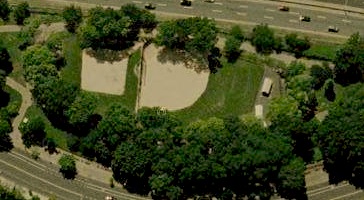
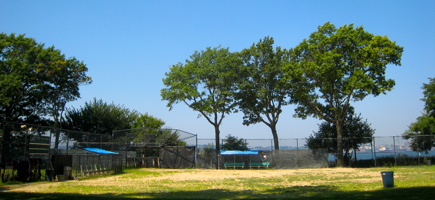
Frank Schnurr Field
Overhead picture taken from Google Maps
Vernon Oval (I)
6th and Bay Ridge Avenues.
The Vernon A.C. of Bay Ridge was founded in 1907, and newspapers record fixtures at this ground
at least as early as 1909, when the Vernons hosted the "fast going Yankees."
Vernon Oval (II)
1st Avenue (Colonial Road) between 76th and 77th Streets.
Also known as Bay Ridge Oval Field, Colonial Oval, and the Colonial Park Grounds.
The powerful Vernon amateur club called this park home from around 1913, although baseball was played at this
location as early as the Bay Ridge-Colored Giants game of 1909 and the Monitor-Oriental clash of 1911, and
football also goes back to at least 1909, when the ground was referred to as Colonial Oval (II). On June 27, 1914,
an organized nine of alumni of Public School 102 played the incumbent P.S. 102 squad here. The alumni won an
exciting game by a score of 20 to 15, in front of a "large crowd of onlookers." William Laemmel took the win
in relief of Walter Pillar, while Westbay took the loss.

A rare, recently identified picture of baseball at Vernon Oval (II) -
the mansion in the background still stands
Photo courtesy of brooklynpix.com
Vernon Oval (III)
78th and 79th Streets, 2nd Avenue (now Ridge Boulevard).
Also known as New Vernon Oval and Legion Field.
The Vernon Club moved to this field in 1916.
The Vernons would play other amateur teams, semipros, and also teams like Municipal Field Club, a picked nine
of the best players from clubs all around Brooklyn. In 1916, they opened the season here by shutting out the
wonderfully named Original Empire Club, 6 to 0. On July 6, 1919, Ben Juceam pitched all 13 innings of a nail
biting 5 to 4 win for the Vernons over St. Jerome's. The Vernons had scored two runs in the ninth to knot the
score at four apiece.
Around 1920, American Legion games were played here.
One fine example was the Buffalo Colored Stars against the Gilbert J. Doyle Post. Also, St. Francis
College played home matches here in 1922.
Good Intent Club Grounds
Benson Avenue, near the Bath House, New Utrecht.
The Good Intents hosted the Wawayanda Club of Gravesend on October 20, 1859, and took the
victory, 29 to 18. Five days later they did even better, defeating Meitowak of Flatbush by
a score of 38 to 20. The Wawayanda's visit was recorded in the Eagle with a wonderfully detailed
score card:
            GOOD INTENT OF NEW UTRECHT.
                        1  2  3  4  5  6  7  8  9
                        -  -  -  -  -  -  -  -  -
1--A J Aumack, C....... .  2  .  1  1  .  .  .  .-- 4
2--P Hegeman, 3d B..... .  .  .  .  .  .  .  .  2-- 6
3--P Snedeker, R F..... 1  .  .  .  .  1  .  .  .-- 3
4--J Morris, 2d B...... .  3  .  2  2  2  3  .  3-- 1
5--T Hinman, L F....... .  .  3  .  .  .  .  .  .-- 3
6--O Aumack, P......... .  .  .  3  .  .  2  3  .-- 2
7--E Williams, C F..... 3  .  .  .  3  3  .  1  1-- 2
8--W Remson, S S....... 2  .  2  .  .  .  .  .  .-- 5
9--S Morris, 1st B..... .  1  3  .  .  .  1  2  .-- 3
                        -  -  -  -  -  -  -  -  -  --
                        5  2  2  2  5  5  4  1  3--29

   James E Dubois, Scorer of the Good Intent.
   Martin Bennett, Umpire, of the Neosho.
   Stephen J. Stillwill, Scorer of the Wawayanda.

              WAWAYANDA OF GRAVESEND.
                        1  2  3  4  5  6  7  8  9
                        -  -  -  -  -  -  -  -  -
1--S Stryker, P........ 1  .  .  .  2  .  1  .  1-- 2
2--B Johnson, C........ .  2  .  .  3  .  2  .  .-- 3
3--J Voorhees, 2d B.... .  3  .  1  .  1  .  .  2-- 1
4--S Storey, 1st B..... .  .  .  2  .  2  3  .  .-- 3
5--A Stryker, C F...... .  .  1  3  .  .  .  1  .-- 1
6--S J Stilwill, S S... 2  .  .  .  1  .  .  .  .-- 1
7--J Stryker, L F...... 3  .  2  .  .  3  .  2  3-- 1
8--S Wyckoff, 3d B..... .  .  3  .  .  .  .  .  .-- 3
9--W Stilwill, R F..... .  1  .  .  .  .  .  3  .-- 3
                        -  -  -  -  -  -  -  -  -  --
                        2  1  3  3  1  2  2  2  2--18
Central Presbyterian Field
Kings Kighway and East 37th Street.
Also known as Hubbard Field. The Hubbard Base Ball Club, a semipro outfit, played here in the
1910s, occasionally holding the "champions of Flatbush" moniker. On June 20, 1915, the Hubbards
played an epic game against the sailors of the U.S.S. Arkansas, who scored 3 times in the eighth
inning to erase a 3-0 lead, and eventually won 4-3 in the eleventh.
Although most games in the Sunday School Athletic League were played
at the Parade Ground, Central Presbyterian was fortunate to have its own ballfield. The 1916 team
reached the S.S.A.L. final, but lost a best of three playoff to Flatbush Christian, two games to
one.
Vanderveer Park
Glenwood Road, Albany Avenue, and East 42nd Street.
The Royal Arcanum League played games here in the 1910s, as did the Sunday Schools Athletic League.
On July 27, 1913, a much anticipated Arcanum pitching duel between Hill of Gilbert and Hanley of
Dauntless went somewhat awry, as Gilbert took the game 13 to 9. Winning pitcher Hill struck out 14
and gave up only five hits, although his fielders make seven errors. Hanley struck out 15,
but gave up 16 hits.
The Vanderveer Park Grounds were home to a long standing, bitter rivalry between the
teams of the two nearest congregations, the Vanderveer Park Methodist Episcopal Church and the
Fenimore Street Methodist Episcopal Church. When both teams reached the championship game of the
S.S.A.L. in July 1917, a great match was in prospect. Alas, the season ended in anti-climax,
as two of the Fenimores were unable to play - one, catcher Robert Pearson, had been called away
to war - and Vanderveer Park took the title by a 9-0 forfeit score.

Vanderveer Park in 1924
Picture
from NYCityMap
Utica Oval
Douglass Street (now St. John's Place) and Utica Avenue.
Also known as St. Mark's Oval, in 1907 and possibly other years around then, when the St. Mark's
Methodist Episcopal team arranged to have these grounds for matches in the Protestant Church League.
This field, with a capacity of 5,000 or more, was home to the amateur Utica nine, a long time
rival of the Howards, from 1904 to 1910, after which the club moved to Saratoga Park. Soccer
matches were also played here. On April 30, 1906, the Uticas took the visiting New Brunswick
team to 10 innings in a thrilling back and forth contest before 2,100 fans, finally losing 11-10.
On April 6, 1907, the Erasmus Hall baseball squad opened its season with a game against the New York
University Freshmen at Utica Oval. As the Eagle aptly put it, "the contest proved nothing more than
batting practice for the Erasmus boys." When pitcher Jack Sibley tired of the rout, he gave way to
Rex Perpall, who proved no easier for the NYU hitters to solve, while Erasmus scored in eight of nine
innings en route to a 26 to 0 win. Almost completely lost in the newspaper coverage was the fact that
Sibley and Perpall did not allow a single hit.
Oaklins Oval
Kingston Avenue and Carroll Street.
Home to the Oaklins junior team around 1910, and the St. Gregory's Club in 1912. On September 10, 1911, a match was set here
between the Oaklins and the Elroy Field Club, for the junior championship of Williamsburg.
This does seem odd, given the field's location in the heart of Crown Heights. In any case,
although we know the Elroys and Oaklins split their previous matches, we cannot find the
result of the championship game.

Elroy F.C., 1911
Ulmer Park
The end of 25th Avenue at the waterfront.
This massive resort and amusement park was opened in 1893. Sadly,
the resort closed in 1899, but the park remained for some time after. A baseball diamond, with stands
to hold 2,500 people, was built in 1904. For many years, cricket was also played
at Ulmer Park, with the Bensonhurst Club's teams at home, although track and field meets were the
most common sporting event. The park was owned by the Ulmer Brewery, which also at one time owned Dexter
Park. In 1896, the Charles Ebbets Club had a day of athletic contests featuring "prominent citizens" and members
of the Brooklyn and Baltimore National League teams.
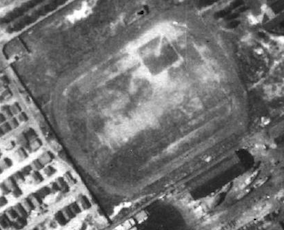
Ulmer Park in 1924
Picture
from NYCityMap
The Felix and Barry Base Ball Club, a semipro squad spun off from a vaudeville duo, was managed by
George Felix and played here from the first game in May, 1904 when they faced the X-Laurels. In the mid 1920s,
New Utrecht High played home games at Ulmer Park, as did the new Lafayette High School in the early 1940s. On June 1,
1927, Madison High beat New Utrecht 1 to 0, the only run being a steal of home by Madison's Hoffman.
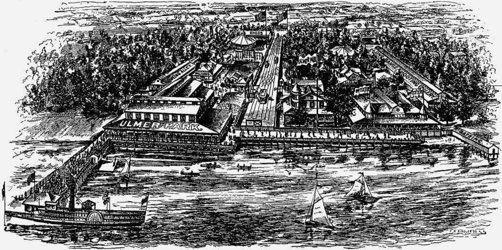
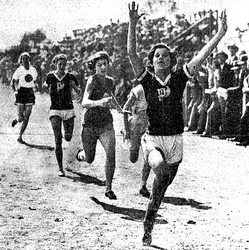
Ulmer Park resort in 1894,
Mary Saunders races to victory in the
1931 Caledonian Games at Ulmer Park
Stillwell's Hotel
Harway Avenue and Bay 48th Street.
The fifth annual outing of the E. Bick Association was held here on August 29, 1909. Activities included
a "hotly contested baseball game" between the E. Bick Association and the Wallabout Market Association.
The Bick squad took the honors, 9 to 6, with Louis Tonyes, president of the association, hitting a three
run home run.
Buhre Oval
East 9th Street, Avenue Q, Ocean Parkway
Home of another beautifully named amateur squad, St. Brendan's Lyceum Club, from 1910. On August 7, 1910,
St. Brendan's put on a show against the Manhattan Reserves, with "batting and base running too much
for the Manhattan nine" in a 10-2 win. On April 3, 1911, the St. Brendan's nine found a multitude
of ways to get on base - 11 hits, 6 walks, and 4 hit by pitch - in defeating the Brighton Field
Club, 10 to 3.
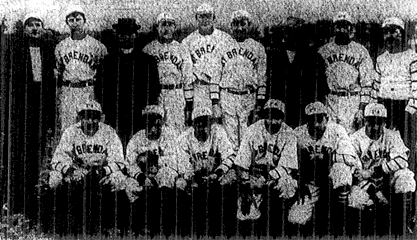
The 1910 St. Brendan's Lyceum squad
Hopkins Farm
Warwick and Elton Streets, Pitkin Avenue, New Lots Road (now New Lots Avenue).
As early as 1891, the large Hopkins Farm property stood out in East New York as properties all
around it were being sold off and broken up for development. In 1902, the East New York Field Club was
formed, challenging out of town nines to play on Wednesdays, Saturdays, and holidays on "one
of the best diamonds in Greater New York, located on what is known as Hopkins Farm." The club
remained for three seasons before moving to Taft's Oval when the farm was sold. The property
fetched $250,000 from developer Solomon Rubin in December 1904, having cost William Hopkins
$4,000 sixty years before.
East New York Oval (I)
New Jersey and New Lots Avenues.
Also known as East New York Field (I). This was home to the East New York semipro squad in 1919 and 1920, facing
such opponents as the Newburgs and the Stamfords.
When the newly formed East New Yorks needed a third baseman for the 1919 season, a bespectacled 17 year
old called George Torporcer was given a shot, after he begged manager Lon Sohl for a chance. He rewarded
his manager by hitting .417 and stealing 23 bases in 55 games. Before too long, "Specs" Torporcer was
playing for the St. Louis Cardinals of the National League, and enjoyed a long and very successful career
later in the International League.
On June 27, 1920, East New York right fielder Loesch made "the longest hit ever
seen on East New York Oval" in a 3 to 1 win over Plainfield. The field lasted only through the end
of that season, so the record likely stood.

"Specs" Torporcer as a St. Louis Cardinal
Rugby Park
Church Avenue and East 57th Street.
Also known as Dun Oval and Orient Oval. Around 1909 this was home to the Orient A.C. nine, and
later in the 1910s this was home to the Rugby Athletic Club. In 1909, Sellers of Orient pitched
a one hitter in defeating the Ætnas 12 to 0. On April 23,
1911, Rugby Park saw a dramatic 7-6 finish: With two down and Mueller on second base,
Avery Payne drove out a neat single over second base and won a close verdict for the Rugby A.C.
against the Hustler F.C. The game was very interesting throughout, many sensational plays being
made, which brought the five hundred onlookers to their feet.
The Commercial and Real Estate League played matches here in 1916, with R.G Dun & Company
calling this field home, finishing third in the league with a 7-5 record.
R.E.B. Field
Ocean Parkway and Avenue S.
The Real Estate Brokers nine acquired and opened this ground in 1913, starting with a 3 to 0 win over
the Parkways on June 7. The team played here until at least 1916, including some seasons in the
Commercial and Real Estate League. Later in 1913, the real estate section of the Brooklyn Eagle referred
to R.E.B. Field as "among the best known amateur baseball arenas of the East."
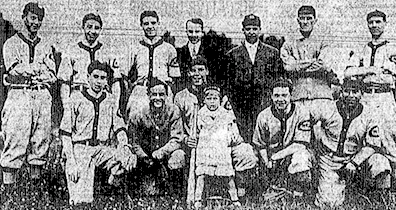
Charles Warren, captain of the Real Estate Brokers,
and the whole team on R.E.B. Field's opening day, 1913
The Brokers won the Commercial and Real Estate League by a single game in 1916, after defeating co-leader
Dieckerhoff, Raftloer Company at R.E.B. Field on September 2, the final day of the season. On September 24,
1916, the league's all star game at R.E.B Field saw the Real Estate Stars rally for a 2-2 tie in the rain
against the Commercial Stars.

Starrett City Field
Vandalia Avenue, Van Siclen Avenue, Bethel Loop.
Also known as Spring Creek Towers Field.
The Starrett City development dates to 1974, and while it officially changed name to Spring Creek Towers
in 2002, the old name has largely remained in use. The area generally has a good reputation for
safety, but one notable incident occurred on the ballfield on June 7, 2009. Eleven year old Devonte
West of the Spring Creek Mets was walking to his coach to ask a question, when he thought he was
hit on the head by a stray baseball. It was in fact a stray bullet, which was removed from his
skull at Brookdale Hospital, and he miraculously walked away four days later, vowing to return
to the playing field.
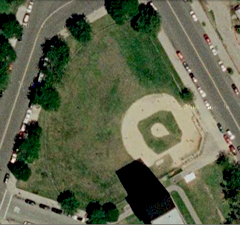
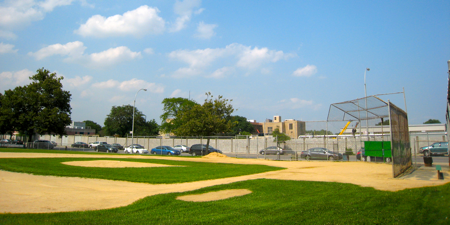
Starrett City Field
Picture taken from Google Maps
Spring Creek Youth Federation Fields
Seaview and Louisiana Avenues.
Also known as the Robert S. Esposito Ballfields.
The Spring Creek Youth Federation has run junior baseball on fields S1 and S2 since 1980, with competitions for
children from age 10 to age 16. The Federation also fields five travel teams: the Black Sox,
Warriors, Royals, Blazers, and Tigers.
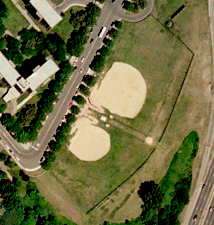
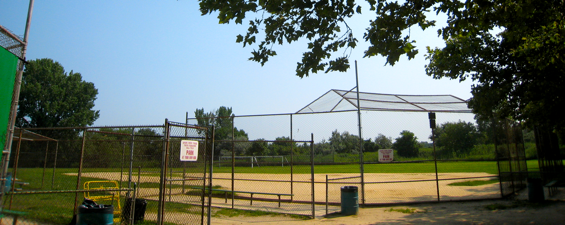
S.C.Y.F. Fields - S1 and S2
Overhead picture taken from Google Maps
Miller's Bay View Grounds
Stanley and Atkins Avenues.
Also known as Miller Oval and Bayview Park. This ground was active around 1909-10, seeing such
matchups as Ionia A.C. against Linwood, Ionia against the Warwicks, and the Nationals against
Asacog. On May 9, 1909, 500 fans saw the Spaldings rap out 12 hits and steal 5 bases to coast
to victory over the Resolutes, 9 to 3. Every Spalding player got a hit, and only pitcher Spencer
failed to tally a run.
McDonald Park
McDonald Avenue between Avenues S and T.
While McDonald Park has an ashpalt ballfield, it is far better known for
its tennis courts. The hard work and inspiration of Liz Shweky of the New York Junior Tennis League
saw $800,000 in Parks Department money spent on a complete overhaul of the courts, in 1999.
Unfortunately, no such funding has yet appeared for the ballfield, but it still sees regular use.
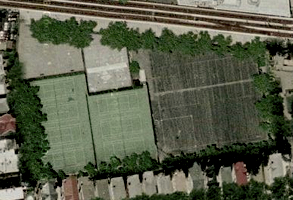
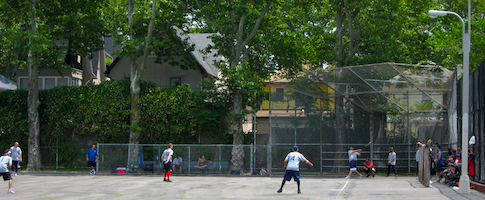
McDonald Park, 2010 - that ball is on its way over the center field fence
Overhead
picture taken from Google Maps
Sunset Diamond
40th Street and 3rd Avenue.
Also known as Dewey Junior High School Field, Playground Three Forty and Gonzalo Plasencia
Playground. This park was built in 1965 to provide recreational space for Junior High School 136,
on the eastern half of the same block. In 1998, the asphalt ballfield was replaced with grass
as part of a $700,000 renovation. Such organizations as St. Michael's Angels and the Sunset Athletic
Club host junior baseball and softball here. The park also has facilities for basketball and handball.
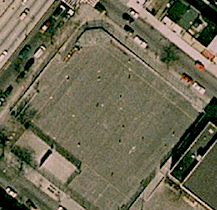
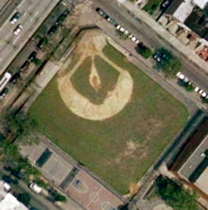

Sunset Diamond in Dewey Park, 1996, 2006, and 2010
Overhead pictures taken from NYCityMap and Google Maps
Vincent DiMattina Playground
Hicks Street and Rapelye Street.
Another little league field tucked in beside a freeway, this time the Brooklyn-Queens
Expressway. Young players from the Prospect Park Baseball Association deal with the noise here,
probably hoping to graduate to a quieter locale in future years. The city acquired the land for
this park between 1941 and 1947, and named it for lawyer and community activist Vincent
DiMattina in 1967. $783,000 was spent on renovations in 2001, when the asphalt field was
replaced with beautifully tended grass.
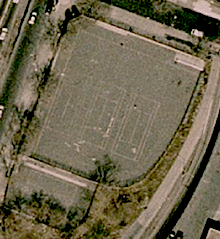
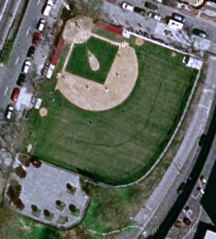
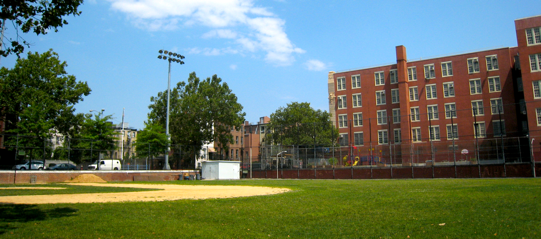
DiMattina Playground's ballfield, before and after
Overhead pictures taken from NYCityMap and Google Maps
Lincoln Oval
Avenue N and East 57th Street.
The Lincoln Club, a junior nine, played home matches here around 1907. Although the Lincolns
handily dispatched such opponents as Bay Park, Outcast, and Montauk, things were different
when the St. Joseph's Juniors visited. The Josephs made two trips to Lincoln Oval in 1907
and walked off with 16-4 and 20-9 wins over the home team.
In later years, regular Sunday games
were played at Lincoln Oval, and gate money collected. In 1916, promoter Rod McMahon was sentenced to
thirty days in jail for contempt of court. A sack containing the proceeds of the July 13 match at Lincoln Oval
had been taken from him as part of a legal judgment, and he recovered same with the use of
a baseball bat.
Amity Little League Stadium
Avenue V, Brigham Street, Knapp Street.
This superbly manicured group of three fields, supported by a large amount of advertising space,
hosts summer leagues for teams from all over Brooklyn. Champions here progress through the Cal
Ripken-Babe Ruth Baseball system. The regular Amity league includes teams in Peanut, Minor,
and Major divisions.
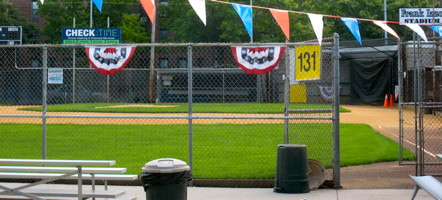
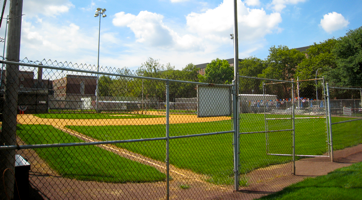
Amity's pristine fields and charming surrounds
78th Precinct Youth Sports gives an annual award in memory of Billy "Pasta" Zitelli, whose home runs
helped the 78th Precinct Bulldogs win the 1996 Amity 10 Year Old League. Known as the Babe Ruth
of Brooklyn Little League for his amazing power, Billy would live just another four years before
he was taken by leukemia.
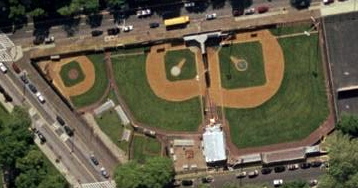
Amity Stadium
Picture taken from Google Maps
Greenwood Playground
East 5th Street and Fort Hamilton Parkway.
This playground was built as a WPA project in 1935, and dramatically altered in a series of
renovations beginning in the early 1950s, when the ballfield was created in place of a filling
station. Although the park has its own active softball league, it is equally common to see members of
the local Indian community playing cricket. Events here are organized annually by Friends of Greenwood
Playground, and include flea markets and roller skating classes.
In December, 2001, the ballfield was named Kevin F. Conroy Ballfield, to honor a victim of the
September 11 attacks.
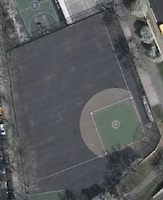
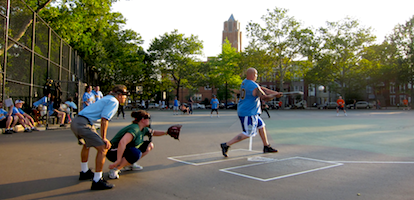
Kevin F. Conroy Ballfield at Greenwood Playground -
Yellow Hookers vs. Hurricanes in Kevin Conroy League softball
Overhead picture taken from NYCityMap
Our Lady's Field
Between Windsor Place and 16th Street, east of Prospect Park West.
Surely the cutest ballpark in Brooklyn, this tiny field is devoted to the most junior players in
the Prospect Park Baseball Association and Holy Name Fathers Guild Sports. This is a beautiful
demonstration of the 150 year old Brooklyn tradition of playing ball in any space available.
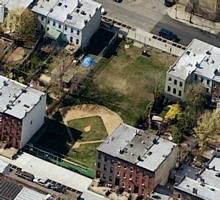
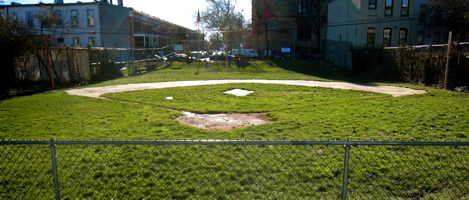
Our Lady's Field
Overhead picture taken from Windows Live Local
North Star Grounds
5th Avenue between Warren and Bergen Streets.
In September 1858, the newly formed Ivanhoe Club announced that it would play at these
grounds, already home to the North Star and Powhatan Clubs, and later the Mohawk and Unknown Clubs. This
location is the present home of Calexico,
the preferred Mexican restaurant of the staff of BrooklynBallParks.com, as well as The
Chocolate Room, the preferred dessert restaurant.
Rice's Oval
Location unknown.
Not to be confused with Rice Oval at Iona College in Westchester. On June 5, 1910, the nine from
Johns-Manville Company crushed that of the United Fruit Company, 20 to 2, in only six innings of
play. Shortstop Muller made 4 hits and scored 4 runs. This ground was also used in the Royal
Arcanum League in 1914.
Monteverde's Grand Street Park
Grand Street and Maiden Lane (now Mazeau Street).
This park opened around 1880, and featured Sunday games between amateur nines,
and beer service for the spectators. The home team was the Elite Club, and Manhattan College
also played games at the park.
These games attracted "what the owners of property joining and near to the
park considered an undesirable class," and led to a running battle between proprieter William Monteverde
and Sheriff Mitchell. Monteverde was indicted twenty times, eventually skipping bail
and disappearing in August, 1887. He left the park in the charge of friends, who were also indicted,
and eventually the place was shuttered on Sundays.
In 1893, Monteverde, having made peace with the
authorities, was sensationally elected Police Justice for Newtown, and immediately began prosecuting
the local parks for making a disturbance on Sundays, including Feldman's Queens County Grounds and the
Long Island Grounds, but not Grand Street Park. Also, while base ball games were prevented, beer and
dance halls remained open, leaving no side pleased with his actions. The battle then became even more
convoluted as Adolph Feldman swore out a complaint against the proprietors in Ridgewood,
believing that they were benefiting from an unfair bias of the Queens authorities. He later withdrew
the charges, however.
From 1890 through 1907, Grand Street Park was home to the Brooklyn Athletic Club, not related to the
former club which competed in Park Slope, and track and field
became the predominant sport. Soccer and base ball matches still took place, however, including occasional
games mixed in with track meets, featuring the Brooklyn A.C., and such visitors as the Defender Club,
the Vincentian Catholic Club, and the Maple Athletic Club. The Mansfield Post soldiers played matches
here during their picnic outings. On August 17, 1897, the Married Men of Mansfield Camp defeated the
Merry Rushers of Elmhurst, 12 to 11.
Washington Park and Casino
Grand Street (now Grand Avenue), between Newtown and Maspeth.
Also referred to as Bruhn's Washington Park. This park dates to 1899. The
New York Times reported that the grounds contained "an athletic field, a race track, two dancing
pavilions, a dining room, bowling alleys, and a shooting gallery." The New York Caledonian Club held its
annual Scottish games at Maspeth's Washington Park in 1899 and every year after for some time. This was
also the grounds for the Brooklyn Athletic Club, which competed in track and baseball, from
around 1908.
In July 1909, a horse was scared by a firework, and bolted through a crowd waiting outside the park
for trolleys. Seven people were injured, but none seriously.
In June, 1911, a picnic day for the Williamsburg Parish included "a 75-yard dash, a 440-yard dash,
a 440-yard handicap and a two mile race" along with "obstacle and hurdle races for the older boys,
as well as a baseball game."

Athletic games of the United Irish Society at Washington Park, 1906
Leo Park
Grand Street, Maspeth.
This ground was in operation somewhere on Grand Street from about 1890 to 1900. The semipro St. Leo's
Church team played here, featuring catcher Eddie McCall, who was later appopinted to the New York State Supreme Court,
and star pitcher William H. Lawton, later to make his name as an opera singer. Willie Keeler also played
at this park for a time, before being lured into professional ball. Leo Park also featured a half
mile race track, used for horse racing under lights in the evenings. The Original Gaelic Athletic
Association played Gaelic football at Leo Park from 1893.
At Leo Park on June 23, 1894, the Zion Lutheran Sunday School team needed only five innings to score 24
runs against St. Paul's Lutheran Sunday School, who put up 8 runs in the losing cause.
Arctic Park (I)
Grand Street, East Williamsburgh.
This field was home to the semipro Acmes from 1884 until 1887, and a venue for other teams in the Semi Professional
League until June, 1888, when the lot was sold for farmland. Amateur games took place, too - on August 17, 1884,
the Eccentrics defeated the Waverly Glees by a score of 34 to 8.
In June, 1886, the White Star and Manhattan Base Ball Clubs of Greenpoint hired an express wagon to take them to Arctic
Park (I) for a match. Unfortunately, however: After driving a short distance, the king-bolt broke, parting the front
and hind wheels, and spilt the ball players over the street. Several of them were injured and had their clothes badly
torn. The teams wound up walking to the park, where the White Stars took the victory, 18 to 10.
Arctic Park (I) was delicately placed, just barely on the Kings County side of the border. The
police of the Williamsburgh sixth precinct were well aware of this, and on Sunday, September 12, 1886, a Semi
Professional League game between the Orchards and Monroes was prevented for violating the Sabbath law.
Any Available Field
All over Brooklyn.
Perfect scenes of Brooklyn baseball, in whatever space will fit a game, have been a constant for 150 years.
You can see it for yourself, all summer long. Just go out and look. Baseball is all around you, from little
league to pro ball, from a block party street match to a tense high school playoff. Remember the
words of Henry Chadwick:
Nowhere has the now National game of Base Ball, taken firmer hold
than in Brooklyn, and nowhere are there better players.

At least ten forgotten ballfields in farthest East Flatbush, 1924
Picture from NYCityMap
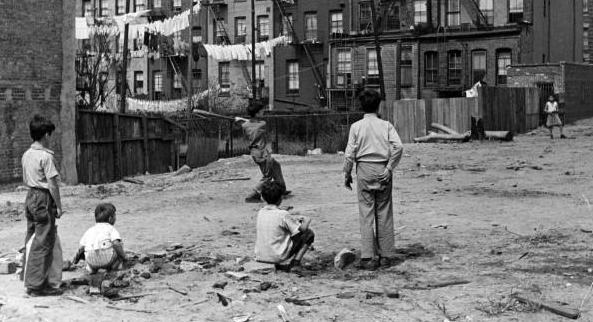
Hicks Street, 1943
Picture by Alfred Eisenstaedt, Life Magazine
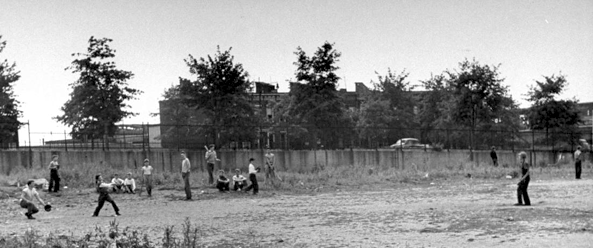
Vacant lot, 1946
Picture by Ed Clarke, Life Magazine
Paul Luchter deserves many thanks for his knowledge, search skills, and wonderful efforts in tracking
down some of these parks and providing extra information for this page.
BrooklynBallParks.com is brought to you by
Andrew Ross (wonders@brooklynballparks.com)
and David Dyte (tiptops@brooklynballparks.com).
Please contact us with any corrections, additions, or requests.