After the new Brooklyn Base Ball Club was formed in 1883, it needed both players and a field
before it could play. The search for a field took place in the South Brooklyn area, and soon
settled on a site once known as the Fifth Avenue Grounds, and used in the 1860s by such clubs as the Ironsides and Albions.
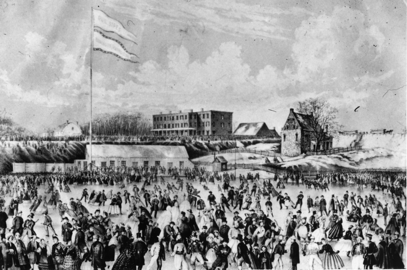
By 1883 the lot had long been in use as a skating park called Washington Pond, bounded by Fourth and Fifth Avenues,
and Third and Fifth Streets - although the park had earlier extended further south to Sixth Street. Washington Pond was
also commonly known as the Fifth Avenue Pond and, less commonly, as Litchfield's Pond.
The skating pond had famously hosted several early matches of base ball on ice. In 1861, the members of the Charter
Oak Club were defeated by the Atlantics, 36 to 27, in the first such match - "something new under the sun" said the Eagle. Some
"ten to fifteen thousand persons were congregated upon the ice and overlooking embankments." By 1865, when the
Atlantic Club was victor over the Gotham Club, 50 to 30, the Eagle pronounced such novelties to be "played
out." But the game on skates would last a while yet.
This site was also home to the Vechte-Cortelyou House of 1699, now known as the Old Stone
House, which had played a large part in the Battle of Brooklyn during the Revolutionary War - the men of the
Maryland Regiment repeatedly engaged the British forces at the house after the Continental Army was outflanked.
All were eventually killed or captured, but their bravery allowed Washington and the rest of his troops to escape,
eventually to return triumphant.
Washington Pond in 1862 Picture courtesy Kim Maier at the Old Stone House
The new Washington Base Ball Park was built around the Old Stone House, using it as a "ladies' house" and for storage. The park
also included a field measuring 500 by 900 feet, a grandstand to seat 2,500 people, and a free
stand for 2,000. Along with facilities for carriages, and a thirteen foot high fence around the whole
block, the venue cost the club some $13,000. Construction began in February and the park was ready in time for 6,000
spectators to attend the Brooklyns' second home game on May 12, the first having been played at the
Prospect Park Parade Ground. A gala opening ceremony was held, with music provided by the Twenty-Third
Regiment band, and the Brooklyn nine celebrated by defeating Trenton 13 to 6. The Brooklyn Eagle's
reporter was suitably impressed:
The ground had been arranged with great care, and in the opinion of good judges was recognized
as one of the finest diamonds in the State. The grand stand, capable of accommodating several
thousand spectators, was placed in good position and afforded a fine view of the field. The grounds
have been laid out regardless of expense by the gentlemen composing the association and are not only
well adapted for the national game, but also for cricket, lacrosse, lawn tennis and other outdoor
games. The president, Mr. Charles Byrne, is well known in this city, and he has shown an energy and
most liberal spirit of enterprise in the matter which give promise of a full attainment of the ends
desired by the association, which embody the providing of a model professional base ball organization
and of a ground where athletic amateur clubs can find ample facilities for the playing of their
several favorite games.
In 1884, similar ceremony marked the debut of the Washington Base Ball Park as a major league field,
as the Brooklyns had been accepted into the American Association. On May 5, a great crowd, including
"the largest assemblage of the fair sex ever seen at a ball match in Brooklyn" enjoyed music
from Conterno's Ninth Regiment band and saw the home team soundly defeat Washington, 11 to 3.
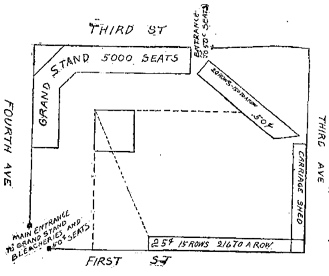
Field for Base Ball Skating and out-door sports - diagram of Washington Park drawn by the
Brooklyn Base Ball Club's founders in 1883, and Washington Park as seen on the 1888 Sanborn map Diagram courtesy Allen Schery, from the
original certificate of association
Ice and snow were not forgotten in the rush to summer sports at Washington Park, though. In January 1884,
ice baseball saw its debut there, as Chadwick's picked nine defeated the Brooklyn Club. With its own special rules for skating the bases, ice baseball left one
lasting legacy to the regular game- the rule allowing a batter to run through first base and remain
safe. In 1886 and 1887, the Nassau Athletic Club, an amateur concern under the charge of Charles
Ebbets, set up toboggan runs complete with electric lights.
Prior to the 1887 season, substantial building work was carried out to increase capacity and comfort.
A new grandstand, 176 feet by 44 feet with a capacity of 3,000, was added directly behind home plate,
and a row of free seats installed along the Third Street and Fifth Street fences. Existing stands
were also improved by raising the seats, so fans standing in front on full days would not block
the view. In total, the official seating capacity of the park was raised to 8,000.
Ice baseball at Washington Park in 1884, drawn by C.J. Taylor
On May 17, 1889, while the Bridegrooms were on an extended western road trip, an amateur game was
played at Washington Park between the Crescent and Staten Island
Athletic Clubs. It is thought that perhaps one of the players left behind a lit cigar after the game.
By the early hours of the next morning, the grandstand and a substantial portion of the Fifth Street
fence had burned to the ground. Much
equipment belonging to other local sports clubs was lost, but the uniforms and equipment of
the Bridegrooms were saved by being in the Old Stone House at the time.
A packed crowd lines the field on Decoration Day, 1887
Photographs courtesy Allen Schery, John Thorn
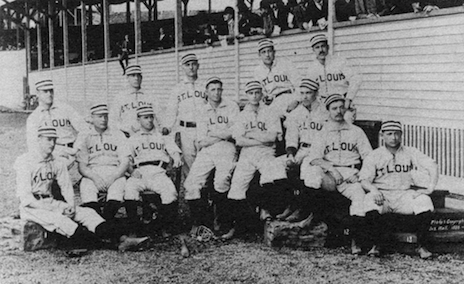
Brooklyn photographer Joseph Hall took pictures of American Association
teams as they passed through Brooklyn in 1888. These photographs show the
Brooklyns and the champion St. Louis Browns posed in front of the old
Washington Park grand stand on the third base line.
Secretary Charles Ebbets
took charge of reconstruction. Braving stormy weather, workers toiled day and night and a new, larger
stand was in place for a double header with defending champion St. Louis
on May 30. No home games were missed. The Eagle reported that the grandstand was "built in the strangest manner, and bolted
so that it can be easily moved or carried away if necessary." St. Louis took the first game at the
second incarnation of Washington Park, 8 to 4, but Brooklyn took revenge in the afternoon, 9 to 7. Well
over 20,000 jammed all corners of the park for the second game. It was thought to be the largest crowd
yet seen for a ball game anywhere on Long Island.
Before the 1890 season, one last set of changes was made: a waiting room for ladies, shaded
bleacher seats, new turnstiles, and one final touch with an eye to style:
The contractors have begun the work of paving the sidewalk fronting the grounds on
Fifth avenue. The work is to be done in an artistic manner, and will add greatly to the appearance
of the entrance when finished. The pavement will be arranged in blocks for a distance of eighty
feet and extending from the fence to the curb line. It will be of light drab color, with letters
of chocolate color forming the words "Brooklyn Base Ball Club."
This rebuilt Washington Park saw two pennants for the Grooms, in a nail-biting finish
over the hated rivals from St. Louis in the American Association in 1889, then a glorious debut
season in the National League in 1890. There would be no more
major league games after that season, as the Bridegrooms merged with the Wonders and moved to
Eastern Park. The final home game at the original Washington Park site, on October 3, was a
10-4 thumping of Pittsburgh by the championship winning Brooklyn club.
The bleachers at Washington Park were set directly into the bank,
a feature readily visible on these late 1880s cigarette cards
Card images courtesy Allen Schery
Just a few practice matches
remained, the last being a 21 to 2 rout of the Metropolitan Club on April 16, 1891 before the move
to Eastern Park was complete. A cycle track was soon laid down, at a cost of $500, and through 1891
and 1892, college and school base ball, track meets, and cycling races were held at Washington Park,
extracting some little income for the Brooklyn Base Ball Club which still held a the lease for $5,000
per year. On August 22, 1891, the championships of the Long Island Amateur Athletic League drew 2,000
fans to the old ground, leading the Eagle to declare the event "the greatest athletic meeting Brooklyn
has ever witnessed." In April, 1892, the grand stand was largely demolished and moved to Eastern
Park. In the final base ball match of the era, the Resolutes defeated the Acorns, 11 to 2.
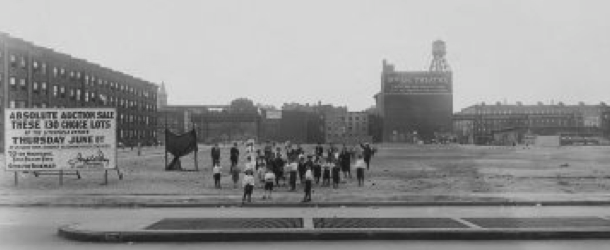
The old lot in 1906 - games were advertised at the
corner of Fourth Avenue and Third Street
The lease finally lapsed at the end of 1892, and in April, 1893, city grading work to even out the
slope of the area buried much of the site, including the Old Stone House, in 16 feet of dirt. But
it was not abandoned completely- Barnum and Bailey's Circus moved from Saratoga Park to the Washington
Park lot for its Brooklyn shows around 1906, and stayed until Fourth Street was run through in 1912,
although lesser circuses continued to be a regular feature. During these years the lot was variously
known as Washington Park Field, Washington Park Oval, Dayton Oval, Newport Oval, Barnum Oval, and the
Circus Grounds.
From 1907 through around 1920, even after being split into two lots and losing all grass cover, the one-time major
league site saw games featuring such clubs as Chinkona, Ampere, Lenox, Milford, Omlyda, and the Washington
Parks. In 1908, St. Mary's Star of the Sea C.C. visited the "champion Newports" and 1,500 fans saw them
trounce the home team, 16 to 9. An odd feature of that game was that nine different Newport players scored one
run each. In 1916, the Daytons, a very junior nine, played the well named Alpha Midgets. There was a diner
in that era across Fourth Avenue, Lew Jordan's, where fans would take refreshments and players would use the
back room to change into their baseball uniforms.
Buffalo Bill's riders create a stir in a promotional appearance
on the old lot which had been Washington Park, in 1916, and kids
crowd the lot shortly before it is sold off at auction in 1922
Buffalo Bill photo courtesy brooklynpix.com
The old Washington Park site was purchased by the Brooklyn Edison Company from the Litchfield Estate in 1922,
and the company first proposed to build a power plant, but public pressure saw them use the site as a playing
field instead. In 1923, the idea was proposed that the city should buy the field and create a park, as the site
was less than impressive at the time. The Eagle reported:
The bones of some of the best men of Maryland lie under the ground at 3d st. and 5th ave.—men
who saved a nation—but no shaft rises, no green park is there. Instead there is an unsightly lot,
innocent of any vestige of grass, one end of which, at 4th ave., is used as a sort of dumping ground. When
an Eagle reporter visited it earlier this week there was a litter of rusty iron junk at the 4th ave. end.
Near 4th ave. there is a baseball ground with a backstop and a rude row of seats. Year after year the
"big top" of the circus has been pitched there in springtime and wild beasts of the forest have roared
from their cages, clowns in grease paint indulged in grotesqueries and monkeys chattered and grimaced
where men died for freedom and a high ideal.
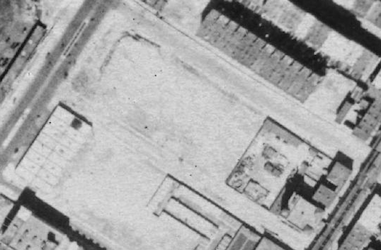
Dust and a backstop in 1924, Excavation in 1932, P.S. 51's playground and Byrne Park in 1952
Overhead photo from NYCityMap, other photographs courtesy Brooklyn Public
Library—Brooklyn
Collection
Brooklyn Edison did pay for a field, which was dedicated by Charles Ebbets himself on October 4, 1923. After an
absence of 32 1/2 years, the Superbas returned to play an exhibition sandlot game against the semipro
Milford Red Sox, winning 13 to 2. 12,000 people crowded the lot for the occasion, and proceeds from the affair
were donated to a fund for a properly upgraded park and memorial. In the next few years, the field
was known as Edison Field (II), with Brooklyn Edison, Manual Training, and St. Francis Prep at home, mainly for
football and soccer. Later, it was used as a storage yard.
The site was eventually returned to the city in 1926, with the proposed park, known as Memorial Park,
still in the planning stages. The city then decided instead to sell the plot to Brooklyn Polytechnic, but
was blocked by community opposition after a fight lasting several years.
2006 - Old Stone House, Wiffle Ball in J.J. Byrne Park
The Old Stone House was dug up in 1933 and rebuilt with the original stones in 1934, and J.J. Byrne Park was
created. Softball still had a presence - in 1952, for instance, the Joan of Arc Girls Softball League
played at Byrne Park. Today the site is still occupied by that park, again named Washington Park as of
2008, between Third and Fourth Streets, and Public School 51 and apartments between Fourth and Fifth.
Fourth Street is a walkway between the two sections. On the park side, asphalt playing fields were replaced
in 2009 with an artificial turf baseball field, with room for one regular match or up to six little
league games at a time.
The view from left field, members of the Gotham BBC playing
the 1864 game in 2009, Pony League action in 2011
Washington Park (II)
After president Charlie Byrne died early in 1898, Charles Ebbets took over the running of the Brooklyn Base
Ball Club. High on his list of priorities was moving the team from far away Eastern Park, where
attendance had never been great, back to South Brooklyn. After being offered several sites, he accepted
a ten year lease on a property owned by the Litchfield estate, bordered by First and Third Streets,
and Third and Fourth Avenues. The Brooklyn fans, with the exception of a few from East New York who
signed a petition to no avail, were delirious. This was just across an intersection from the old
Washington Park, where the team had won three pennants, and would be given the same name.
The
Brooklyn Eagle covered the move to new Washington Park in great detail
Work on the site began on March 24, with Maie Ebbets, daughter of Charles, turning the first sod. Building
costs of $20,000 were shared by the Nassau and Brooklyn L railroad companies, both of which ran lines
nearby and stood to gain a great deal of business. The club paid another $80,000 in expenses to
move the team, but Ebbets said he felt "thoroughly satisfied with the prospect in view." This Washington
Park featured a grandstand to seat 5,000, with 7,000 cheaper seats, and "unlimited" standing room. There
was also room for 60 carriages to be parked. A stone yard and blacksmith shop were removed to make
way for the ballpark.
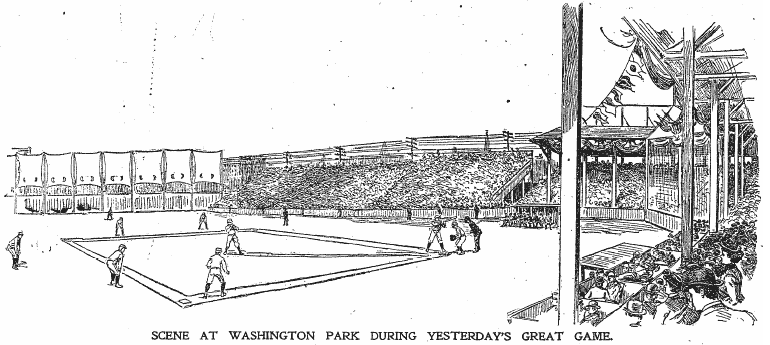
The Eagle's images from Opening Day, 1898 and 1899. In 1899, note the canvas
sheets to thwart nosey fans on apartment buildings on First Street.
On April 30, Brooklyn lost their long awaited home opener, 6-4 to Philadelphia. They won the remaining
five games of the homestand, however, playing to packed houses. Brooklyn outfielder Jimmy Sheckard
greeted the new park with home runs in each of its first three games. With the help of the close right
field fence, Sheckard would lead the National League in home runs for 1903, as would first baseman
Tim Jordan in 1906 and 1908.
When the Brooklyns left for a road trip on May 12, change was already in the air. During the trip,
a new drainage system was installed to help prevent rain delays, seats were raised to improve views,
and the bleachers along the First
Street side shortened by 100 feet at each end. Those seats were moved to the Third Avenue side.
Players had complained that fans were too close, and catchers did not like having fans in a direct
line behind the pitcher and second base. Those seats furthest away from the plate, on the other hand, were at such
a distance and angle that no one bothered to use them. High poles supporting canvas sheets were also added to prevent fans in the Ginney Flats
on First Street from watching the game for free. These lasted through 1899, although the
First Street fence was heightened several feet prior to the 1907 season.
The remainder of the disliked First Street bleachers would be dismantled completely in March, 1899,
with the lumber used to build new bleachers on the Fourth Avenue side. The grandstand was also
extended further along the Third Street side.
The crowds continued to jam the stadium,
seeing National League pennants brought back to Washington Park in 1899 and 1900. Even as the team
became less competitive in years to come, attendance remained high. Substantial renovations prior
to the 1908 season, including thousands of new 25c bleacher seats along the Third Avenue side,
and upgrades of the existing bleachers to more expensive seats,
saw capacity increased to 20,000. A luxurious new clubhouse, including 24 lockers for home players
and 20 for visitors, was also built behind the flagpole in left field, and new fangled "dugouts"
were provided for the shelter of players on the bench.
Grandstand entrance: 75c, Field seats: 25c Grandstand picture courtesy brooklynpix.com
Charles Ebbets had originally been unsure about replacing the left field bleachers with better
seating in 1908, but his hand was forced by Charles Jr. While the younger Ebbets was managing the park's use as an ice rink
over the winter, the flooding operation wiped out an embankment in center field. To shore up the mess
required more dirt, which he acquired, and $900 worth of lumber, which he instead obtained by
dismantling those bleachers. In his capacity as secretary of the Brooklyn Baseball Club, he called
an emergency meeting of the executive committee, of which he was the only member present in Brooklyn,
to approve his own actions as head of the Washington Park Skating Club. As he said to the Eagle,
"I'm afraid Dad will be hot when he sees it, because he wasn't exactly sure about building new
stands."
In 1909, in a scheme which would be echoed 100 years later in Queens and the Bronx, the front of
the grandstand was moved forward 15 feet, adding about 900 seats in "large and commodious"
boxes for higher paying customers, as well as an expanded press box. This reduced the distance
between home plate and the grandstand to about 75 feet, still 25 feet more than most teams in the
major leagues at the time.
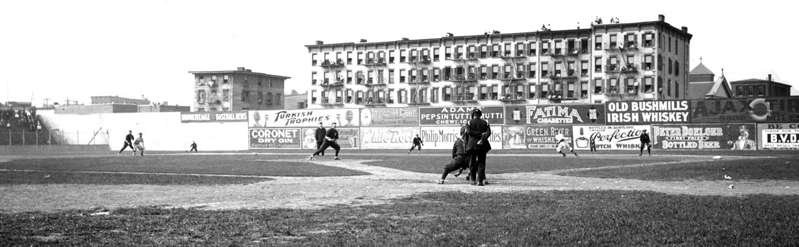
Washington Park after the 1908 renovation
The new box seats are clearly visible in
this 1909 team photo of the Superbas
There was further drama in 1911, when an anonymous call to the Department of Buildings suggested
that an inspection of the grandstand was in order, the day before Brooklyn's home opener. With the
inspection duly failed due to rotting supports and aisles declared too narrow for an emergency,
Ebbets had 100 carpenters work through the rest of the day to make the necessary repairs and
adjustments. In June and July, fires burned out parts of the fence, but no major damage was done.
Sanborn map from 1906, original plans for the 1908 renovation
Like most ballfields in Brooklyn during the deadball era, Washington Park had its share of Sunday
baseball warfare. In 1904, the Brooklyns got around the law by selling 12,000 fans programmes as
they entered the stands. In 1906, voluntary contribution boxes were placed at entrances. When Ambrose
Hussey and Nat Strong proposed to lease Washington Park for semipro games on Sundays in 1908, rival promoters
were enraged, but nothing came of the plan. 1910 saw a very odd plan used to dodge the law - an
amateur club was formed called the Washington Park A.C. to play at Washington Park on Sundays.
These amateurs were all the same people who played for the Superbas from Monday to Saturday, and the
authorities soom investigated and put a stop to the scheme. Finally, in 1912, a legitimate semipro
squad called the Washington Parks played at the ground, without great incident, against powerful
opponents such as Plainfield of New Jersey.
1910 - Washington Park deep in industrial Gowanus,
with a superb view of the Brooklyn Ball Club sign
Photo courtesy brooklynpix.com
Despite all the improvements and repairs over 15 seasons at Washington Park, by the last few years
the wooden stands were starting to look creaky, outdated, and small. During 1911 the idea of moving
was floated by many writers, with the Eagle even suggesting the replacement of the old stands
with steel and concrete. It was not until January, 1912 that Charles Ebbets finally revealed his
long hidden plans to move to the other side of Prospect Park and a new, grand ballfield.
Washington Park II, circa 1910, with the battle scarred lot
of the original Washington Park in the background
Photo courtesy brooklynpix.com
When 25,000 opening day fans overwhelmed Washington Park, causing a farcical six inning game of
ground rules and police intervention, which almost no one was able to see, the tone for the final
season was set. That the Giants won 18 to 3 merely rubbed salt into the wound. The Brooklyns struggled
throughout 1912, and Washington Park endured a few "last games" in July and August before it became
apparent that the new plant would not be ready until 1913. Eventually the Superbas farewelled
Washington Park with a 1-0 loss to the hated Giants, the end of a dismal 58-95 campaign, and departed
for their final home, Ebbets Field in Flatbush.
Washington Park in 1905 - Boys High vs Pratt at football
Panoramas of Washington Park, 1907 and 1909 Pictures courtesy Allen Schery and John Thorn
Washington Park circa 1910, looking both ways along Fourth Avenue Pictures courtesy
brooklynpix.com, via Allen Schery
The high school football season remained to be played, and on November 15, the Poly Prep-Adelphi game
was a farewell of sorts for Washington Park. A half holiday was granted to the schools, and 11,000 people attended
to see Adelphi "hammer their way to a magnificent victory" by a score of 14 to 7. Charles Ebbets was there, as were
judges, district attorneys, political leaders, and a long roster of civic icons.
A packed house sees the last ever event at Washington Park (II) - Adelphi v Poly Prep
In December, the New York
Times and Brooklyn Eagle reported sadly on the dismantling of the old park, with the wooden
grand stand and clubhouse being torn down, presumably to make way for new streets and apartments.
Recycling was the order of the day:
Most of the lumber has been sold to a Brooklyn firm, dealers in second-hand material, but the
turnstiles are to be removed to Ebbets' Field while the iron railings inclosing the boxes will
be sent to Newark to be used in the park of the International League Club there. The latter club
is controlled by President Ebbets. Some of the heavy material now at Washington Park is to be used
in the erection of an automobile garage opposite Ebbets' Field.
But the story of Washington Park was not quite finished.
The chaos of opening day, 1912 Pictures from the Joseph Burt Collection - courtesy Long Island Collection,
Queens Public Library
Phillies baserunners heading the wrong way at third in 1912 (note the rare view of the scoreboard)
Cubs at Brooklyn in 1912 Picture courtesy Mark Rucker (Transcendental Graphics)
Washington Park (III)
When the Brooklyn Tip Tops of the rebel
Federal League needed a place to play in 1914, here was an obvious site. Monte Ward, instigator
of the 1890 Players League, was business manager for the Tip Tops and signed a ten year lease on
February 13. The Ward brothers, owners of the team and no relation to Monte, took inspiration from
Weeghman Park in Chicago, originally intending to make an exact replica.
In the end they created yet another new Washington Park. This one was designed by
C.B. Comstock, after consulting with Weeghman Park architect Zachary Taylor Davis, and built using steel, brick,
and concrete, with stands seating 18,000 people.
The contractors, P.J. Carlin and Company, boasted that the entire structure would
take just six weeks to build, with May 2 the aim for opening day. Rumors swirled that Wallace's Ridgewood
Grounds might be used in the meantime, or even West End Oval or Hawthorne Field, but the league
accommodated delays by rearranging the schedule and piling up a few double headers for later.
There was also a death on the site after a scaffold tower fell, several strikes, and legal
wrangling over whether the city might assert its right to extend Second Street through the block.
April 1 - "growing overnight like an enchanted castle"
Early May - Recognizably a ballpark
May 11 - partly roofless, but ready
Eventually, the ground was ready for play by May 11, after the Tip Tops had opened the season with a 13 game
road trip. Although the grandstand roof was not yet completed, and the outfield was more dirt than grass,
15,000 fans still arrived to see the club lose a pitcher's duel to Pittsburgh, 2-0. President Gilmore
and various magnates of the Federal League were present, and the Borough President threw the
first pitch in an unusual manner at the time, from on the field instead of in the stands:
Having disposed of the society features, Borough President Lewis H. Pounds entered upon the scene
and did his part in real baseball style, indicating that Brooklyn's chief executive is some sport
lover. Mr. Pounds went right into the pitcher's box and threw a curve to Grover Land, thus changing the
routine that marked this incident in the past. Mr. Pounds had had no chance to warm up, hence his shot
was a bit wide of the plate, but it was evident that he could have done better with another chance.
However, his effort answered the purpose and he got a huge cheer, which was satisfying.
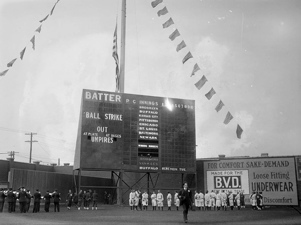
Opening day festivities in 1915 - note the scoreboard in play in center field
The final incarnation of Washington Park was smaller than the previous one - the stadium was built some
distance from Fourth Avenue - and had several unusual features. The scoreboard in center
field, including the ground beneath it, was in play, which could lead to awkward times for outfielders.
The flag flew from a mast that was at one time part of the yacht Reliance, successful defender of the
America's Cup in 1903. The mast stood until 1921, when it was bent in half by a lightning strike.
$20,000 was spent on a system of 75 foot high light towers, which were tested out by semipro players on October 26,
1915, for use in the 1916 Federal League season that never happened. A sign on the right field wall
read: Base Ball Players are all human, and therefore love applause. If you want a winning team, root for them,
speak well of them to your friends, and while we are here let us all be clean of speech -- so that the ladies may
find it pleasant to come often.
Columbus Day football, 1914 - Bay Ridge High takes on Brooklyn Prep
Opening day, 1915- a patriotic display, Borough President Pounds throwing the first pitch
The Federal League lasted just two years, with the Tip Tops contending only briefly in the first season,
and not at all in the second. The final major league game at any Washington Park saw the Tip Tops lose 3-2 to
Buffalo on September 30, 1915. The Federal League was dissolved in a complex peace deal with the two older major
leagues, leaving Washington Park without a tenant. In 1916, rumors circulated of plans to move an American
League team to Washington Park, with the Washington and New York teams both mentioned. Nothing came of either
possibility, however.
The site continued as a venue for track and field, college and high school football, professional boxing,
and even a visit from Buffalo Bill's Wild West Show, through the end of 1917, under the management of the
Washington Park Sports and Amusement Club. Cycling was also planned but did not pan out. On June 29, 1916,
10,000 boxing fans watched a much anticipated bout under the lights as Jack Dillon, the Hoosier Bearcat,
easily defeated favored Frank Moran. The bout was a financial failure, however - just as many people
crowded the Brooklyn Eagle building for round by round updates, without spending a cent.
Buffalo Bill's Wild West Show in 1916 - note the light tower built inside the stadium
Photo courtesy brooklynpix.com
General Wingate, head of the Public Schools
Athletic League, tried to save the stadium for the permanent use of scholastic sports, but to no
avail. Baseball was played in an unofficial form from 1918: a bunch of kids called the Lockports would
play games in the old parking lot, with home plate at 1st Street and the left fielder in severe danger
from 4th Avenue traffic. The Lockports and their local rivals, the Milfords, went on to become semipro
clubs, and their contests would continue on the old field at the earlier Washington Park site.
Being used as a warehouse in 1924, and demolition
work in 1926 - a light tower on the way down
Overhead photo from NYCityMap
Control of Washington Park passed first to Organized Baseball, as part of the peace deal with the
disbanded Federal League, then through several hands, including use as wartime warehouse space in 1918, when
the park was also used for ice skating, with half the proceeds going towards a New York Sun fund to buy
tobacco for American troops. Eventually, the Brooklyn Edison electric company took possession in 1925 and
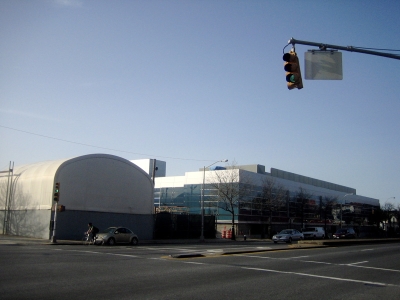
razed the stands in 1926. Today, the site is a storage facility for Consolidated Edison.
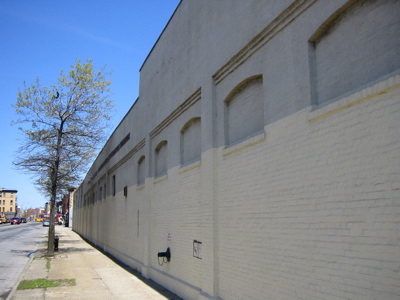
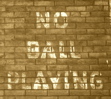
The left field wall stood along Third Avenue for many years, and was saved from destruction in 2002 by a group of
concerned baseball fans and historians. In October, 2010, however, about two thirds of the wall was demolished
by Con Ed, with only the northernmost corner along Third Avenue and First Street left intact. This corner is the
last relic of the Federal League in Brooklyn.
The final site of Washington Park, in 2006
October, 2010 - the wall is coming down, but the author souvenirs a brick
Many thanks are due to Neil deMause and Phil Lowry for helping to untangle the messy history of Washington Park, to
Kim Maier at the Old Stone House for correcting our interpretation of its history, and to Professor
Allen Schery for material from his superb collection.