Also known as Ridgewood Park (I) and the Athletic Base Ball Grounds.
In the 1880s in the Ridgewood area of Queens, just barely across the county line from Brooklyn,
there was a flourishing trade in picnic parks, with associated hotels and venues for amateur sports.
Such places were particularly popular on Sundays- while Brooklyn had strictly enforced blue laws,
those in Queens were a little more relaxed, and residents of Brooklyn would head across the county
line to drink, or catch a ballgame. At one such park, Grauer's Ridgewood Picnic Park, the amateur Ridgewood
Park Base Ball Club played as early as 1883. In August, 1885, proprietor George Grauer purchased a ten
acre lot adjoining the picnic grounds, and laid out a new diamond in the hopes of attracting crowds
to regular games.
On April 11, 1886, Charlie Byrne's Brooklyn squad ventured a few blocks over the line to the
grounds of the Long Island Athletic Club, Grauer's "new and unfinished field." Before 3,000
"unusually orderly" fans, the Brooklyn team made its Sunday exhibition debut,
and soundly defeated the home team, 22 to 1. The poor Athletics, awed and outmatched, committed
10 errors besides giving up 16 hits. The Brooklyns scored 12 runs in the sixth inning alone. But the
score did not matter. As the Eagle reported:
The great fact of the event was, however,
that so orderly and respectable a gathering could be got together to witness a match on such a day
and so far out of town.
Suitably impressed by the exhibition, Byrne scheduled a number of American Association
Sunday matches for his Brooklyn squad on the field at Grauer's Ridgewood Park. The ballfield was
along Myrtle Avenue, with picnic grounds covering the rest of the area stretching along what is
now Seneca Avenue (there was no street then) and Myrtle Avenue to Summerfield Street. In the first
major league game at the park, Brooklyn defeated Baltimore 11 to 1, on April 25, with 7,200 fans present.
Crowds flocked to Grauer's for baseball in great numbers in those early matches. Management
was encouraged, and expanded the facility in May, erecting a new free stand in center field and
extending the grand stand.
The Long Island Athletics continued to play their brand of semipro ball throughout 1886, facing
such visitors as the Alpines, Ridgewoods, Sumners, Jersey Blues, Cuban Giants, and Peerless of
Cypress Hills. Admission cost 15 cents, 10 cent discount on the American Association price.
Grauer's Ridgewood Park lasted just one season as a
major league venue, while the New York Times railed constantly against it in the editorial pages,
before Byrne complained that the stands had been too small, and the financal arrangement too one-sided
to turn a profit. The field was folded into the picnic grounds, and made unavailable for
further professional contests. In the final game there, on September 13, 3,000 people saw Brooklyn
come back from a four run deficit to defeat the Metropolitans 7 to 5.
The picnic grounds persisted, gradually being covered in dance halls and other recreational venues,
until 1906. Now the site has had many streets run through it, and consists of a mix of retail,
housing, and industrial areas.
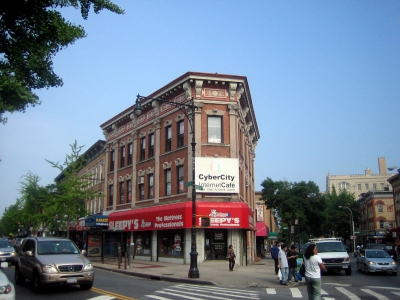
Seneca and Myrtle now, looking along Seneca on the right side of the photo.
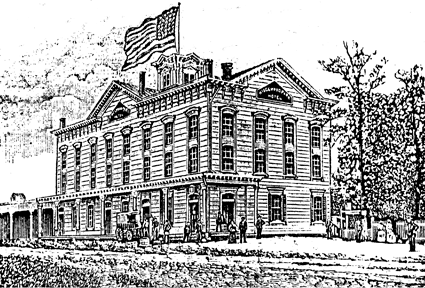
Imagine a time when Seneca didn't exist, and you could look past the Ridgewood Park
Hotel to see the picnic grounds and ballpark beyond. That was Grauer's Ridgewood Park.
Wallace's Ridgewood Grounds
Also known as Ridgewood Athletic Grounds, Ridgewood Base Ball Grounds, Ridgewood Base Ball Park, Ridgewood Park (II),
Wallace Field, Wallace Oval, Horse Market Grounds, and Ridgewood Field.
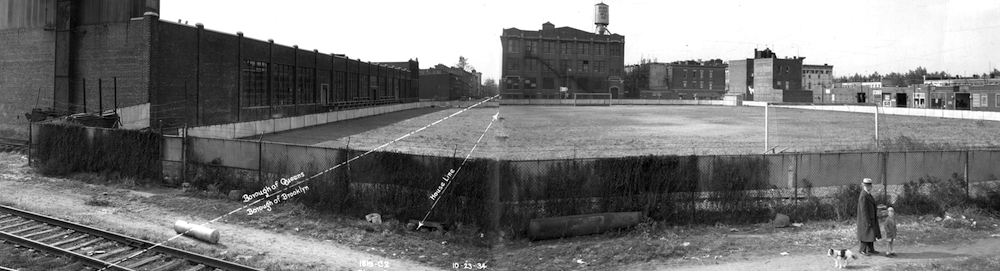
William W. Wallace, secretary of the Ridgewood Athletic Association, built the his Ridgewood Grounds
on a lot between Wyckoff and Irving Avenues, and Weirfield and Covert Streets, after the association
rented the block in September 1884 for $500 per year. A railroad cut through the land then, near to Wyckoff
Avenue. The smaller section along Wyckoff was used for picnic grounds, and a baseball field with grandstand
was built on the larger section. The field, intended to host all kinds of sports, measured 750 by 450 feet.
The Ridgewood Athletic Association nine opened the grounds on April 5, 1885, hosting the Brooklyn Atlantic, with the
Atlantic winning 3 to 1 in front of 3,000 spectators. Police were present but found no disturbance
of the "Sabbath repose of the community."
When the Thirty-Second Regiment of the National Guard paraded at the grounds, the Eagle offered an
unflattering assessment:
The inspection and muster were held on the Ridgewood Athletic Grounds, an unattractive
spot of sunbaked clay, unrelieved by greensward, wholly without shade, and lying far out in the
suburbs.
At the end of that year, looking for a more permanent arrangement, Wallace
and partners formed the Ridgewood Exhibition Company. They bought the land for $12,000. At the
beginning of 1886, the grounds boasted a grand stand seating 2,000 and a large free stand, either
side of the diamond in the northern corner of the field, near Wyckoff Avenue. Wallace advertised the
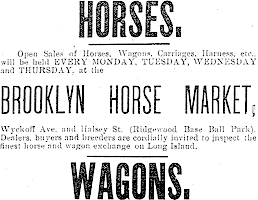
grounds for rental in the Queens newspapers, for all kinds of sports, and held the Brooklyn Horse Market
there on weekdays in the 1890s.
In August, 1886, 5,000 fans filled the grounds for a much anticipated boxing bout between the champion
John L. Sullivan and Frank Herald. The Queens authorities decided at the last moment to ban the fight,
however, and under threat of arrest, an ingenious plan was hatched:
Ned Mallahan and Arthur Chambers chatted a minute or two and conceived a bright idea. The
northwestern corner of Wallace's grounds is in Kings County, and over this spot the police of Queens
have no jurisdiction. They told Sullivan and Herald of this and they were quite willing to fight in the
corner in question, but Peter J. McEvoy, of the Brooklyn sanitary squad, heard of their game and
hastened to them. "If you fight in Kings County," he said, "I will notify Captain Dunn, of the
Fourteenth Precinct, and he will come with his men and scoop the whole lot of you."
Needless to say, the fight did not take place.
Sanborn maps of Wallace's Ridgewood Park - a partial map from 1888 showing a grand stand
west of Halsey Street, which was then closed, and a later map showing a store house on that spot
and the location of the main stands at Irving Avenue and Covert Street.
Byrne's Brooklyn team moved its Sunday venue to Wallace's Grounds in 1887. April 10 of that year
saw the first major league game at Wallace's Grounds, with the Brooklyns taking on the Boston Blues.
George Pinkney led off the first with a three bagger, and the rout was underway. Byrne's men pushed
13 runs across in the third inning, and wound up winning 21 to 4 in eight innings. Pinkney scored
five runs.
Wallace, never one to turn down a chance to build business, modified his stadium often.
In 1887, new stands were built to accommodate the Brooklyns and their Sunday crowds. But more was
needed - after the opening day crowd of 6,000 was barely
able to squeeze into the park, he moved an infield free stand to far left field, built a new
grand stand on the third base line, and ringed the field with rows of seats, bringing the capacity
to 10,000 seated fans. In 1889, Halsey Street was extended through the lot, cutting off a section
of left field. To make up for this, before the 1890 season began the diamond was moved back 75 feet
and a new grandstand constructed to seat 3,500. A picket fence was also erected around the field to help
keep rowdy crowds from straying into the playing area. In 1898, further renovations saw capacity enlarged
and a new diamond laid out. Wallace boasted that the new diamond was "constructed so that a game
can be played on it one hour after the heaviest rainfall."
Finally, in 1912, the stands were again remade, at the expense of promoter Ambrose Hussey, and the
entrance moved to Halsey Street, near the Long Island Railroad tracks. During all this time, the diamond
was moved between the northern and southern corners of the grounds at least once, also.
Run out by roughs - Umpire Mitchell and the St Louis nine are chased out
of Ridgewood Park by a mob of Brooklyn hoodlums - Wallace's Grounds in 1887.
Image from the National Police Gazette.
The finest sequence for the Brooklyns at Wallace's Grounds took place on successive Sundays -
May 20 and 27, 1888. First, Bob Caruthers pitched to the minimum 27 batters- allowing two hits
but forcing a double play and benefiting from a man caught stealing - in defeating Kansas City 9
to 0. Seven days later, Adonis Terry did even better and pitched a no-hitter against Louisville
before 4,872 fans. Four errors were made by Brooklyn, but Terry kept the shutout. The Brooklyns
eked out a 1-0 lead in the sixth, and finally broke things open in the eighth to win 4 to 0 in
"the finest exhibition of ball playing ever seen on the field since the park was opened."
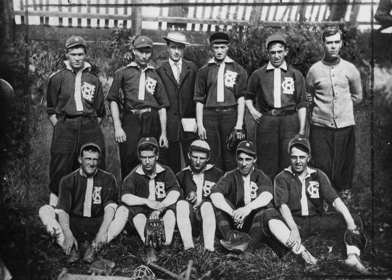
The Brighton Field Club played at Wallace's Grounds in 1906. This team photograph,
sent in to the Brooklyn Eagle's Old Timer page and duly doctored for newspaper
reproduction, offers a tantalizing hint of how Wallace's Grounds looked back then.
Photograph courtesy Brooklyn Public Library—Brooklyn
Collection
In 1890, Byrne's club vacated the American Association and Ridgewood, and the new
Brooklyn Gladiators Association team called Wallace's Grounds home. A futile season for them
saw few victories at Ridgewood. The most memorable was the first - a raw, error filled 22-21 squeaker over
Syracuse in front of "500 shivering spectators" on April 18. In the final major league game at Wallace's Grounds,
the Gladiators again defeated Syracuse, 9 to 5, on June 8. Despite the rare win, and a larger than usual crowd of
2,000, who "applauded the many fine plays of both teams with uniform impartiality," Kennedy's men jumped to the Polo
Grounds in New York.
Local teams continued to use the park for football, Gaelic football, hurling, and baseball.
The Nationals semipro squad was the main tenant at this time. In 1895, the Liberty Wheelmen proposed to lease
the ground for cycling, but at the last second were told they must buy it instead. They turned the deal down.
Business slowed through the decade, even after the field was offered for free at the end of the 1897 season,
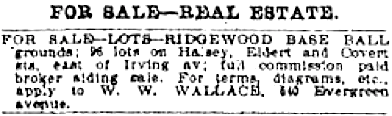
and completely renovated in 1898. Wallace sought to divide the site into lots and sell up in August of that year,
but found no takers. Wallace's Ridgewood Grounds fell quiet in 1899, and in 1900 the Brooklyn Eagle began to
speculate on the future of the disused plot, suggesting it could be sold for $60,000. But the Ridgewood Exhibition
Company remained intact, with Wallace in charge, and by 1902 he had Ambrose Hussey's Ridgewood nine as regular
tenants, with other teams (including local Negro squads) and sports to fill in the gaps.
On August 9, 1913, the Namm Company held an outing at Wallace's Grounds, with athletic contests
and a baseball match. A Brooklyn Eagle photographer was on hand, and this is the result -
a photograph of the female competitors, perhaps with the Eurich brewery in the background.
When the New York Highlanders of the American League signed an agreement to play Sunday games at
Wallace's Ridgewood Grounds in 1904, a turf war was sparked with the Dodgers that dragged
in the American and National Leagues, baseball's National Commission, the New York City council, and
the Queens County police. The fight between the clubs, and between baseball and blue laws, would
carry on until New York legalized Sunday baseball in 1919. The Highlanders did end up playing some
exhibitions at Wallace's Grounds against the Ridgewoods, but no official games.
On October 15, 1905, 10,000 spectators packed Wallace's Grounds and saw a major upset. The semipro
Ridgewoods took on the newly crowned World Series champion Giants and beat them 5 to 2, behind the pitching of
star twirler Ernie Lindemann. The locals were delirious. Not long afterwards, the Ridgewoods beat
the Highlanders, too, completing a triumphant double over New York's major league squads.
Wallace's Grounds from overhead in 1924 -
clearly a composite - from NYCityMap
In January, 1907, the Brooklyn Eagle announced that Wallace's Grounds had been cut into
building lots, and "what remains is totally unfit for baseball." The Ridgewoods moved away to
Meyerrose Park in 1907, but the lots remained undeveloped and Wallace's Grounds survived. The
Ridgewood nine returned in 1912, and with financing from Hussey, the diamond was renovated, and
the stands made large enough for 14,000 fans. When Hussey retired from the game in 1913, day to
day management was taken over by Max Rosner, Nat Strong, and Ambrose Hussey, Jr. The crowds missed
their old favorite, who had been joked with endlessly, but were still richly entertained by
regular umpire and raconteur Arlie Latham, whose clownish antics as a St. Louis player in the 1880s
were still well remembered.
Wallace's Grounds continued to host semipro baseball, Negro League baseball (mainly the
Royal Giants), high school football, Gaelic football, and boxing. On September
19 of 1917, however, a fire of unknown cause burned the grand stand down and severely damaged the bleachers.
Two thousand fans turned up the following Sunday, some to view the ruins, some not knowing and still expecting
a ball game. Rosner and Strong, who had bought out Hussey, Jr. and reformed the Ridgewoods as the Bushwicks,
were forced to move to Dexter Park in the aftermath of the blaze.
The rickety post-fire Wallace Grounds in 1922 Photos by Eugene L. Armbruster
In 1918, discouraged by a legislative setback for Sunday baseball, Wallace decided against
rebuilding and advertised the site for sale as industrial space, but it did not sell. In the end, he
constructed a new stadium in far less grandiose form as Ridgewood Field, holding 1,500 fans, with the
diamond in the northern corner at Halsey Street and the railway right of way.
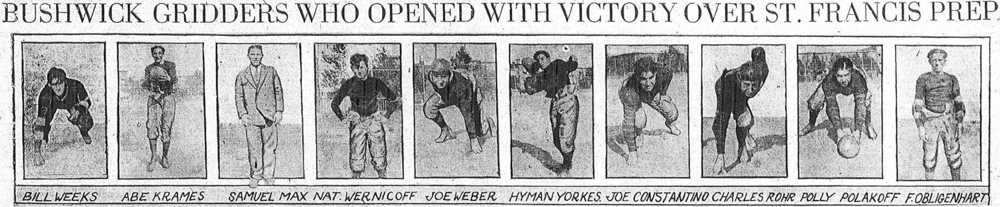
Bushwick High's 1924 football team played at Wallace's Grounds, which are dimly discernible
in the background
Dexter Park had taken the Bushwicks away, so Wallace's rebuilt ballpark hosted a new Ridgewood
semipro team, managed by Henry Wagner. Ridgewood Field was re-opened on June 30, 1918, as the Ridgewoods
split a twin bill with the Grand Central Red Caps. The field was also sometime football and baseball home of
Bushwick High School and Boys High School and saw higher level soccer matches, in front of crowds of 1,500 to
3,000, until it was sold off to developers in late 1927, shortly before William Wallace's death. The
last baseball game we can find was on April 5, 1928, when Newtown High defeated Bushwick High at
Wallace Field, 7 to 2.
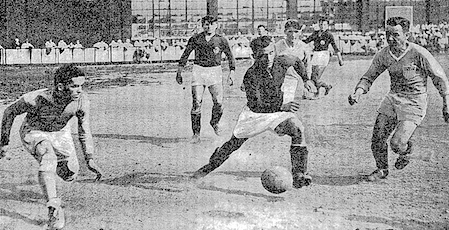
A trial match to select the 1936 Olympic soccer team at Grand Stadium
Once again, Wallace's Grounds lost a slice, as the portion between Covert and Eldert was
built over in 1928. The lot between Halsey and Eldert remained in use as a soccer pitch and occasional track
and field venue for some years afterwards, under the name Grand Stadium. A new grandstand was built in 1937.
Soccer at Grand Stadium featured such home teams as Brooklyn German, German-American Athletic Club, Ridgewood,
and Kollsman, until 1959, when the last piece of Wallace's Grounds finally succumbed to industrial development.
Like so many other former major league grounds, no sign of the site's rich history remains.
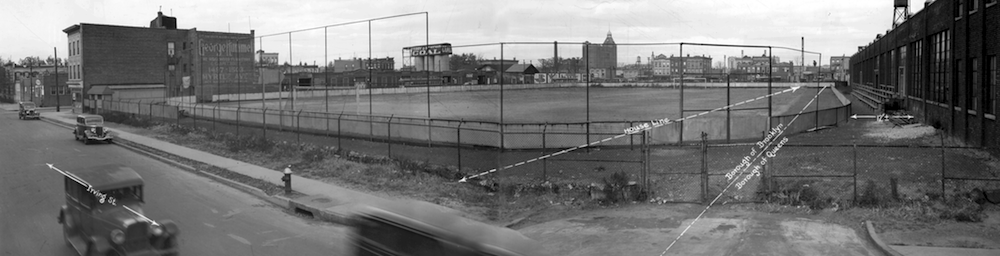
Wallace's Ridgewood Grounds today, in part home to a beer distributor
Meyerrose Park
Also known as Atlantic League Park, Union League Park.
On April 3, 1907, the Brooklyn Eagle reported from Ridgewood:
There is a big field on the corner of Covert avenue and Woodbine street, that strangely
resembles a country farm. A narrow footpath twists across the lot, evidently a short cut for the good
citizens of Ridgewood, from the Covert avenue station to their cosy little homes. Here may be seen
twenty or more Italians digging and hauling, hammering and building under the watchful eye of
Ambrose Hussey. Each day the ground is rapidly losing its isolated appearance. A big board fence,
fully ten feet high, almost incloses the grounds and on the west side of the field in a graceful
semi-circle there is growing day by day a mighty grandstand that will seat almost 5,000 people.
Meyerrose Park was designed by Carl Berger and built for Ambrose Hussey, on land leased
from Joseph Meyerrose, for the 1907 season. The gound stood south of the Covert Avenue elevated railway stop, where Onderdonk Avenue was planned
but did not yet exist. Hussey moved his Ridgewood
semipro team and Brooklyn outlaw Atlantic League team there immediately. In 1907, newspapers usually
referred to the field as "the grounds at the Covert Avenue 'L' station" but by 1908 the Meyerrose Park
name seems to have stuck.
Meyerrose Park circa 1908 to 1911 - note the word "UNION"
painted where the word "ATLANTIC" must have been earlier.
Photo courtesy of the Greater Ridgewood Historical Society
The largest crowds seen at Meyerrose Park were usually for double headers. Typically, two popular
Negro League teams such as the Royal Giants and Phildelphia Giants would play, with Ridgewood to take on the
winner. Other times, Ridgewood would play a powerful semipro team such as Hoboken. In this way, fans
of three or four teams would pay their way in. Hussey's outlaw team saw its largest crowd, over 5,000,
for a Union League double header with Washington on May 23, 1908.
Soccer matches were played at Meyerrose Park in the winter, with the Critchley Club of Brooklyn scheduling home
games there around 1909.
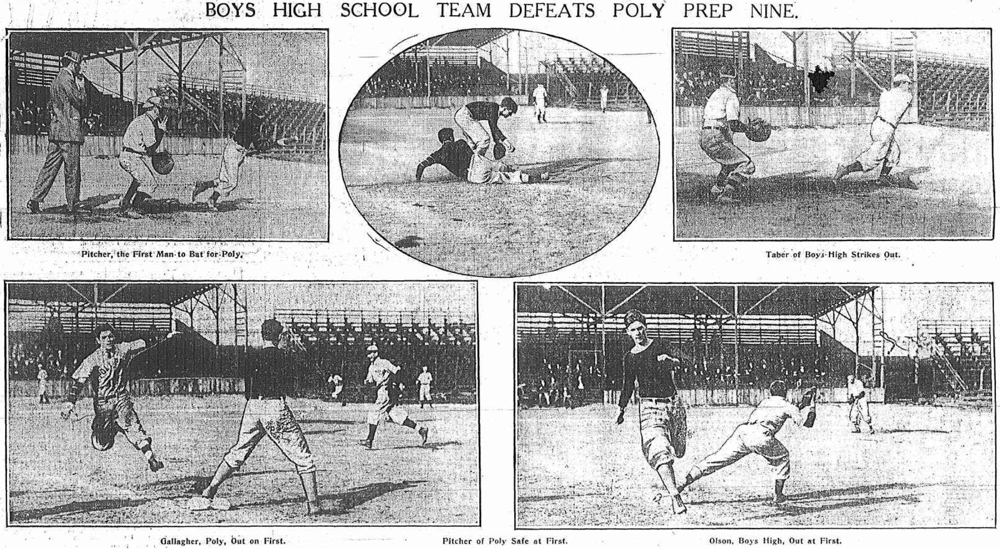
The Brooklyn Eagle's superb photo spread from Boys High's 7-1 win
over injury depleted Poly Prep at Meyerrose Park on May 19, 1909
While Hussey's outlaw Brooklyn franchise only lasted until June 1908, the Ridgewoods
stayed, and the park also hosted the Royal Giants for a time. Many high school matches were also
played at Meyerrose Park, featuring teams from the East New York area such as Boys High and
Commercial High.
In 1909, the Resolute Club also plied its semipro trade at Meyerrose Park. On July 31,
the Resolutes played a doubleheader against the Brooklyn Grays, taking both ends of the twin bill by scores of
4 to 0 and 10 to 9. The first game was particularly notable, as Schneider pitched a no hitter for the
Resolutes, striking out 11 Grays in a seven inning affair.
Meyerrose Park was sold off for housing lots in February, 1911, along with the
rest of the larger property it stood on, the old Meyerrose Farm. This 20 acre area was bounded
by Myrtle, Gates, Covert, and Woodward Avenues, and fetched $400,000 from developer Gustave X.
Matthews. One final season was played at Meyerrose Park in 1911 before it was demolished, then
Hussey moved his Ridgewoods back to Wallace's Grounds. The Meyerrose Park lot is now a mix of
housing and commercial space.
Meyerrose Park today, with Onderdonk Avenue running through
Note: the long serving reference guide Ballparks of North America by Michael Benson
erroneously merges all three of the parks of Ridgewood into one. We presume this accounts for
similar errors in such places as the official Dodger website. To be fair, though, as early as 1886 the
Newtown Register complained that other newspapers were confusing Grauer's Ridgewood Park and Wallace's
Ridgewood Base Ball Grounds.
One last thing. Sunday baseball at Ridgewood was never too easy. The law may have been less
strict in Queens than in Brooklyn, but any kind of "disturbance" remained illegal. Byrne was called
before a Queens grand jury in 1889, Wallace was convicted of breaking blue laws and fined in 1895,
and Hussey was arrested as late as 1906. By 1917, however, the tide had turned, and charges were
routinely thrown out. Magistrate Miller of Jamaica said, in one ruling: It is beyond my understanding
why persons are allowed to go to a moving-picture show, pay admission, and be in a place where the
doors are kept closed and there is poor ventilation, and why they are not allowed to see a baseball
game where they will be out in the open and clear air and see good, clean sport. Sunday baseball
was finally legalized in 1919.
Many thanks to George Miller and the staff at the Long Island Division of the Queens Borough
Public Library for their patience and kind assistance with this page.