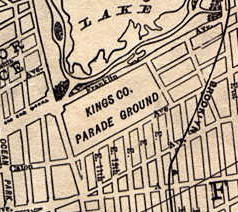
The Kings County Parade Ground (also known as the Prospect Park Parade Ground, or the Prospect Park Base
Ball Grounds), bounded by Parade Place, Franklin Avenue (now Parkside Avenue), Caton Avenue,
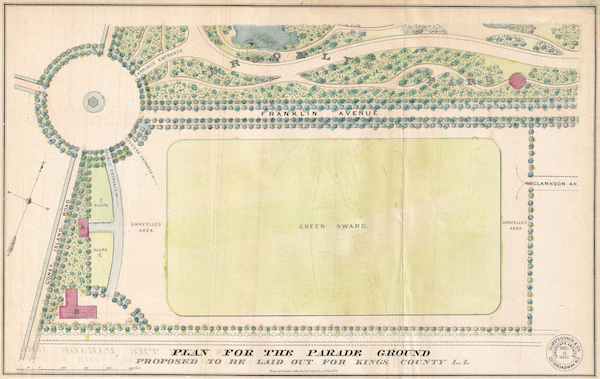
and Coney Island Avenue, was designed by Olmsted and Vaux along with adjacent Prospect Park and saw its
first parade in 1867. The 11th Brigade's Howitzer Battery was the lucky unit to be the first to march and
fire a shot. Although intended from the start as a military facility, sports moved in early, and by
1871 the Parade Ground was being described by Henry Chadwick as the "finest free ball ground in
the United States."
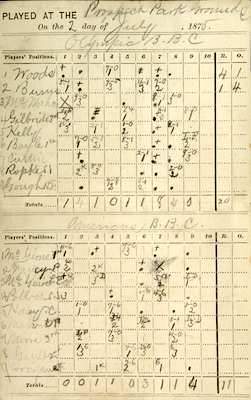
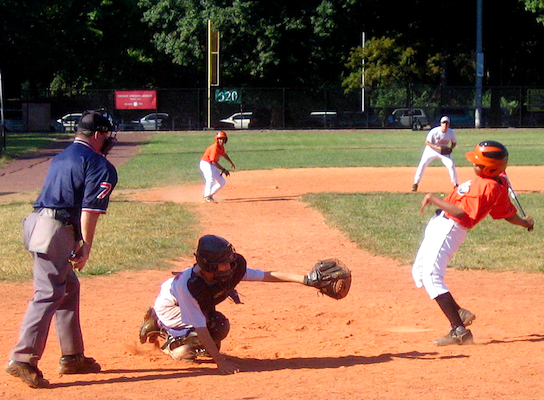
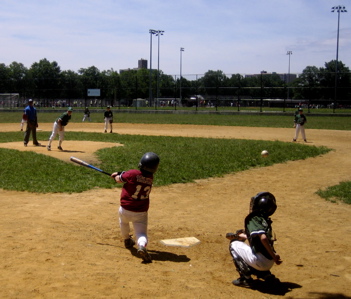
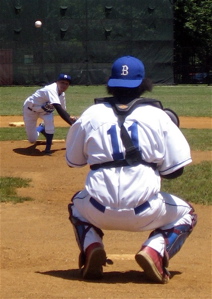
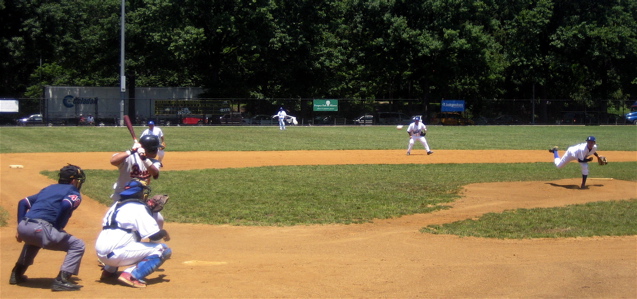
Parade Ground baseball - just as vital in 1875 and 2007
Over the course of the next two decades, military activity diminished and the Ground's potential as a
public sporting venue was fully realized. This was not limited to amateur sports. Charlie Byrne's new
Brooklyn Base Ball Club, its Washington Park home not yet ready, played and won its first
Inter-State League game at the Parade Ground on May 9, 1883, over Harrisburg by a score of 7 to 1.
Reports vary, since tickets were not taken, but perhaps 2,000 fans attended the first and last
professional match at the ground, and witnessed a vicious exhibition of kicking by the visitors. The Brooklyns
eventually held off the same team to win the pennant in September.
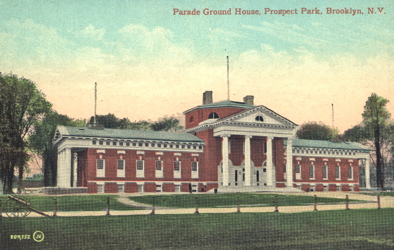
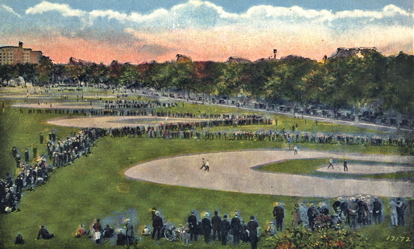
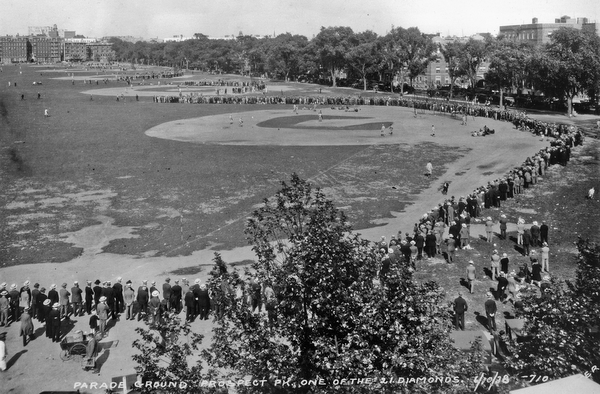
Postcards of the Parade Ground- sadly, the field
house was demolished some time ago Pictures courtesy
Prospect Park Archives
By 1885, renovations included Bowling Green Cottage, especially for sporting clubs, as the
Ground was used almost exclusively for sports. Foremost among these was baseball. The New York Times
reported that the 1885 season saw some 900 baseball games, 150 cricket matches, 150 football matches,
and 35 lacrosse games.
These early years at the Parade Ground saw such classic amateur matchups as Nameless vs Peerless,
and Resolute vs Dauntless. There were occasional accusations of "revolving" in the 1880s, where a
star player would be shared amongst several clubs to obtain an advantage. But for the most part,
competition at the Parade Ground remained on friendly terms.
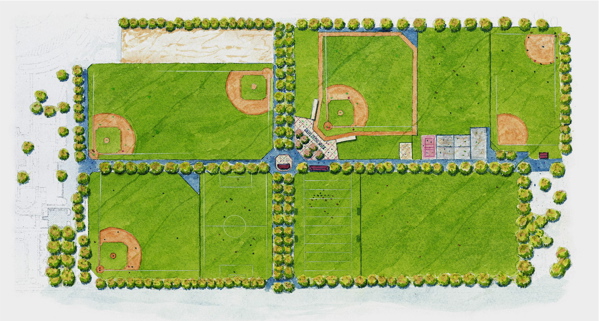
Map of the modern Parade Ground by Christian Zimmerman Drawing courtesy
Prospect Park Alliance
In 1887, baseball clubs complained of the difficulty of finding space at the Parade Ground-
Central Park did not allow baseball, and clubs were flooding in from neighboring New York. In 1900,
baseball clubs found themselves having to compete for space with polo teams. At various times in
the years to come, time-starved ballclubs would request lights for night games, but were politely
declined, the reason being that the Parade Ground was at the physical limit of how much game playing
it could take.
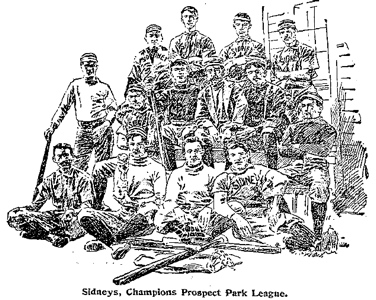
The Sidneys won Brooklyn's amateur championship in 1895
But the truly baseball starved could not be stopped from making use of Brooklyn's greatest
collection of ballfields. In March, 1901, the Eagle reported on a group of serious fanatics:
Base ball is the national game in the United States, and is more popular than any other sport with rich
and poor alike, If any one has any doubts on this score such misgivings would have been dispelled by a visit
to the Prospect Park parade ground this winter, which is used as a base ball field for the public.
It seems incredible, but nevertheless, it is a fact that there has been a clique of men playing
ball every day, with the exception of four days, since last summer, on the parade grounds. Whether it
rained, snowed, froze or thawed, these men invariably met and tossed the leather sphere around as if it
was mid-summer.
Most of the players are well known to the public in some capacity. Several are star ball players and
play in the National League.
The leader of the men is Alec Brown, the old manager and matchmaker of the Coney Island Sporting
Club, and once a well known pitcher for the Fultons. Brown objects to being called the leader, and says he
is only there to make fun of the man who inadvertently drops the ball. He, however, plays right along.
Dr. Conklin is the batter for the crowd and he has the reputation of being an expert at fungo hitting.
He keeps every man moving. Dr. Conklin is a well known New York specialist, but always devoted two hours a day
to base ball. He refrains from catching the ball at all for fear of hurting his fingers, which, of course, would
incapacitate him in his profession.
Harry Howell is also one of the well known enthusiasts. Then there is Fred Jacklitz, the Philadelphia
National League pitcher, and his brother is also a good ball player, who turns up daily as does Pitcher Felix
of the Montreal Club. Others more or less well known are Larry Batten, Clarence Smith, John Martin, and Eddie
Daly.
All of these men have been out at the park nearly every day and to watch them play is a pleasure. Their
constant practice has kept their arms in good trim and they throw the ball around with the swiftness of a
star pitcher in midsummer. At the park it is said that the ball players have played on ice, in the mud and, in
fact, in every kind of weather.
The largest crowd recorded at the Parade Ground was on June 16, 1927. 200,000 people attended a
reception for Charles Lindbergh, celebrating his flight across the Atlantic. After a procession from the
Manhattan Bridge, Lindbergh addressed the crowd with a plea for a great airport to be built in
Brooklyn.
Sports wise, not much changed as the years wore on. Other summer sports, such as polo, disappeared
as "baseball crowded out nearly everything else." Various amateur and junior baseball leagues
formed and reformed: the Brooklyn Amateur League, the Sunday School Athletic League, the Ice Cream
League, the Morning Newspaper League, the Eagle Junior League... In 1949, the New York
Times reported on a pick-up game at the height of summer, when the players "heckled each other with the
rich jargon of Ebbets Field bleacherites" while "some 100 spectators alternately mopped sweating brows and
sipped soda pop." Such a scene could just as easily have come from 1899 or 1999 as 1949.
The Parade Ground, through it all, remained the vital center of junior sports in Brooklyn, especially
baseball. Future stars such as Sandy Koufax, Joe Torre, Manny Ramirez, and John Franco all played ball at the
Parade Ground. Torre was MVP of the Parade Ground League at age 16. 15 year old Fred Wilpon, later owner
of the Mets, threw two no-hitters for the Blue Jays of the Brooklyn Kiwanis League in 1952.
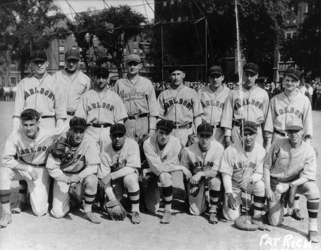
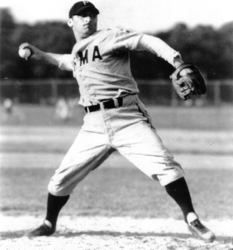
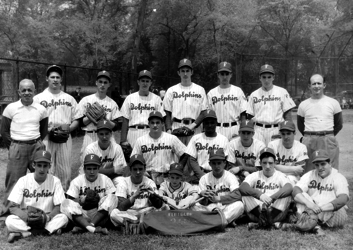
A Parade Ground family - Abe Spiro (standing, 5th from left) on the 1927 Marlboros and
pitching for Arma in 1943, Bernie Spiro (kneeling, 2nd from left) on the 1953 Flatbush Dolphins
Baseball at the Parade Ground is a tradition passed through the families of Brooklyn. In 1925,
young Julie Spiro played for the Marlboros at the Parade Ground. In 1927, his brother Abe starred with
the same club. Then, in 1934, the two pitchers faced off in a playoff for the Brooklyn Industrial
League title. Julie's Brooklyn Edisons won over Abe and the Kings County Lighting Company, 3 to 2.
Julie pitched for the Edisons right through the 1930s, while Abe played for Loeser and Company, Kings County Lighting,
Bay Ridge, the Bay Parkways, Arma Corporation, and the House of David. In the 1950s, Abe's
son Bernie joined a new Marlboro team, pitching an Ice Cream League no hitter in a 16-0 win over the Indians, and later
played for the Flatbush Dolphins.
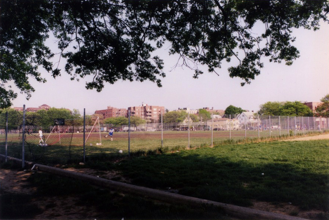
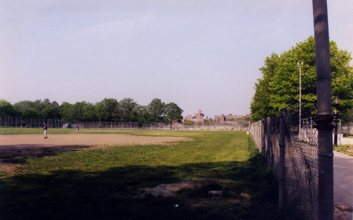
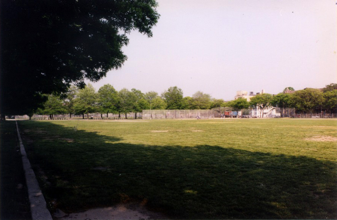
The Parade Ground in 1999, before the renovation Photos courtesy Neil deMause
The most serious threat to the Parade Ground during its first century came in 1957. With the Brooklyn Dodgers
threatening to leave town, a rush was underway to find another plan. Abe Stark, then Brooklyn Borough President,
hastily offered the Parade Ground as the site for a new stadium. The idea swiftly came to nothing - Dodgers owner
Water O'Malley and Parks Commissioner Robert Moses, in a rare, possibly unique, show of unity, dismissed it out
of hand. Community uproar was loud, too. Even the beloved Dodgers could not be allowed to run roughshod over
Brooklyn's favorite playground.
Gradually, though, all the activity took a toll, and the Parade Ground fell into disprepair.
The main part of Prospect Park and of course Central Park saw far more Parks Department funding,
and in later years the Ground was lined by ugly chain link fences and missing grass in large patches. It was,
however, still a hive of sporting activity.
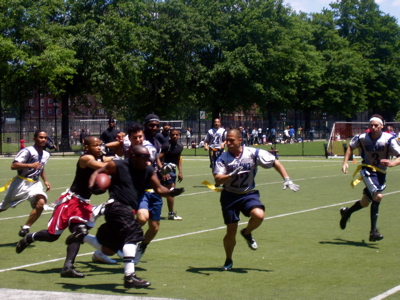
78th Precinct junior baseball, flag football
Then, in 1999, came the New York Mets and their Parade Ground improvement plan. While Keyspan Park was being
built, the Mets needed somewhere to put their new minor league franchise for the 2000 season. They proposed
the Parade Ground. Half the space would be turned into a parking lot, the rest into a temporary minor
league stadium. Afterwards, they promised that the stadium half would be turned back into something
useful for the amateurs and little leaguers.
The amateur Brooklyn Warriors have a familiar looking uniform
The soccer mom crowd was galvanized into action. We at BrooklynBallParks.com are proud to say we
were with a huge crowd of parents, children, and concerned citizens marching across the
Brooklyn Bridge to City Hall. The chant still rings in our ears: "We like soccer a whole lot! We
don't need a parking lot!" (Andrew would, however, like it known that while he neither wanted nor
needed a parking lot, he does not like soccer at all.) Political pressure forced the Mets to abandon
the plan and place the team at St. John's University for the season.
Field 3 is the showpiece of the new Parade Ground
Subsequent publicity focused attention on the poor state of the Parade Ground. In 2000, a
$2 million allocation from the city was added to $10 million from Borough President Howard Golden,
and a complete overhaul began. The revitalized Parade Ground was opened in 2004 to universal acclaim.
The sandlot became an oasis of well maintained fields, both grass and fieldturf, and even lights
for night play. Visit to the Ground today and you'll see swarms of young kids in uniforms with
stylish 78 logos- 78th Precinct youth sports. Amateur baseball, basketball, flag football, soccer,
tennis, and softball feature prominently, too. The Parade Ground League title remains a coveted prize
for all age groups, as it has been for well over a century, and venerable organizations such as the
Bonnies and Youth Service League vie with newer ones like the Warriors and Gauchos for the honors.
In June, 2008, the New York Times reported on a charity game at the Parade Ground between the staff
of the Brooklyn Cyclones and the Old Boys of Summer, a team of players whose history at the Parade Ground
stretched as far back as 1950. The Cyclones staff won, 8 to 1. Old Boys player Frank Chiarello took
umbrage, in a good natured way: "Life stinks," he joked. "I hate young guys. I hate every guy on that team."
Fifty years from now, there will still be Old Boys of Summer, remembering their youthful exploits
at the "finest free ball ground in the United States." The Parade Ground, still going strong, will likely stay
as long as Brooklyn itself.
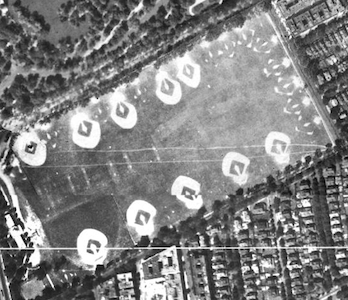
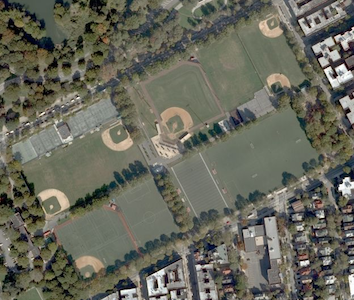
Changes in configuration, and surface: the Parade Ground in 1924, 1996, and 2010
Photos taken from NYCityMap and Bing Maps
An 1868 rendering of Olmstead and Vaux's original Parade Ground plan
Many thanks to Amy Peck at the Prospect
Park Archives for her tireless help with this page.