In 1884, an syndicate of businessmen leased a picnic ground on the south side of Grand Street (now Grand Avenue), Maspeth,
immediately west of where 54th Street now exists, from the brewing firm of N. Seitz's Sons. Around the grounds
they built a horse racing track, for night racing, as well as a hotel, a ball field
within the track, and a grand stand. The newly named Queens County Grounds were reachable by the Grand Street and Newtown
horse cars, although the Brooklyn Eagle warned that to journey there meant traveling through the
"fertile cholera breeding district" of Newtown Creek.
That year, the Queens County Grounds were home to an Atlantic Base Ball Club of Brooklyn (not the Atlantic Club), which played the only
professional matches at the venue. The team joined the Eastern League after the Harrisburg club folded, and played their
first match on July 14, losing 7-5 to the visiting Richmond Club of Virginia. On July 15, in the last
professional match at the Queens County Grounds, the Atlantics entered the ninth inning with a 7-4 lead,
but gave up four unearned runs to lose 8-7. They were then expelled from the league for failing to
pay the Richmonds their guarantee.
Another Atlantic Club called the field home in 1886, and renamed it Atlantic Park. That year, the
stands were moved back 100 feet, and enlarged to seat 2,500. Ladies were admitted free to baseball games,
but all this did little good, and the club folded in July. The semipro Acmes played home games at Atlantic Park
in 1884 and 1887, also.
Racing and alcohol kept the place in business, for a while. When horse racing there
ended, the track was used for a time by the Queens County Athletic Association instead.
Later on, the Feldman family took the the lease, added "Feldman's" to the name, and ran all kinds of entertainment.
A casino, a pool room, and a dance hall were added to the hotel and proved very popular.
On September 7, 1890, residents complained of a baseball match between masculine and feminine nines, which apparently
took place merely so that the gentlemen could allow the ladies to freely run the bases in their short skirts. Residents
took particular umbrage that boys under 12 were admitted to the spectacle for just 15 cents, and that the whole thing
took place on a Sunday.
The name of the park changed from Feldman's Atlantic Park to Feldman's Queens County Grounds at some
point, and sports of all sorts once again gave way to picnic grounds. The hotel and casino continued,
however, until a fire on April 13, 1902 destroyed much of the hotel, and all of the grandstand and
dance hall. Damage was estimated at $13,000 in total. Eventually the lot gave way to the growing
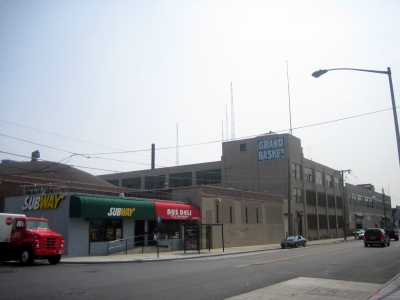
industrialization of the area, and today it houses various buildings, including a basket factory.
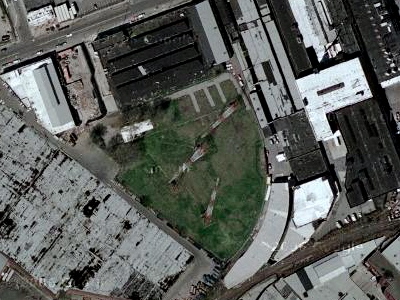
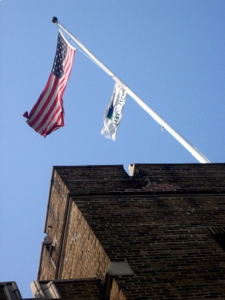
Feldman's Atlantic Park today- the four towers in the background
are, coincidentally, on a ballpark shaped space.
Overhead view taken from Google Maps
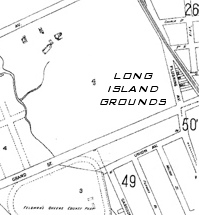
Long Island Grounds
Just across Grand Street from the Queens County Grounds, where Grand Avenue and 57th Street now meet, was a field where the amateur Skelly Base Ball
Club made its home. At the end of the 1885 season, three exhibition matches at Skelly Park were so well attended,
that people stood on sheds to see the diamond. These matches each featured the New York National
League team- two against the Metropolitans of the American Association, and one against the Skelly Club
itself. During the Skelly game, attended by 5,000 people, excited fans stamped on a beer shed so hard that it
collapsed beneath them. Fortunately, no serious injuries were sustained.
Despite the success of these matches, the Skelly Club moved elsewhere in 1886 and the field was taken by the Long Island
Base Ball Club, and renamed the Long Island Grounds. The Long Island Club had professional aspirations,
building a grandstand at the field and joining the Eastern League. Their campaign lasted barely three weeks, however, and they quit the
league with a 1-11 record on May 24. Although the Long Island Club lost its first match at Jersey City,
we cannot find a record of their home matches. The Long Island Club continued for the remainder of the season
as an independent club, playing such opponents as the Stars of Long Island City.
Baseball retained a strong presence at the Long Island Grounds, even after the Eastern League debacle. In 1887 a special
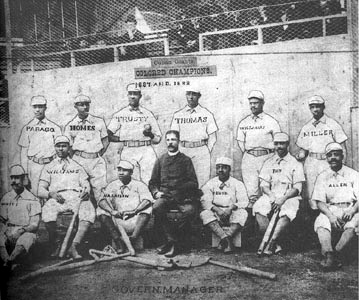
grandstand was built just for the ladies in attendance. The Cuban Giants, the first and
most powerful professional colored team, played Sunday games at the Long Island Grounds from 1887 until
at least 1893. The New York Telegram said of the team: In addition to their excellent exhibition of
baseball the Giants afford considerable amusement by their original antics and coaching.
On July 15, 1888, the Gorhams visited and defeated the Cuban Giants 10 to 9, to become Colored Champions
of the region. The Gorhams scored five runs in the ninth inning, the last with two out.
During this era the grounds were managed by William Primrose, who was associated with the Metropolitans,
not the old American Association entrant, but an independent club which repeatedly threatened to disband
during the summer of 1889. In 1890, the Greenpoint Athletic Club leased the grounds, and overhauled the
whole venue. The grand stand and free stand were enlarged, the ground was filled and rolled, new drainage
was installed, and five diamonds were laid out in all - four for amateur clubs and the grand stand one for
professional and semipro matches.
The 1887 Cuban Giants- this photo may have
been taken at the Long Island Grounds
In the most commonly recorded professional games at the Long Island Grounds, the
major league American Association arrived in 1890. The Brooklyn Gladiators, trailing the league and in
trouble, had abandoned their home at Wallace's Ridgewood Grounds for the Polo Grounds in New York. They
announced at the time, in June, that they would continue to play on Sundays in Ridgewood, but when the
team returned from a 34 game road trip, this agreement was no longer in place. We may surmise that William
Wallace was none too pleased at the Gladiators leaving, and was in no mood to do them any favors.
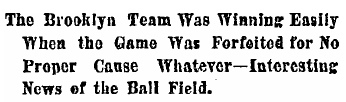
So Kennedy's Gladiators played two Sunday games at the Long Island Grounds. In the first, on July 27,
Brooklyn led Columbus 13 to 8 after 7 1/2 innings, but forfeited the game when they apparently ran out
of baseballs, in a decision branded by the Eagle as "ludicrous in the extreme." This happened despite the fact
that three baseballs were within plain sight of umpire Jimmy Peoples, albeit in used condition. In the second,
on August 3, the Gladiators lost to Toledo, 9 to 2, and that was the last major league action the Long Island
Grounds would see. Both matches were attended by 1,000 hardy fans.
A more entertaining spectacle of 1890, perhaps, was the follow up to Feldman's masculine vs feminine
match. A week later, the Long Island Grounds hosted the Red Stockings and Black Stockings, both feminine
nines. Whether this match was a serious one is not recorded anywhere we can see.
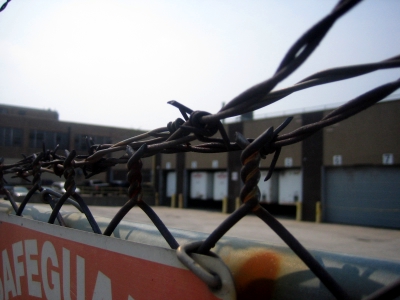
The Long Island Grounds today
Although the big leagues were gone, the Cuban Giants remained at the Long Island Grounds for Sunday games,
playing such teams as the Murray Hills, the Acmes, and the Monroes. Their style remained light hearted, but
effective. On opening day, 1891, for instance, the Giants hosted the Metropolitans: Their funny coaching
amused 1,500 spoectators but it had a tendency to rattle pitcher Barney, who was hit hard in the opening innings.
The Cubans took the match, 9 to 6.
On June 5, 1892, the semipro Allertons visited the Cuban Giants and came away with a 7 to 4 victory in "nine stubbornly
contested innings" in front of 1,108 fans. Powers took the win, while Nelson was the losing hurler. The visitors' four
run second inning was aided by a play that rates as unusual, to say the least: With the bases full, Nelson threw the
ball wild and three men scored. We have yet to find another instance of a bases clearing wild pitch.
In 1893, the Long Island Grounds and Feldman's Atlantic Grounds found themselves on the wrong side of
Judge William Monteverde's unusual crusade against Sunday base ball, and with play and beer sales prevented
on a number of occasions with as many as 3,000 fans in attandance. Oddly, nearby Grand Street Park, which was
owned by the same Monteverde, was exempted from such policing.
Some time in the next decade, the Long Island Grounds fell into disuse, and the fact drew little or no notice.
Nowadays, the site is covered in warehouses and factories, and there is no historic marker to tell of a major
league baseball game forfeited for a lack of baseballs.